
Branding • Messaging and Voice
Messaging and voice that sounds like your company, not like a consultant wrote it.
Messaging and brand voice for Toronto & GTA companies — copy that sounds like you.
Every company has a messaging problem before it has a messaging system. The founder pitches the business one way. Sales pitches it a second way. Marketing writes a third version for a landing page. Support answers in a fourth. The buyer moves through all four versions in a week and forms a quiet verdict: this company has not figured out what it is yet.
We fix that layer. Not with a brand deck nobody reads, but with a messaging architecture the team can hold under pressure and a voice system the team can actually use in live work.
The Difference Most Teams Miss
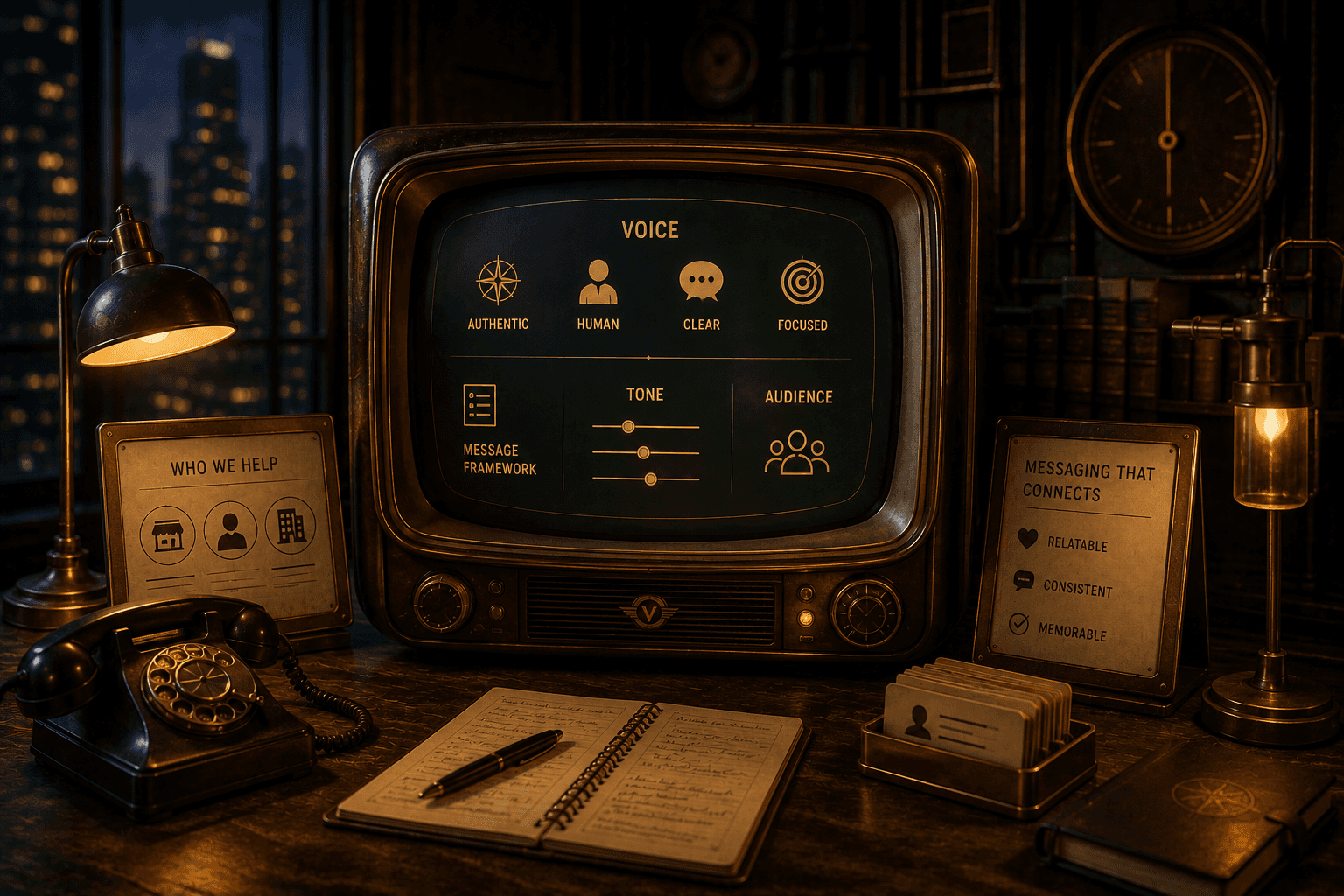
Messaging is not copywriting. Voice is not a vibe. Both are operational.
Most teams confuse messaging with copy. Copy is the specific words on a landing page or inside a sales email. Messaging is the framework upstream of the words: the positioning, the category frame, the messaging pillars, the persona-adapted narratives, the objection-handling spine. Copy changes weekly. Messaging should change only when the company changes.
Voice works the same way. Voice is not a vibe a designer picks in an all-hands. Voice is the operating tone your sales team holds on a cold call, the register your CEO writes investor updates in, the personality your support team brings to a frustrated customer, and the editorial line every piece of content gets judged against.
Both layers are operational. Both get measured by whether your team can use them in live work, not by whether the document looks good in a brand review.

What Inconsistent Messaging Quietly Costs
Messaging drift is a pipeline problem, a margin problem, and a hiring problem.
The cost of weak messaging rarely shows up as a line in a P&L. It shows up as a longer sales cycle, a higher discount rate, a flat content program, and a founder stuck explaining the company to every new hire for another month.
How We Scope The Work
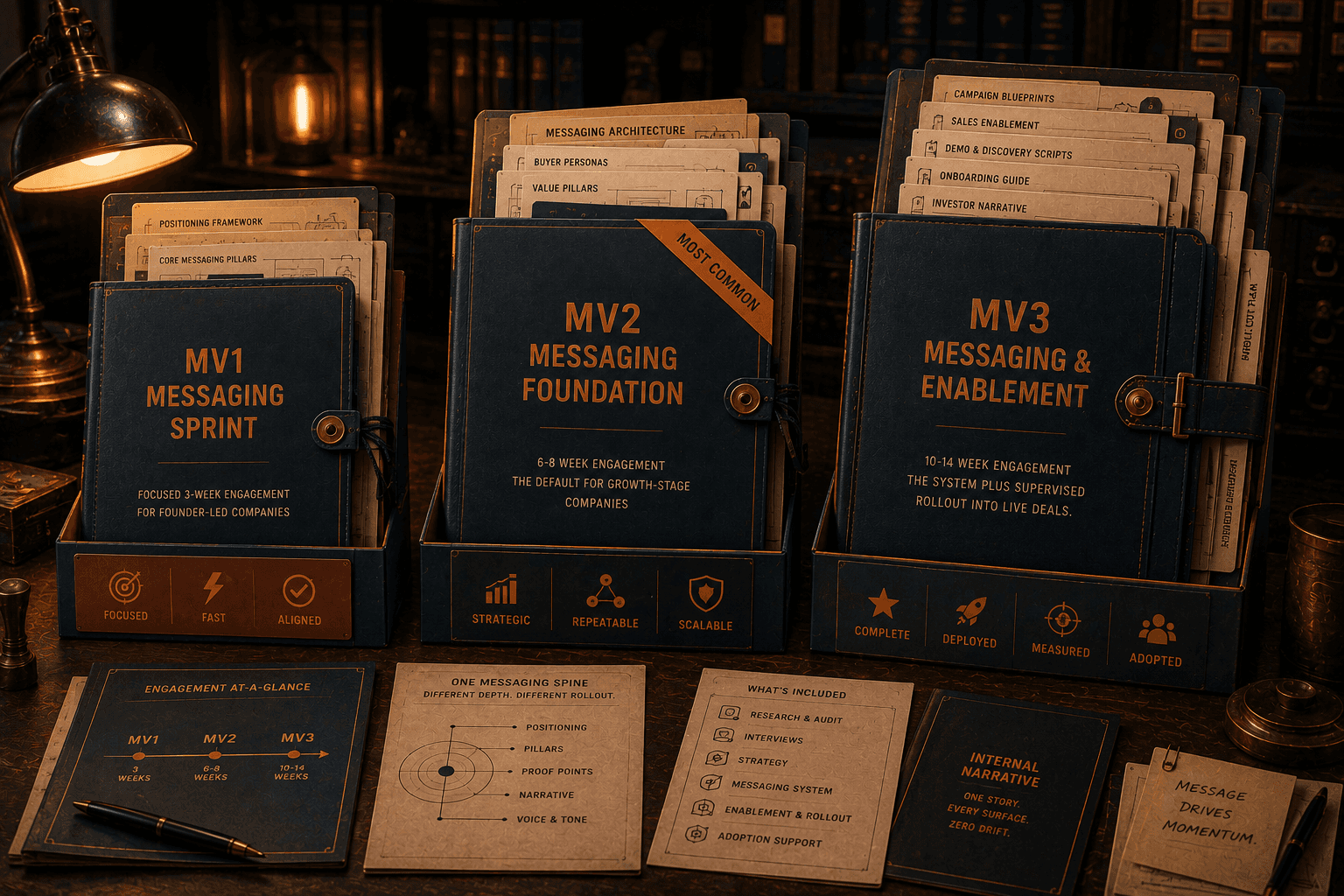
Messaging and voice work runs as a standalone engagement and also lives inside the B2 and B3 branding tiers. The right shape depends on how many surfaces the system has to carry and how heavily the sales and marketing teams will lean on it inside live deals.
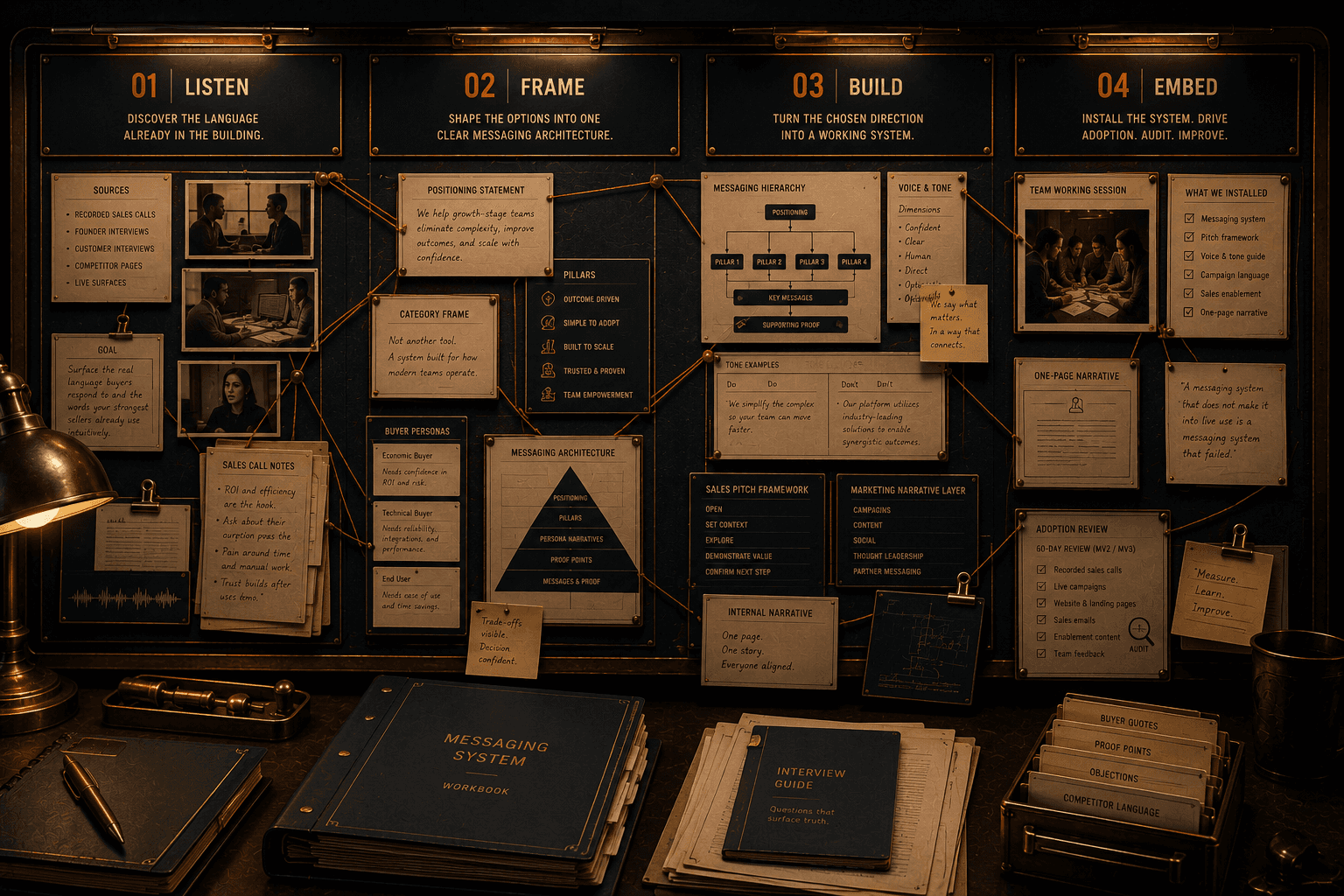
Four phases. You own the direction. We do the interviews, synthesis, and hard language decisions.
Phase 01 Listen
We start by collecting the language already in the building. Recorded sales calls, founder interviews, customer interviews, competitor pages, and live surfaces. The goal of this phase is to surface the real language buyers respond to and the words your strongest sellers already use intuitively.
Phase 02 Frame
We shape the options into one clear messaging architecture. A positioning statement. A category frame. Four to six pillars. Persona-adapted narratives. We present with the trade-offs visible so leadership is choosing with its eyes open, not picking from a buffet.
Phase 03 Build
We turn the chosen direction into a working system. Full messaging hierarchy. Voice and tone handbook with dimensions, dos and do-nots, and rewritten examples. Sales pitch framework. Marketing narrative layer. One-page internal narrative for new hires.
Phase 04 Embed
A messaging system that does not make it into live use is a messaging system that failed. The last phase is the rollout: a team working session, the one-page narrative installed where people actually read it, and on MV2 or MV3 a sixty-day adoption review where we audit recorded sales calls and live campaigns against the new system.

Four commitments we refuse to compromise.
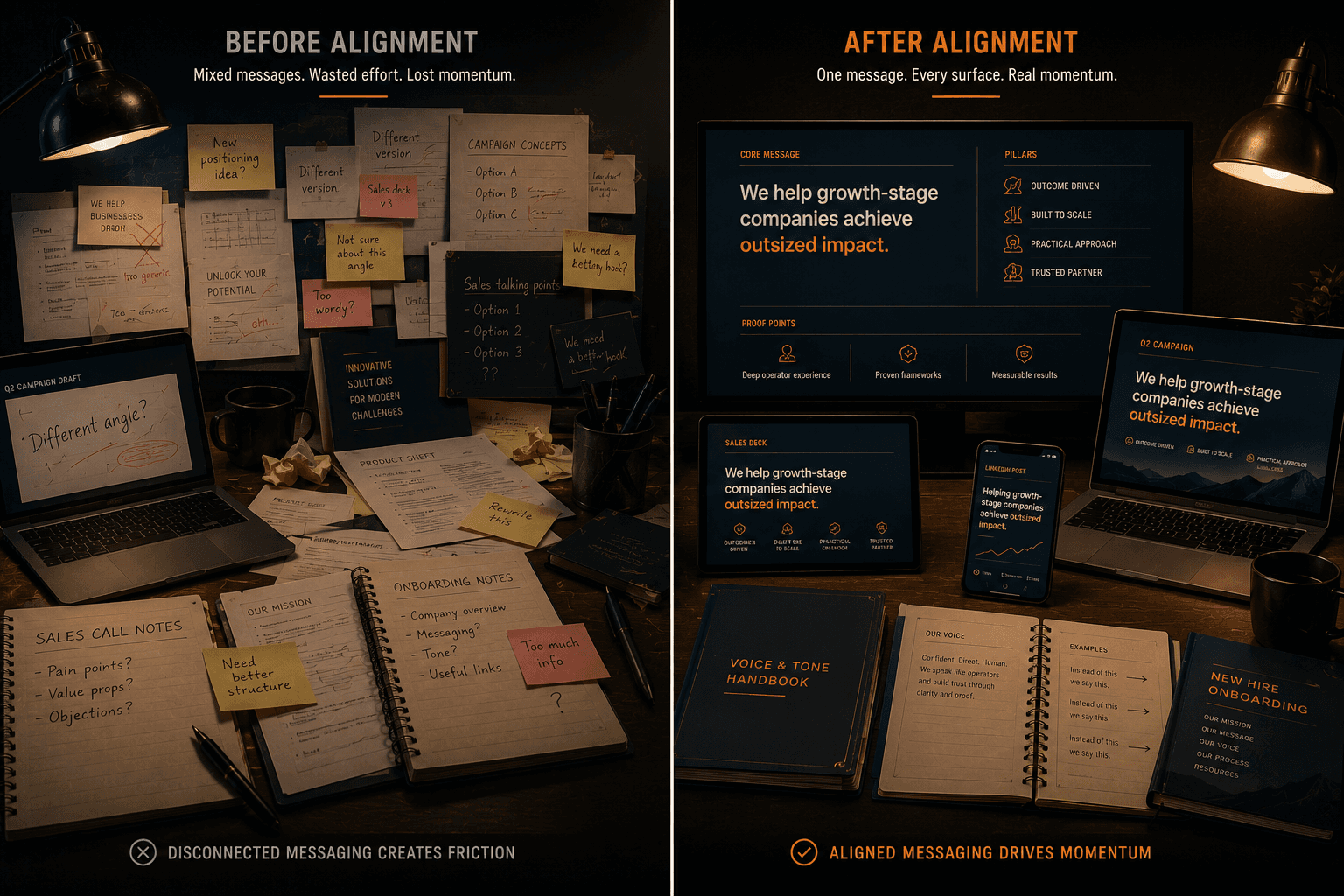
The operator-level shift a usable messaging system produces.
Companies that adopt the system inside a real rollout window tend to see the same pattern inside ninety days. The sales team starts pitching the same company. Marketing stops rewriting foundations on every campaign. Content tightens. New hires ramp faster.

Is this the right engagement?
Strong fit if
Every team member pitches the company differently and buyers have noticed
Your positioning is locked or mostly locked, and now the language needs to match across site, deck, and outbound
You are scaling the commercial team and new hires are diluting the voice as they ramp
You just repositioned, changed pricing, or entered a new segment and the language has not caught up
You want a system your team will actually use, not a forty-page PDF nobody opens past week two
Probably not the right fit
You have no positioning yet and need strategy work first. We can sequence that, but messaging before strategy is expensive rework
You want a copywriter to write new website copy. That is a different engagement, and messaging is upstream of it
You expect a branded voice guide you can hand to contractors without any internal adoption effort
You want the company to sound like every other business in your category
You are not ready to commit the leadership time required for real interviews and working sessions
What serious buyers usually ask.
How long does a real messaging engagement take?
Three to fourteen weeks, depending on the shape. MV1 runs three weeks. MV2 runs six to eight weeks. MV3 runs ten to fourteen weeks with enablement and rollout layered in.
We already have a brand strategy. Do we still need messaging work?
Usually yes. Strategy defines the position. Messaging turns the position into sellable language across personas, use cases, and surfaces. One is the frame, the other is the spine. Most companies have one without the other.
What is the difference between messaging and copywriting?
Messaging is the framework: the core positioning, the pillars, the tone system, the objection handling, the persona-adapted narratives. Copywriting is the specific surface-level words that sit on the framework. We build the framework. Your team, a copywriter, or a follow-on engagement writes against it.
Who from our team needs to be involved?
Founder or CEO, head of sales, head of marketing, and one or two customer-facing leads who live inside real deals. Usually three to six people total on the leadership side, plus three to five customer interviews we run.
How detailed should the voice guide actually be?
Usable, not encyclopedic. Five to twelve pages for most companies, anchored in three to five voice dimensions with rewritten examples drawn from your current content.
How do we make sure the team actually uses the system?
MV2 and MV3 include a rollout session, a new-hire onboarding doc, and a sixty-day adoption review. We audit recorded sales calls, live campaigns, and support interactions against the system so drift is caught and corrected.
What if we already have some messaging in place?
Good. We would rather start with real surfaces than with a blank page. The first diagnostic question in the audit is which parts of the current messaging are already working and should be preserved.
What budget does a real messaging engagement sit in?
Pricing is scoped against shape, interview depth, and rollout support. We cover the budget range on the discovery call so neither side wastes time. We will not enter an engagement priced below what the work actually requires.
What happens if we disagree with the messaging direction you recommend?
We build space for it. We present the messaging architecture with the trade-offs made visible and one pivot moment built in. Past that, scope changes are scoped as a change order so timelines stay protected.
When is this worth doing now versus later?
Now, if the sales team is losing deals on clarity, if marketing is burning spend on inconsistent campaigns, if the founder is being pulled into every retelling of the company, or if a raise, launch, or category shift is within the next two quarters.
What does a strong messaging engagement usually turn into next?
A website messaging rebuild, a sales enablement sprint, a campaign concept build, or a full visual identity refresh informed by the new narrative. Messaging is upstream of most of the marketing work that actually moves revenue.
Our Services








Quick Links


" height="149.2535067768008px" id="IOCTf08f5" width="1199.9520008715217px"/></svg>)