
Websites • Shopify Websites • ecommerce Store
A Shopify store is not a website. It is the sales floor.
Shopify websites for Toronto & GTA brands — built as your sales floor, not a template.
Most Shopify stores are theme installs. A paid template, a few product photos, a scatter of apps, and a store that technically works. That is fine at launch. It is not fine at scale. Once you are past the first wave of orders, the store stops being a showcase and starts being infrastructure. Every design choice, every product page block, every checkout field, every third-party app either pushes revenue per session up or drags it down. The founders who understand that shift are the ones who break past the stall most D2C brands run into.
We build Shopify stores for brands that have proven the product and are ready to build the commercial engine around it. The goal is not a prettier store. The goal is a store that converts more of the traffic you already pay for, raises average order value without burning the brand, and runs operationally without holding the founder hostage.

Why this matters
E-commerce is a game of details, and every detail either makes money or costs it.
Two percentage points of checkout conversion is the difference between a D2C brand that scales and one that stalls. Those two points are not won in a splashy campaign. They are won in hero photography, in the first three blocks of a product page, in the honesty of the size guide, in the friction of the checkout form, in whether or not the cart drawer nudges at the right moment. Every decision is a lever. Every lever moves the unit economics.
The brands that break through are not the ones with the loudest ad creative. They are the ones whose store respects the buyer's intent, removes the friction the category usually tolerates, and reads cleanly on a mid-tier Android at a bus stop. Most Shopify stores do none of those things. Many cost their owner 15 to 30 percent of their potential revenue every month without anyone noticing, because the store still ships orders and the number still goes up.
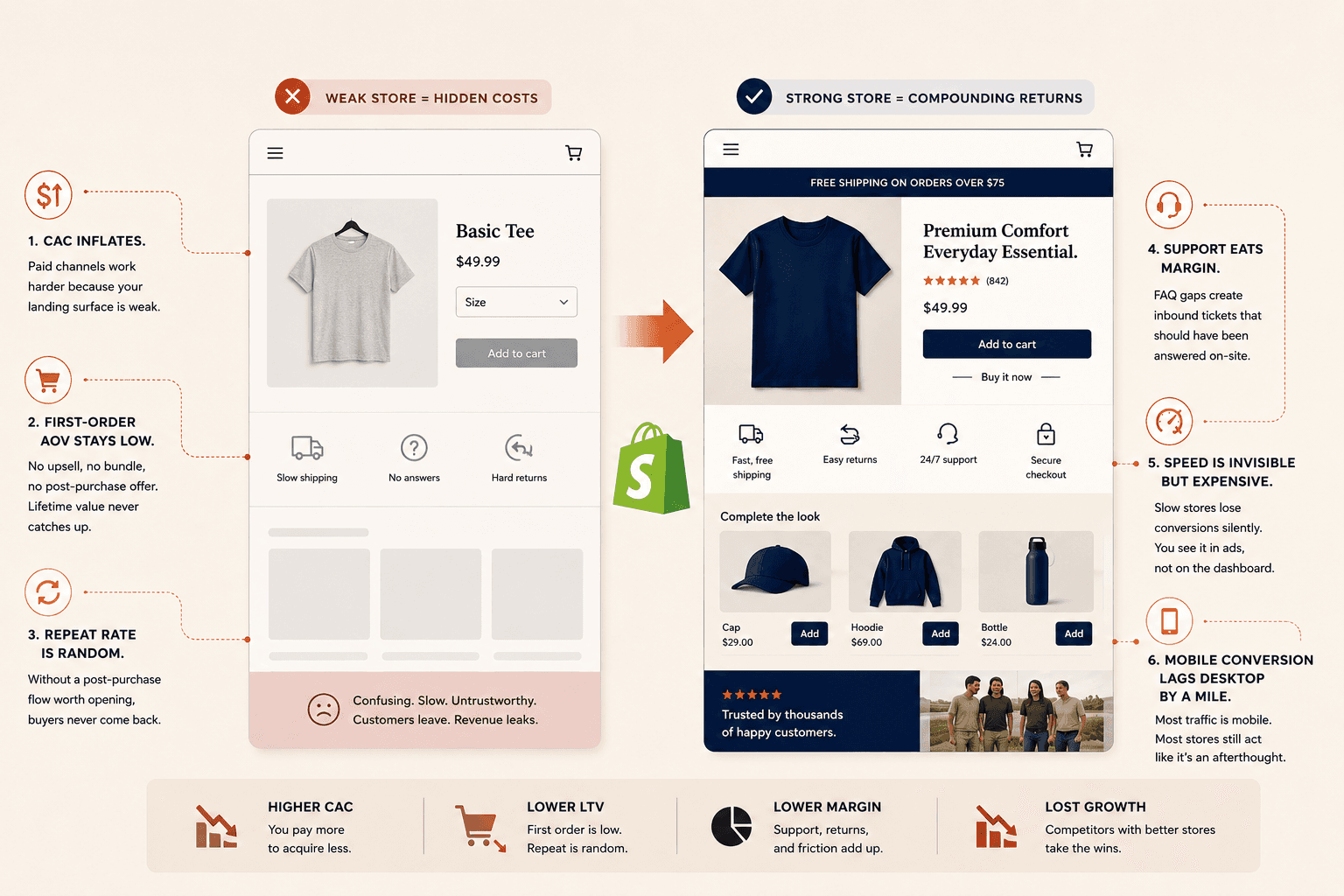
What a weak shopify store actually costs
You do not see it on the revenue line. You see it everywhere else.
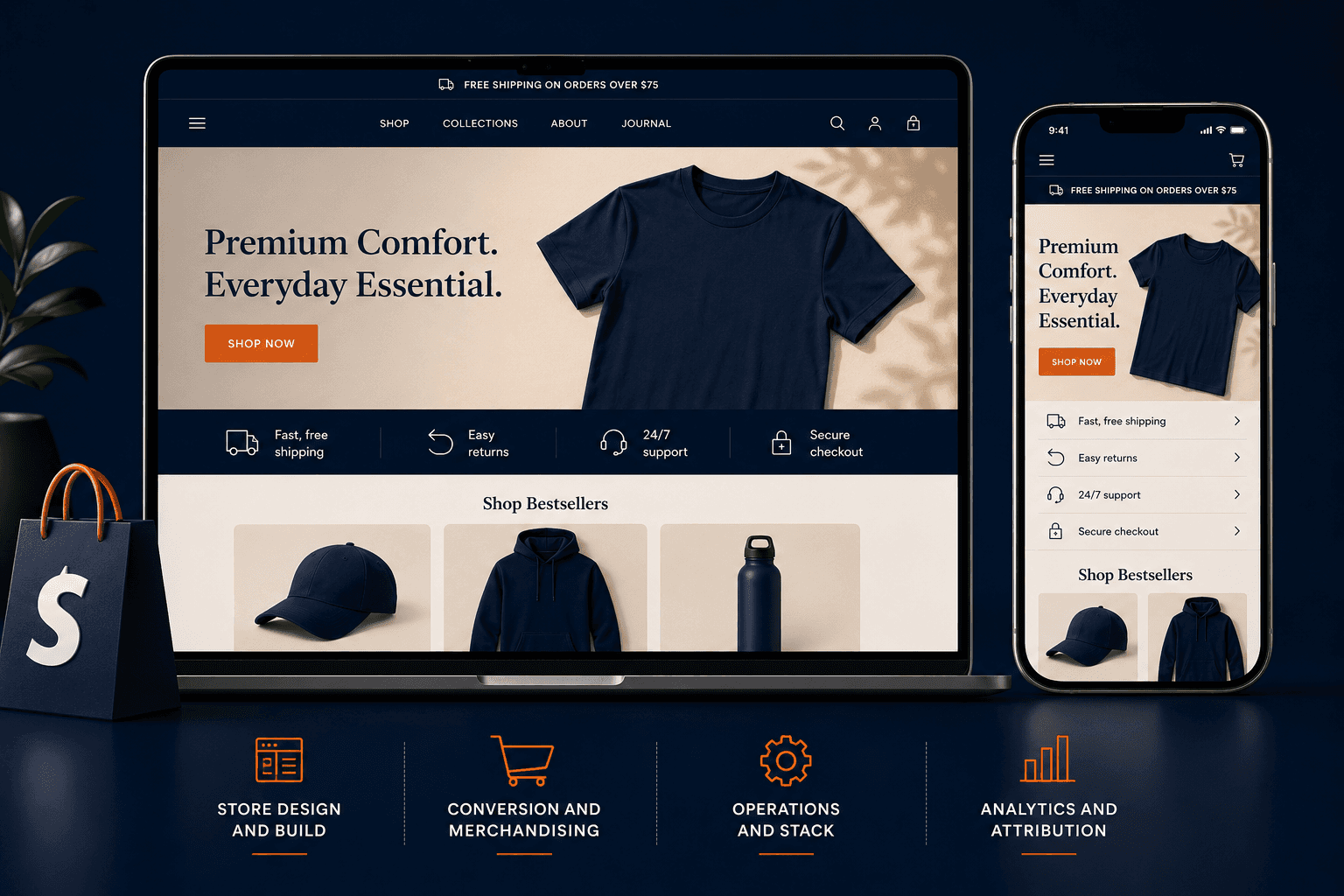
What we build
Three pillars, all three weighted equally.
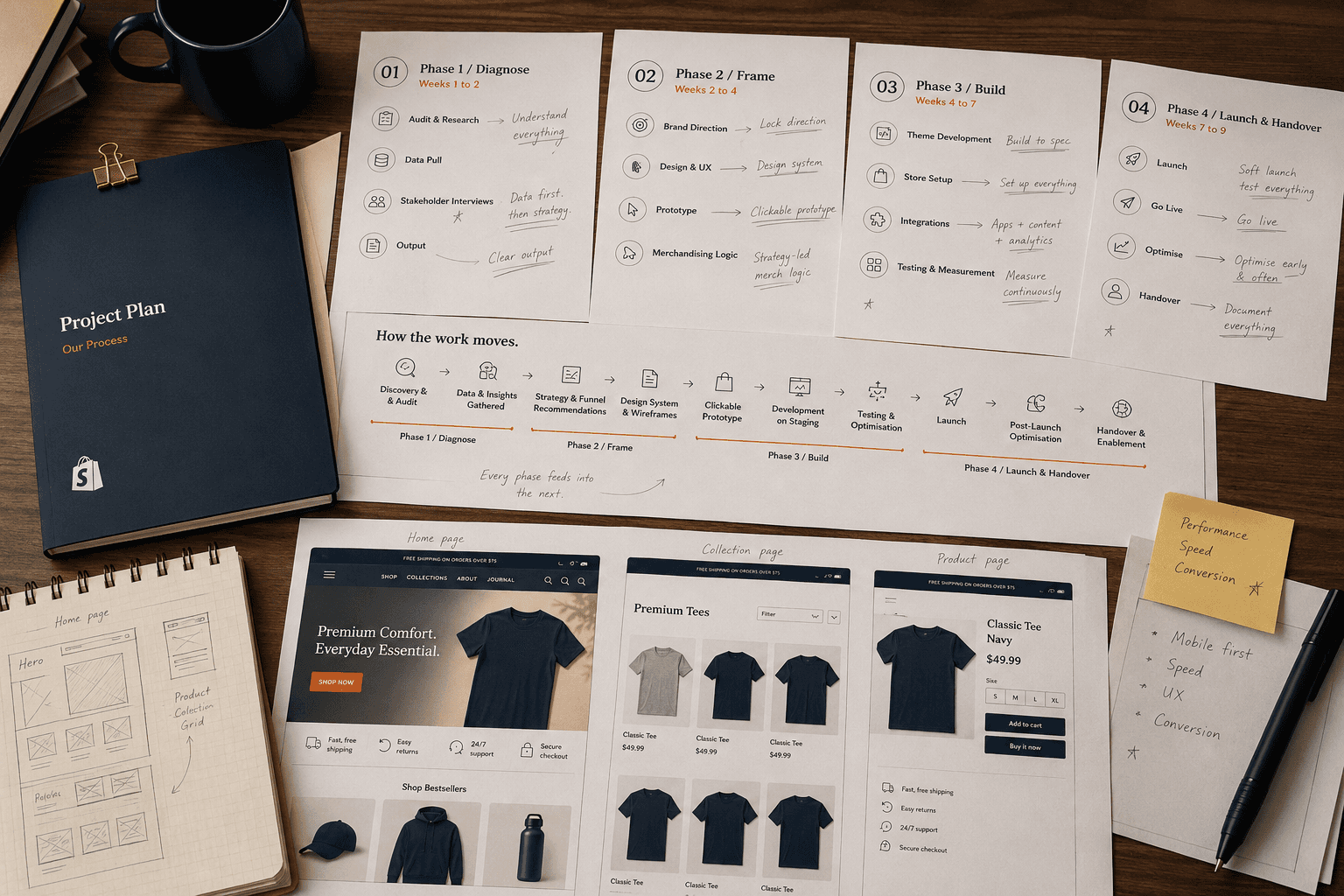
How the work moves. Four phases, whether we are launching new or rebuilding an existing store.
Phase 1 / Diagnose (weeks 1 to 2)
We audit the current store, the product line, the brand, and the competitive set. If the store is live, we pull conversion data, cart abandonment data, paid landing performance, and mobile session recordings. We interview the founder, the marketing lead, and the ops lead. Output is a written store diagnostic, a merchandising and funnel recommendation, and a scoping range.
Phase 2 / Frame (weeks 2 to 4)
Brand direction locked, design system set, page templates wireframed, copy drafted, photography and video direction defined. A clickable prototype of the full site is reviewed before code is written. Merchandising logic is decided at this stage so the build reflects the strategy, not the other way around.
Phase 3 / Build (weeks 4 to 7)
Theme development, custom sections, product setup, collection logic, cart and checkout configuration, app integration, content migration, blog setup, and analytics wiring. You see progress weekly on a staging URL. Performance is measured continuously, not as a launch-week panic.
Phase 4 / Launch and handover (weeks 7 to 9)
Soft launch, test orders, redirects from the old URLs, DNS cut-over, paid traffic slowly routed to the new store. The first two weeks post-launch are a live optimisation window: conversion tracking, cart flow, checkout behaviour, speed on real devices. Handover is written, not verbal. Your team owns the store operationally from day one.
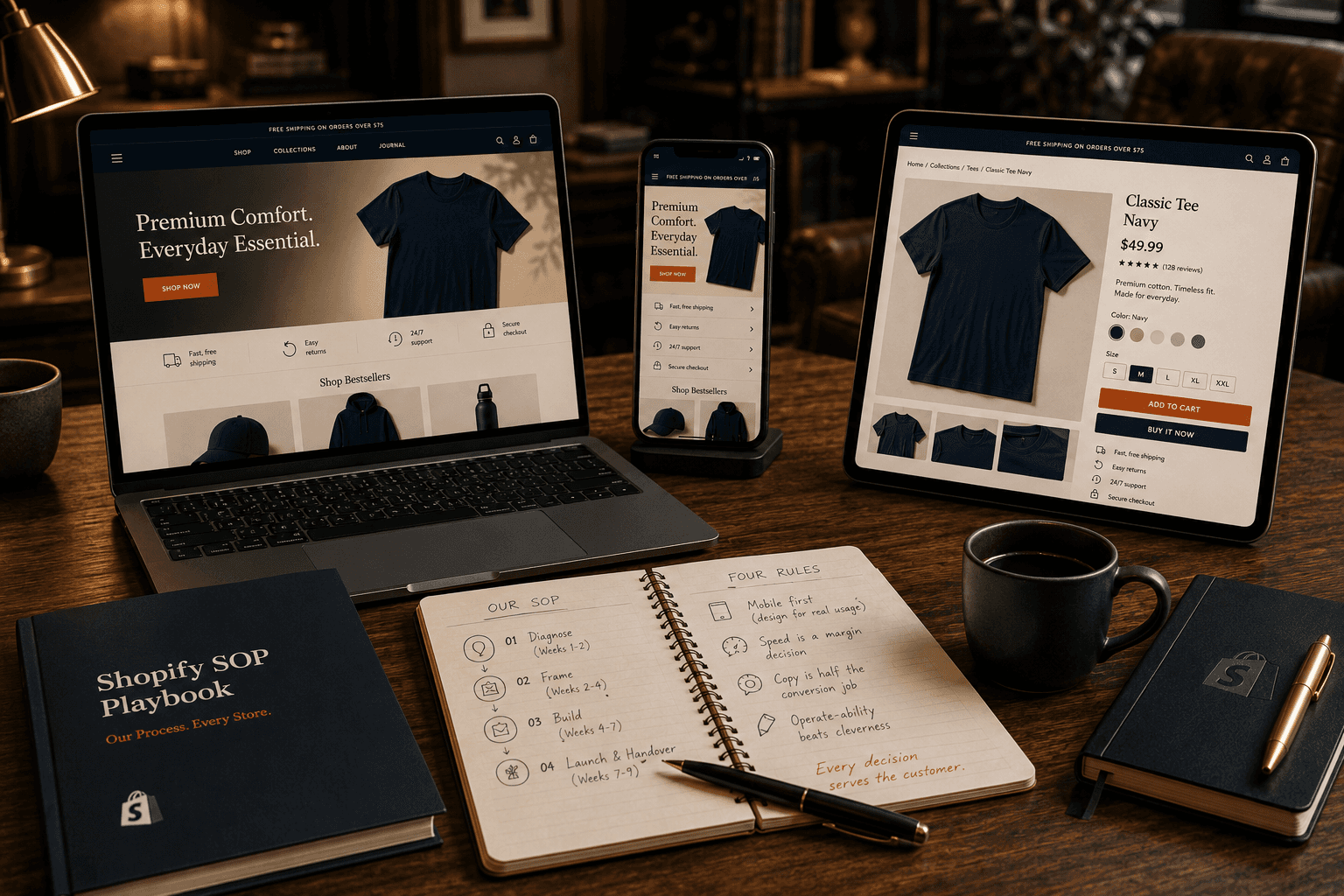
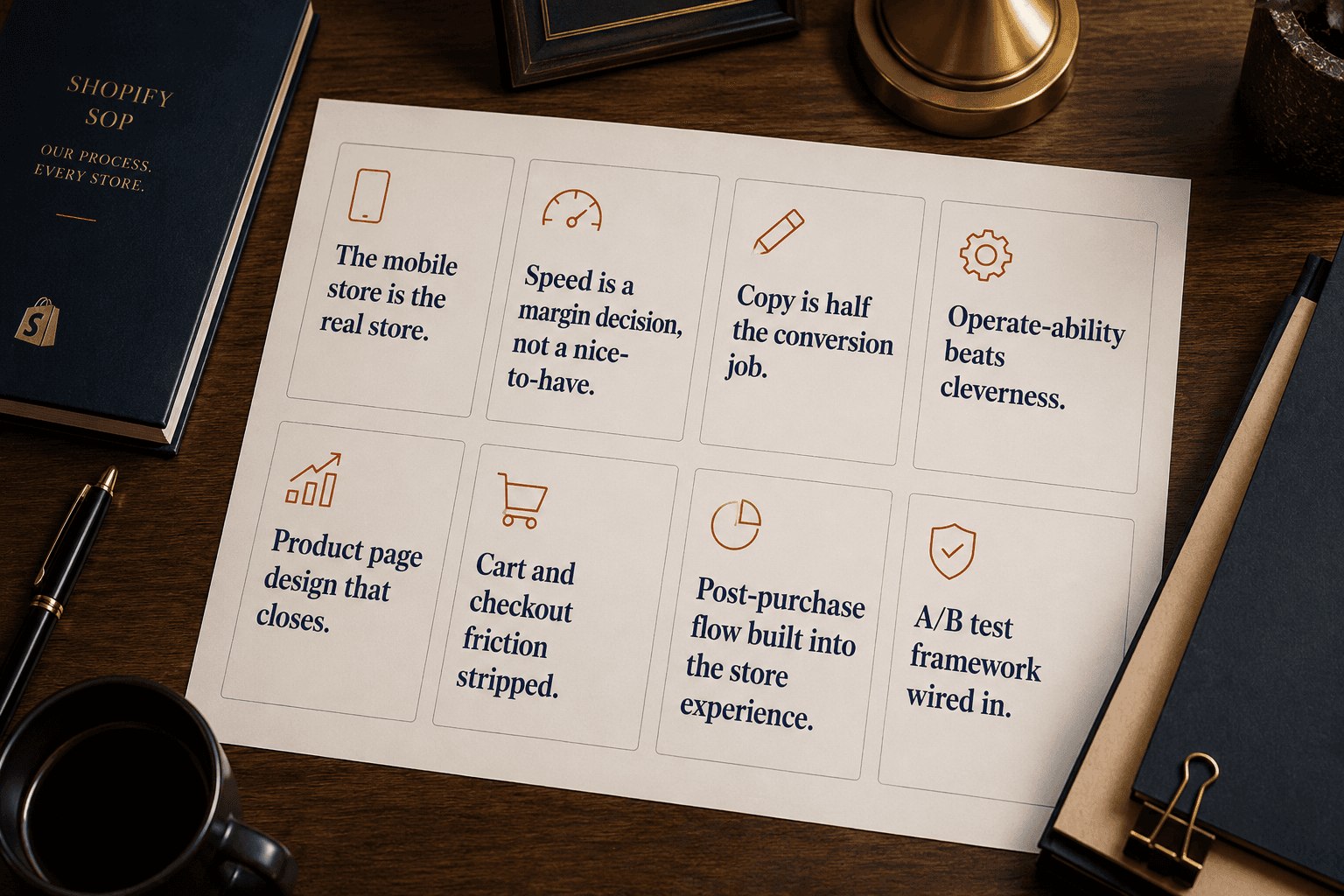
Four rules, every store.
What changes inside the first 90 days?
Observable shifts. No fabricated metrics.

Is this the right engagement?
Strong fit if
You have proven the product. Orders are coming. The question is scale.
You are migrating from a theme-heavy store, WooCommerce, BigCommerce, or a custom build that has gone brittle.
You are launching a second or third brand and want a real commercial foundation rather than another theme install.
Mobile is your primary traffic source and your current store is not built for it.
You are ready to invest in photography, copy, and merchandising, not just a pretty front-end.
Probably not right if
You are testing a product idea and do not yet have traction. Use a free theme. Come back when the data is in.
You want the cheapest possible Shopify vendor. We are not that vendor, and there are good freelancers for early-stage stores.
Your business needs are fundamentally not e-commerce and a booking or B2B flow would serve you better. Look at B2B Websites.
FAQ
Should we be on Shopify or on a custom e-commerce build?
Shopify for almost every brand under 50 million in GMV. It is fast, secure, affordable to operate, and flexible enough at the Plus tier to support most custom needs through Shopify Functions and headless front-ends. Custom builds are for true edge cases: very high volume, unusual compliance requirements, proprietary marketplace logic, or when Shopify's commercial terms genuinely do not fit. The diagnostic tells you which one you are. We will not push custom just because we can build it.
Can you migrate our existing store from another platform?
Yes. We migrate from WooCommerce, BigCommerce, Magento, Squarespace Commerce, custom builds, and from older Shopify themes. Products, customers, orders, subscriptions, and historical data all move. Migrations are usually the right moment to redesign the store, rewrite the copy, and reshoot the photography, because nothing else you do will move the numbers this much again.
How customisable is Shopify really?
Far more than most brands realise. We work at the Liquid layer, build custom sections in the theme editor, extend with Shopify Functions for checkout and discount logic, and move to a headless front-end on Hydrogen or Next.js when the scale justifies it. The limits exist, but they almost never block a commercial need we have had to solve.
Do you help with product photography and content?
We art-direct, we brief, and we coordinate. If you have an in-house team, we give them a shot list and standards. If you do not, we recommend and manage a photographer or a content studio we have worked with before. Photography is not an add-on; it is one of the highest-return investments in an e-commerce store.
What is the right app stack?
It depends, and we audit yours against the commercial job it is supposed to do. As a baseline, most brands need: a proper email platform (usually Klaviyo), a reviews app that pulls its weight, a bundle or upsell tool, a shipping and returns workflow, and a subscription app if the business model justifies one. Every extra app is a tax on speed and a tax on your ops team's attention. Fewer, better apps almost always outperform a stacked dashboard.
How do you handle subscriptions?
We build subscription flows for brands where recurring revenue fits the product and the buyer. Recharge or Shopify's native subscriptions, depending on the complexity. Gift, swap, pause, and skip are first-class behaviours, not afterthoughts. If subscriptions do not fit your category, we will say so.
What about email marketing and lifecycle?
The store and the email platform have to speak the same language. We integrate Klaviyo (most common), Omnisend, or Mailchimp, segment around buyer behaviour, and build the core flows: welcome, browse abandon, cart abandon, post-purchase, winback. The store passes clean data to the email platform by default.
Do you handle ongoing conversion rate optimisation?
Yes, on a care plan. CRO is not a one-time job; it is a monthly discipline. Quarterly A/B tests, product page iteration, funnel monitoring, and quarterly review of merchandising mix. Some brands run this in-house with us on standby. Most co-run it with us for the first year.
What is the typical timeline?
Most Shopify builds run six to nine weeks end to end. A brand-new store with a small catalogue can move faster. A migration from a complex existing platform can stretch to twelve. We scope honestly after the diagnostic call and commit to a launch date once the scope is signed.
Who on your team actually builds the store?
The principal who runs the diagnostic stays on the engagement through strategy and design. Shopify development is led by a senior developer who has shipped at scale. You know every person on the project by name; you do not get handed to a pod.
What investment range should we expect?
Most Shopify builds sit in our W2 or W3 tier depending on catalogue size, customisation depth, and integration scope. Shopify Plus migrations with heavy custom development land at W4. The diagnostic call produces a real scoping range based on your specific store, not a website-style ballpark.
Our Services







Quick Links


" height="149.2535067768008px" id="IOCTf08f5" width="1199.9520008715217px"/></svg>)