Websites • B2B • System Implementation

A B2B website is not a brochure with a contact form. It is the longest
running sales call in your company.

Somewhere between your first ad click and your first held call, your buyer is quietly making up their mind about you. They land on the homepage, scan for their specific use case, open two service pages, skim a case study, check a pricing page that probably does not exist, and then try to forward something internally to a sceptical colleague. Most of that journey happens with no human in the room. Most B2B sites are not built to survive it.

A B2B website has one commercial job: compress the sales cycle, raise win rate among target-fit buyers, and filter out the rest. If the site is doing that job, pipeline quality rises even when raw lead volume does not. If the site is not doing that job, sales cycle time inflates quietly and the team blames the market. Ninety percent of the time, the site is the problem.

The image featured at the top of the about us page #1

Why most B2B sites fail

They were built as marketing sites and quietly repurposed as sales sites.

When you look at a typical B2B homepage, you are looking at a page that was written for an investor visit, lightly updated when positioning shifted, and then left alone while the sales team built a very different pitch in private. The site talks to one audience. The sales team talks to another. Every serious buyer who arrives on the site is reading a paragraph that was not written for them.

The service pages were written for a trade show handout three years ago and never rewritten after the product grew. The case studies exist but are trapped inside a gated PDF nobody wants to download. The pricing page is either missing, deliberately vague, or a three-paragraph promise that "pricing depends on your specific needs." The resource library was built for SEO and never built for the buyer inside a live deal.

When a serious buyer arrives, they cannot find their own use case, cannot tell whether you are a fit, cannot forward anything useful to the rest of the committee, and cannot self-educate to the point where a sales call is a good use of anyone's time. The fix is rarely a redesign. It is an architecture rebuild.

The image featured at the top of the about us page #1

What a weak B2B site actually costs

You do not see it in a conversion metric. You see it in cycle length.

  1. Cycle stretches.

Every question the site fails to answer becomes an email, a Slack thread, a follow-up call, or a second discovery. The deal moves slower than it should, and the pipeline ages out.

  1. Champion-led forwarding breaks.

An internal advocate tries to pass a page, a case study, or a pricing frame to the rest of the committee. There is nothing on the site that holds up to forwarding. Deals die inside email threads you will never see.

  1. Sales repeats itself on every call.

Every call starts at zero. Positioning gets relitigated. Objections get handled manually. The team carries the site's job, and the capacity ceiling hits fast.

  1. Win rate drops among target-fit buyers.

The site filters in curiosity shoppers and filters out serious buyers. Your best-fit prospects bounce without a signal because they could not verify fit in public. They hire a competitor with a clearer site, not a better product.

  1. Paid spend converts poorly.

Demand-gen runs into a site that cannot carry the weight. The ads look bad, the landing pages look worse, the forms capture nothing, and CAC rises without explanation.

  1. Attribution is unreadable.

You cannot tell the CEO which page, asset, or campaign moved revenue. Board decks get softer, media budgets get softer with them, and the story about what is working becomes a story about what is hopeful.

  1. Cycle stretches.

Every question the site fails to answer becomes an email, a Slack thread, a follow-up call, or a second discovery. The deal moves slower than it should, and the pipeline ages out.

  1. Champion-led forwarding breaks.

An internal advocate tries to pass a page, a case study, or a pricing frame to the rest of the committee. There is nothing on the site that holds up to forwarding. Deals die inside email threads you will never see.

  1. Sales repeats itself on every call.

Every call starts at zero. Positioning gets relitigated. Objections get handled manually. The team carries the site's job, and the capacity ceiling hits fast.

  1. Win rate drops among target-fit buyers.

The site filters in curiosity shoppers and filters out serious buyers. Your best-fit prospects bounce without a signal because they could not verify fit in public. They hire a competitor with a clearer site, not a better product.

  1. Paid spend converts poorly.

Demand-gen runs into a site that cannot carry the weight. The ads look bad, the landing pages look worse, the forms capture nothing, and CAC rises without explanation.

  1. Attribution is unreadable.

You cannot tell the CEO which page, asset, or campaign moved revenue. Board decks get softer, media budgets get softer with them, and the story about what is working becomes a story about what is hopeful.

  1. Cycle stretches.

Every question the site fails to answer becomes an email, a Slack thread, a follow-up call, or a second discovery. The deal moves slower than it should, and the pipeline ages out.

  1. Win rate drops among target-fit buyers.

The site filters in curiosity shoppers and filters out serious buyers. Your best-fit prospects bounce without a signal because they could not verify fit in public. They hire a competitor with a clearer site, not a better product.

  1. Champion-led forwarding breaks.

An internal advocate tries to pass a page, a case study, or a pricing frame to the rest of the committee. There is nothing on the site that holds up to forwarding. Deals die inside email threads you will never see.

  1. Paid spend converts poorly.

Demand-gen runs into a site that cannot carry the weight. The ads look bad, the landing pages look worse, the forms capture nothing, and CAC rises without explanation.

  1. Sales repeats itself on every call.

Every call starts at zero. Positioning gets relitigated. Objections get handled manually. The team carries the site's job, and the capacity ceiling hits fast.

  1. Attribution is unreadable.

You cannot tell the CEO which page, asset, or campaign moved revenue. Board decks get softer, media budgets get softer with them, and the story about what is working becomes a story about what is hopeful.

The image featured at the top of the about us page #1

What a B2B website actually needs

Five components that work together. Removing any one breaks the system.
Use-case architecture

The site is designed around how your buyer self-identifies, not around your internal org chart. Industry, role, company size, or use case, depending on which maps cleanest to buying reality. A visitor finds their specific path inside three clicks. No "one solutions page fits all."

Forwarding-ready assets

Comparison pages that take the competitive question seriously. Case studies that pass a procurement review. One-pagers designed to be forwarded, not downloaded. ROI frames with honest inputs. Pricing pages (even directional ones) that respect the committee process. Every asset is designed to move deals forward when no one from your team is in the room.

Commercial measurement

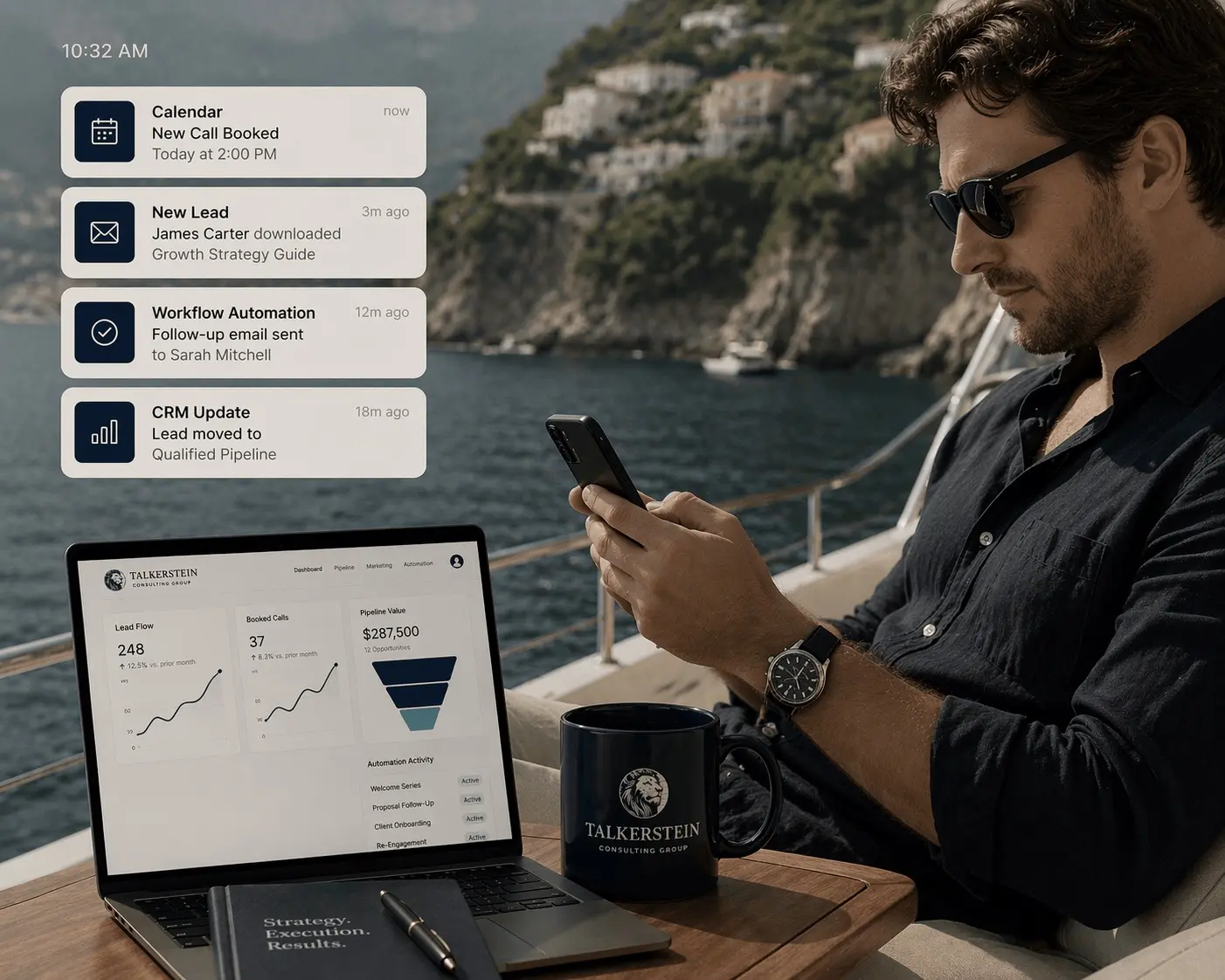
Every page, every asset, and every CTA is tied to a pipeline stage. Attribution is honest. Pipeline per visit, pipeline per asset, pipeline per campaign, and cycle length are all visible in a dashboard the revenue team trusts. This is treated as a build deliverable, not an afterthought.

Sales-grade copy on every page

Copy that reads like the best human at your company is writing it, not like a content agency filling a template. Specific, honest, commercially serious. Every page commits to a point of view. No hedged language. No empty "leaders trust us" headers. Example questions, example outcomes, example tradeoffs.

Champion enablement

The site helps the internal advocate sell you inside their organisation. It anticipates the CFO's question, the security team's question, the legal team's question, the COO's question. Content exists specifically to be shared, not just to be read.

Use-case architecture

The site is designed around how your buyer self-identifies, not around your internal org chart. Industry, role, company size, or use case, depending on which maps cleanest to buying reality. A visitor finds their specific path inside three clicks. No "one solutions page fits all."

Forwarding-ready assets

Comparison pages that take the competitive question seriously. Case studies that pass a procurement review. One-pagers designed to be forwarded, not downloaded. ROI frames with honest inputs. Pricing pages (even directional ones) that respect the committee process. Every asset is designed to move deals forward when no one from your team is in the room.

Commercial measurement

Every page, every asset, and every CTA is tied to a pipeline stage. Attribution is honest. Pipeline per visit, pipeline per asset, pipeline per campaign, and cycle length are all visible in a dashboard the revenue team trusts. This is treated as a build deliverable, not an afterthought.

Sales-grade copy on every page

Copy that reads like the best human at your company is writing it, not like a content agency filling a template. Specific, honest, commercially serious. Every page commits to a point of view. No hedged language. No empty "leaders trust us" headers. Example questions, example outcomes, example tradeoffs.

Champion enablement

The site helps the internal advocate sell you inside their organisation. It anticipates the CFO's question, the security team's question, the legal team's question, the COO's question. Content exists specifically to be shared, not just to be read.

Use-case architecture

The site is designed around how your buyer self-identifies, not around your internal org chart. Industry, role, company size, or use case, depending on which maps cleanest to buying reality. A visitor finds their specific path inside three clicks. No "one solutions page fits all."

Sales-grade copy on every page

Copy that reads like the best human at your company is writing it, not like a content agency filling a template. Specific, honest, commercially serious. Every page commits to a point of view. No hedged language. No empty "leaders trust us" headers. Example questions, example outcomes, example tradeoffs.

Forwarding-ready assets

Comparison pages that take the competitive question seriously. Case studies that pass a procurement review. One-pagers designed to be forwarded, not downloaded. ROI frames with honest inputs. Pricing pages (even directional ones) that respect the committee process. Every asset is designed to move deals forward when no one from your team is in the room.

Champion enablement

The site helps the internal advocate sell you inside their organisation. It anticipates the CFO's question, the security team's question, the legal team's question, the COO's question. Content exists specifically to be shared, not just to be read.

Commercial measurement

Every page, every asset, and every CTA is tied to a pipeline stage. Attribution is honest. Pipeline per visit, pipeline per asset, pipeline per campaign, and cycle length are all visible in a dashboard the revenue team trusts. This is treated as a build deliverable, not an afterthought.

The image featured at the bottom of the about us page

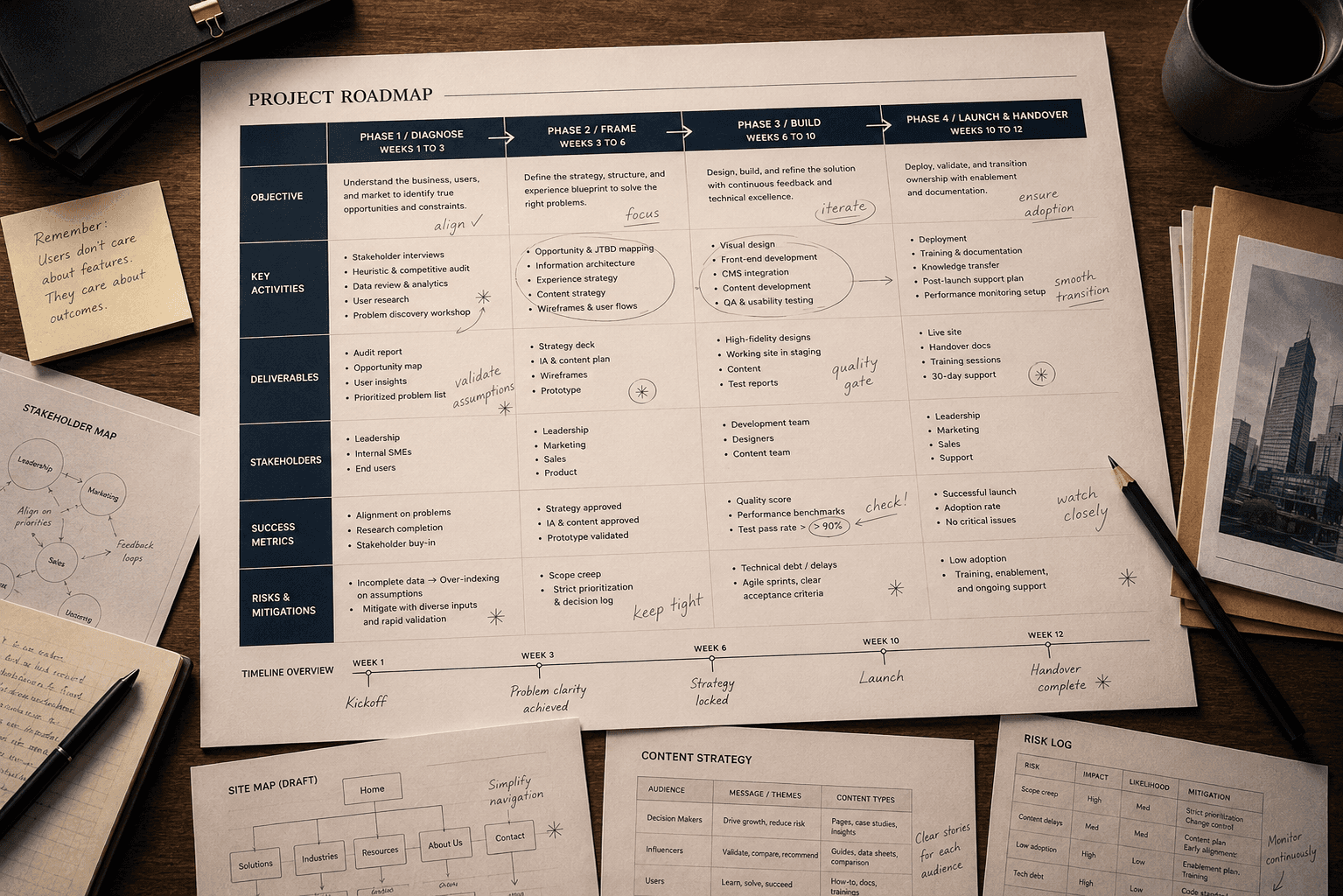
How the work moves. Four phases, buyer-journey-first.

Phase 1 / Diagnose (weeks 1 to 3)

Commercial discovery with the founder, the head of sales, the head of marketing, and where relevant, the head of revops. We interview three to five recent closed-won deals and three to five recent closed-lost deals to map the real buyer journey. We audit the current site against that journey. Output is a written B2B website brief, an architecture recommendation, and a scoping range.

Phase 2 / Frame (weeks 3 to 6)

Positioning sharpened, messaging hierarchy built, page architecture designed, copy drafted, design direction set. A clickable prototype of every core page template is reviewed before code is written. Stakeholders review in stages. Sales and marketing sign off on the narrative together, so the finished site does not need a sales-team apology tour at launch.

Phase 3 / Build (weeks 6 to 10)

Design system, page templates, CMS build, forms, CRM integration, marketing automation wiring, analytics, and asset production all run in parallel. You see progress weekly on a staging URL. QA happens across browsers, devices, performance, accessibility, and the real CRM behaviour before any launch date is accepted.

Phase 4 / Launch and handover (weeks 10 to 12)

Redirects, DNS cut-over, sales enablement rollout, internal training on the CMS and the analytics dashboard, and a live optimisation window for the first fortnight. Sales leadership is briefed separately so the sales motion adapts to the site, not the other way around. Handover is written, not verbal, and includes a 30-day review cadence.

The image featured at the top of the about us page #1

Four non-negotiables.

The site is sales infrastructure.

It is measured on pipeline, not page views. Every decision is tested against that.

Mobile-first is not optional.

Roughly half of B2B traffic now arrives on a phone, including at the consideration stage. The site is designed mobile-first and validated on real devices, not in a browser simulator.

Copy carries more of the job than design does.

A sharp, specific page with average design will beat a beautiful page with average copy on a committee buyer. Every time.

Forwardability is designed in.

Every core asset is designed to survive being passed, emailed, dropped into a deck, and scrutinised in a second meeting where your team is not in the room.

The site is sales infrastructure.

It is measured on pipeline, not page views. Every decision is tested against that.

Mobile-first is not optional.

Roughly half of B2B traffic now arrives on a phone, including at the consideration stage. The site is designed mobile-first and validated on real devices, not in a browser simulator.

Copy carries more of the job than design does.

A sharp, specific page with average design will beat a beautiful page with average copy on a committee buyer. Every time.

Forwardability is designed in.

Every core asset is designed to survive being passed, emailed, dropped into a deck, and scrutinised in a second meeting where your team is not in the room.

The site is sales infrastructure.

It is measured on pipeline, not page views. Every decision is tested against that.

Copy carries more of the job than design does.

A sharp, specific page with average design will beat a beautiful page with average copy on a committee buyer. Every time.

Mobile-first is not optional.

Roughly half of B2B traffic now arrives on a phone, including at the consideration stage. The site is designed mobile-first and validated on real devices, not in a browser simulator.

Forwardability is designed in.

Every core asset is designed to survive being passed, emailed, dropped into a deck, and scrutinised in a second meeting where your team is not in the room.

The image featured at the top of the about us page #1

What changes once the architecture is right?

Observable shifts in the first two quarters.

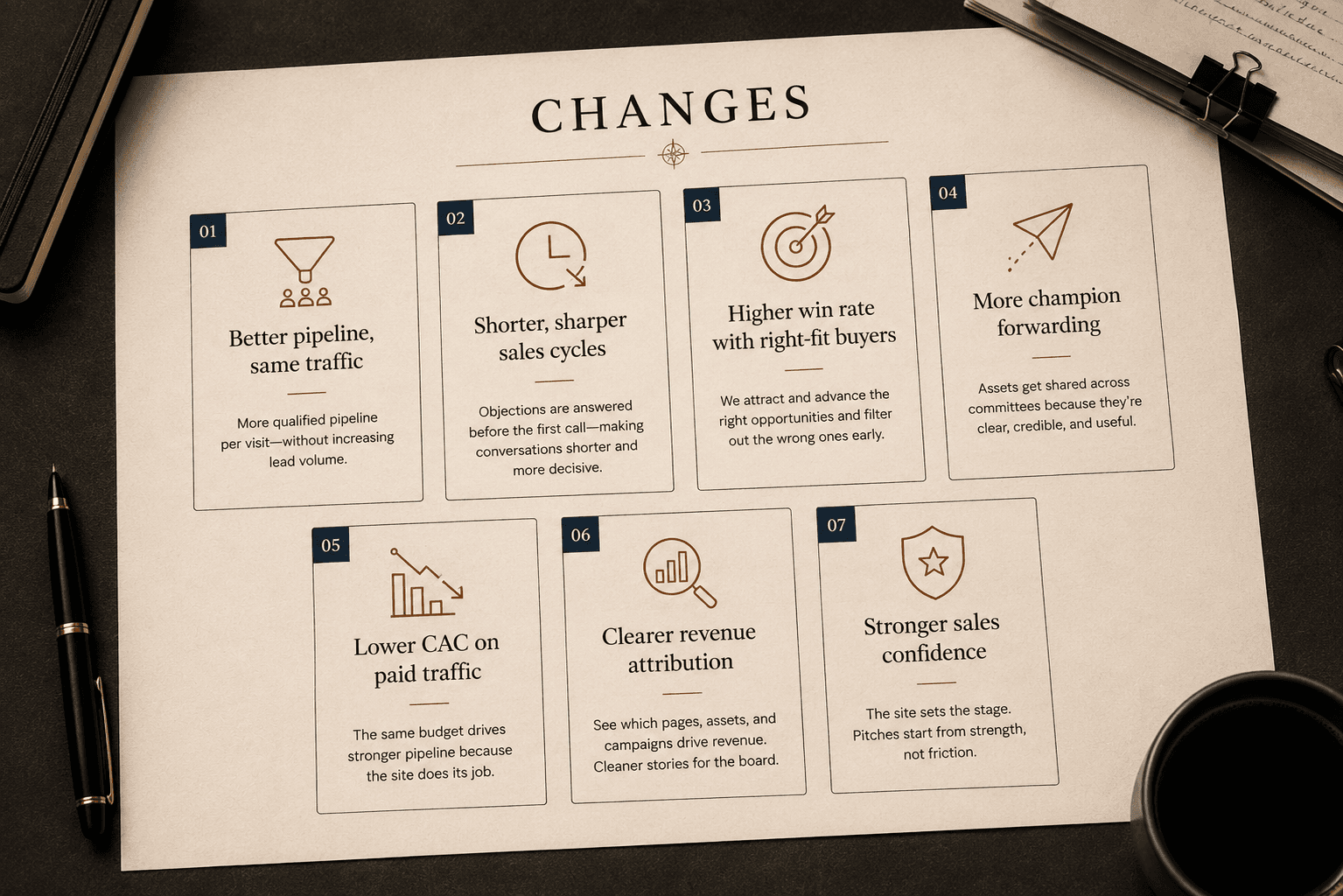
Qualified pipeline per visit rises, even when total lead volume does not change. The site is filtering for better buyers, not more buyers.
Win rate rises among target-fit buyers. The site is pre-qualifying the right deals and disqualifying the wrong ones.
CAC on paid traffic falls. The same spend produces a better pipeline because the landing surface is finally doing its job.
Sales team confidence rises. Pitches open from a position of strength because the site sets up the conversation instead of creating friction.
Sales cycle length compresses. Committee objections get handled on the site before the first call, so the call is shorter and more decisive.
Champion-led forwarding increases. Assets get shared inside buying committees because they are worth sharing.
Attribution becomes legible. The CEO can see which pages, assets, and campaigns are driving revenue. Board conversations get cleaner.
Qualified pipeline per visit rises, even when total lead volume does not change. The site is filtering for better buyers, not more buyers.
Win rate rises among target-fit buyers. The site is pre-qualifying the right deals and disqualifying the wrong ones.
CAC on paid traffic falls. The same spend produces a better pipeline because the landing surface is finally doing its job.
Sales team confidence rises. Pitches open from a position of strength because the site sets up the conversation instead of creating friction.
Sales cycle length compresses. Committee objections get handled on the site before the first call, so the call is shorter and more decisive.
Champion-led forwarding increases. Assets get shared inside buying committees because they are worth sharing.
Attribution becomes legible. The CEO can see which pages, assets, and campaigns are driving revenue. Board conversations get cleaner.
Qualified pipeline per visit rises, even when total lead volume does not change. The site is filtering for better buyers, not more buyers.
Sales cycle length compresses. Committee objections get handled on the site before the first call, so the call is shorter and more decisive.
Win rate rises among target-fit buyers. The site is pre-qualifying the right deals and disqualifying the wrong ones.
Champion-led forwarding increases. Assets get shared inside buying committees because they are worth sharing.
CAC on paid traffic falls. The same spend produces a better pipeline because the landing surface is finally doing its job.
Attribution becomes legible. The CEO can see which pages, assets, and campaigns are driving revenue. Board conversations get cleaner.
Sales team confidence rises. Pitches open from a position of strength because the site sets up the conversation instead of creating friction.
The image featured at the top of the about us page #1

Is this the right engagement?

Strong fit if
  • Your deal sizes are into the mid-five or six figures and your sales cycle runs multiple months with multiple stakeholders.

  • Your sales team is strong. The site is now the bottleneck, not the pitch.

  • You are preparing for a repositioning, a new product tier, a geographic expansion, or a fundraise where the site has to hold up.

  • You run paid demand-gen, content, outbound, or partner channels into a site that cannot convert the traffic those channels earn.

  • Your buyer committee is getting larger and more distributed. The site has to work when no one from your team is in the room.

Probably not right if
  • You have no defined buyer. Positioning is still being fought out internally. Start with brand strategy.

  • Deal sizes are small and the cycle is short. A transactional site is a better investment than a B2B architecture.

  • You want a visual refresh only. A refresh is cheaper and faster. Start with Visual Identity.

  • You want the cheapest possible option. We are not that vendor. A freelancer will probably ship a nicer-looking site faster for less, and it will still not solve the pipeline problem.

FAQ

How do you measure B2B website success?

Qualified pipeline per visit, sales cycle length, win rate among target-fit buyers, and cost per booked call. Not lead volume alone. Lead volume can rise while revenue falls if the leads are worse-fit. We agree targets up front against your sales data, and we report against them in the first full quarter after launch.

Do you integrate with our CRM?

Yes. HubSpot, Salesforce, Pipedrive, GHL, Close, Attio, and most of the modern B2B stack. Leads route directly from every form into the CRM with scoring, source attribution, and deal-stage syncing already wired. Manual lead entry is never part of the ask. If your CRM is unusual, we will say so during the diagnostic.

How long does a B2B rebuild actually take?

Most B2B rebuilds run ten to twelve weeks end to end. Complex ones with multi-region architecture, multiple case studies to produce, or deep integration work can stretch to sixteen. Faster than that and the discovery phase gets cut, which always shows in the final product. We scope honestly after the diagnosis and hold the date.

What if our sales cycle is eighteen months or more?

Long cycles need more nurture surface, more forwarding-ready assets, and more consideration-stage content than shorter cycles. The site is designed with that pattern explicitly: longer-form case studies, ROI calculators, email sequences tied to specific pages, retargeting built in from the start. The site is one part of the long-cycle motion, not the whole of it.

How important is mobile traffic for B2B?

More than most B2B teams assume. Roughly half of B2B traffic arrives on mobile, including at the consideration stage, and an internal champion forwarding a case study in a meeting is probably opening it on a phone. The site is built mobile-first. Every case study, ROI frame, and pricing page is readable on a phone without pinching.

Do you also produce the case studies and sales assets?

Yes. Case study development is part of most B2B rebuilds. We interview customers, draft the story, design the page, and write an accompanying one-pager. We can also build comparison pages, ROI calculators, demo leave-behinds, and internal sales-enablement assets that share the same source of truth as the site.

How do you handle multi-product or multi-offering portfolios?

Through use-case architecture. We segment the site by solution, role, or industry depending on how your buyers actually self-identify. Navigation is designed so a visitor finds their specific case inside three clicks. We do not make them read through your full org chart.

How do you position against competitors?

We recommend a comparison page that takes the question seriously. It names competitors, describes tradeoffs honestly, and frames when your approach is the right one. A well-written comparison page is usually the highest-converting page on a B2B site. Vague comparison pages lose the buyer to whoever wrote a sharp one.

What about pricing? Do you recommend publishing it?

Usually, yes, even if the number is directional. Buying committees now disqualify vendors who hide pricing. A directional range with clear "starts at" language and a transparent deal-shape description performs better than "contact us." We recommend the specific pricing posture during the diagnostic based on your deal profile.

What about pricing? Do you recommend publishing it?

Usually, yes, even if the number is directional. Buying committees now disqualify vendors who hide pricing. A directional range with clear "starts at" language and a transparent deal-shape description performs better than "contact us." We recommend the specific pricing posture during the diagnostic based on your deal profile.

Can you work with our in-house marketing team?

Yes. We co-lead with in-house marketing teams regularly. Clear swim-lanes up front. Your team usually owns content, campaigns, and ongoing updates after launch. We usually own strategy, architecture, design, and launch. Hybrid models work when both sides commit to one governance cadence.

Our Services

What Our Partners Think

They are highly supportive! I feel completely supported in every part of my marketing. They are a wonderful team of people each bring in their own talents and strengths. They are responsive and eager to please and it's been a pleasure working with them.

Tova, Toronto

Co-owner of FRINGE boutique

What Our Partners Think

They are highly supportive! I feel completely supported in every part of my marketing. They are a wonderful team of people each bring in their own talents and strengths. They are responsive and eager to please and it's been a pleasure working with them.

Tova, Toronto

Co-owner of FRINGE boutique

Let's Work Together

What Our Partners Think

They are highly supportive! I feel completely supported in every part of my marketing. They are a wonderful team of people each bring in their own talents and strengths. They are responsive and eager to please and it's been a pleasure working with them.

Tova, Toronto

Co-owner of FRINGE boutique

What Our Partners Think

They are highly supportive! I feel completely supported in every part of my marketing. They are a wonderful team of people each bring in their own talents and strengths. They are responsive and eager to please and it's been a pleasure working with them.

Tova, Toronto

Co-owner of FRINGE boutique

Let's Work Together