
Consulting • Workshops
One day in a room, and your team stops disagreeing in private.
Executive workshops for Toronto & GTA leadership teams.
Your team knows something is off. Sales thinks it is a product. The product thinks it is marketing. Operations thinks everyone else is the problem. Nobody says it out loud. Decisions stall, the same debate surfaces every quarter, and the work that actually moves the business keeps slipping behind the work of managing around the disagreement. A workshop ends that pattern. It is a structured working day with a trained facilitator, clear questions, defined outputs, and a decision log signed before anyone leaves the room. Not a retreat. Not a strategy offsite that dissolves on the drive home. A day of real work that your team will still be referring to six months from now.
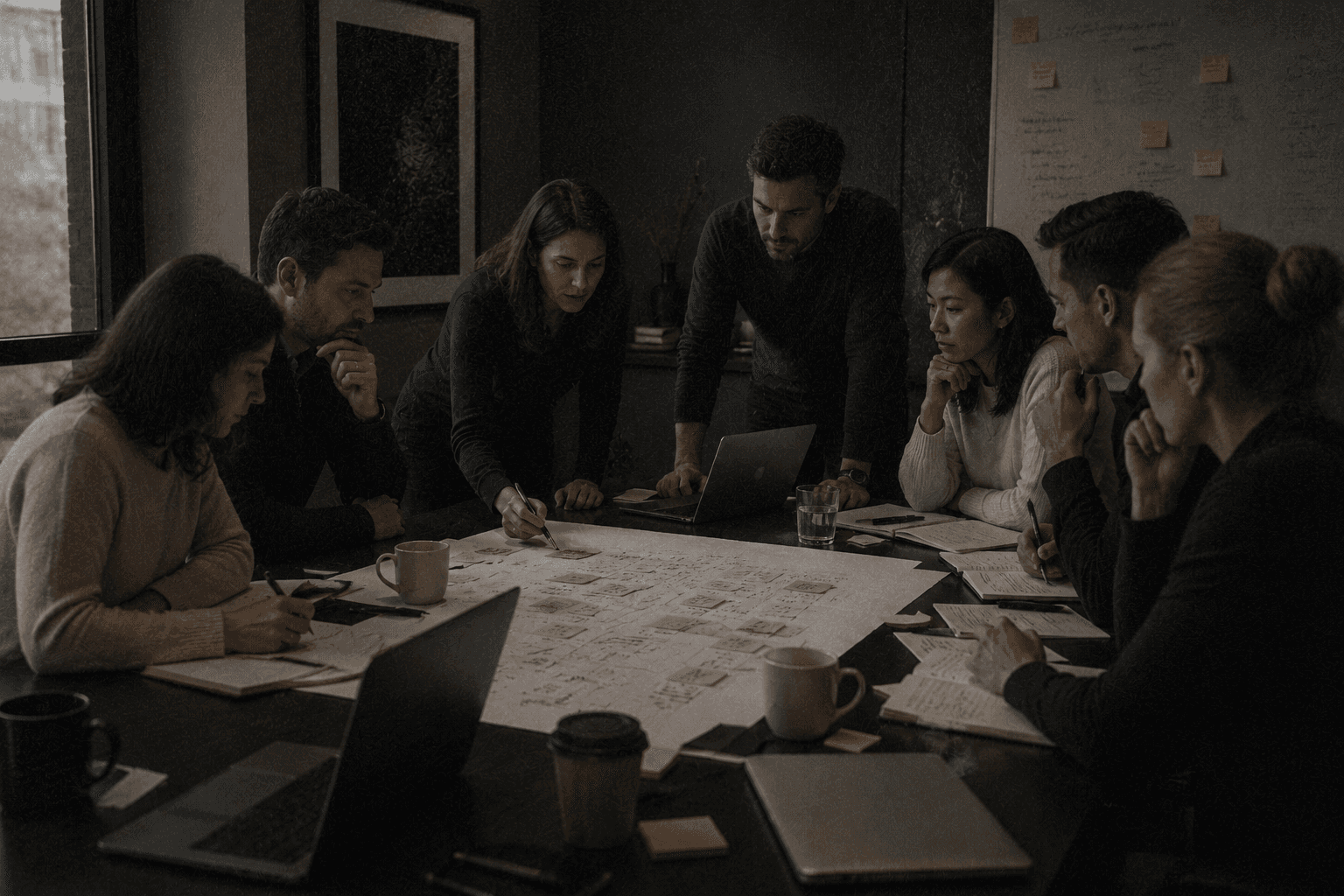
Misalignment is a tax you pay every week until you stop paying it.
Most founder-led teams operate in quiet parallel. Each leader has a version of the strategy in their head. Each version is partially right. None of them fully match. Sales sells one promise, delivery keeps a different one, marketing tells a third story, and the founder patches the gaps in the middle of the night on Slack. Prospects feel it. Partners feel it. New hires feel it within their first month.
A good workshop forces those versions into the same room, stress-tests them, kills the weakest ones, and documents the surviving version so no one can claim confusion again. It is not a team-building exercise. It is the single most effective way we have found to stop the slow bleed of compounding misalignment without the noise, cost, and consulting theatre of a quarter-long engagement.
This page covers the five workshop themes we run, how a session is actually structured, what your team leaves with, and how to tell whether a workshop or a longer consulting engagement is the right shape for the question in front of you.
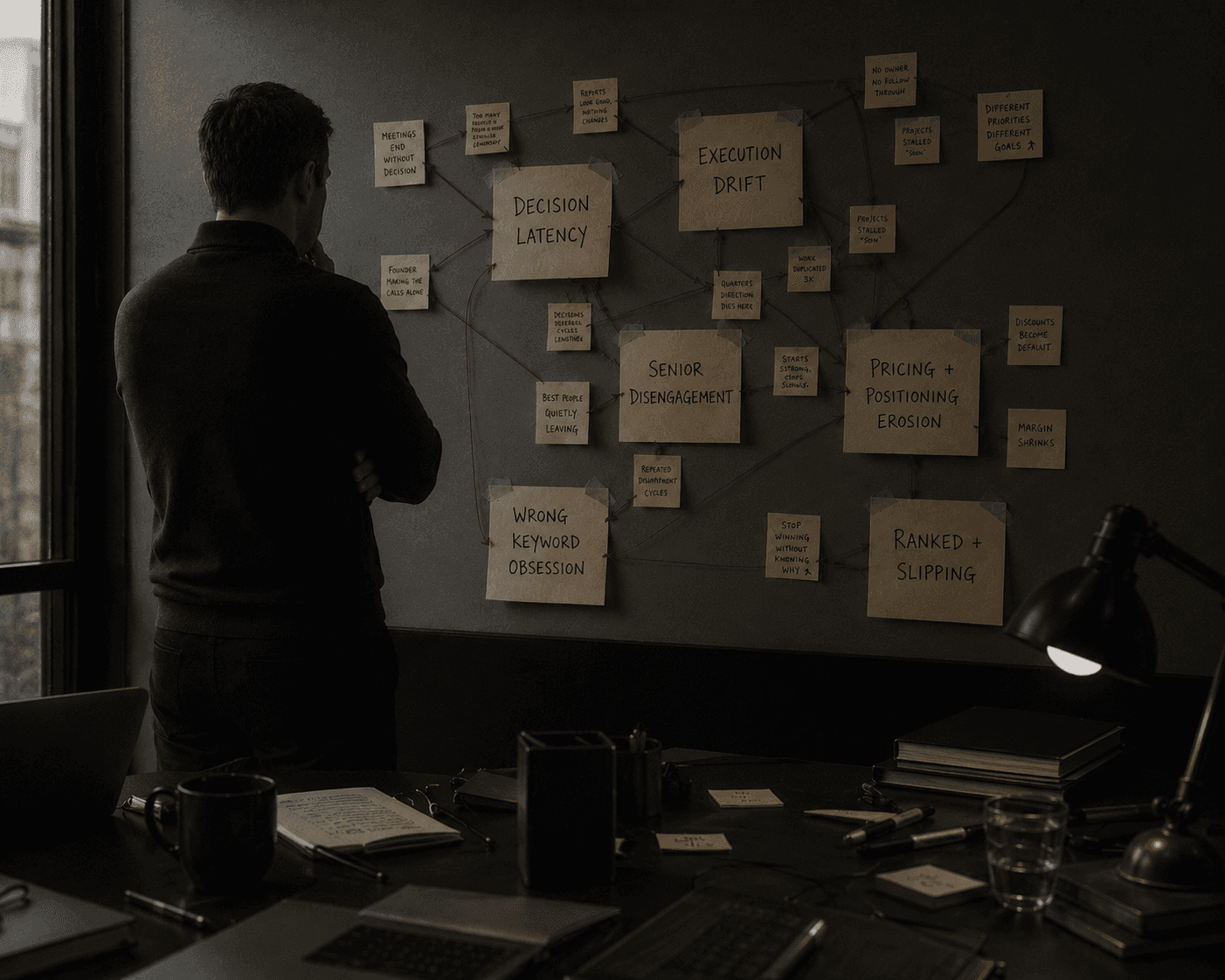
The price of staying misaligned is rarely loud. It is almost always big.
Delayed alignment does not show up as a line item on any report. It shows up in slower sales cycles, duplicated work, bruised senior hires, and the one or two strategic bets your team keeps almost making. Four costs we see on nearly every team that has avoided a hard conversation for more than a quarter.
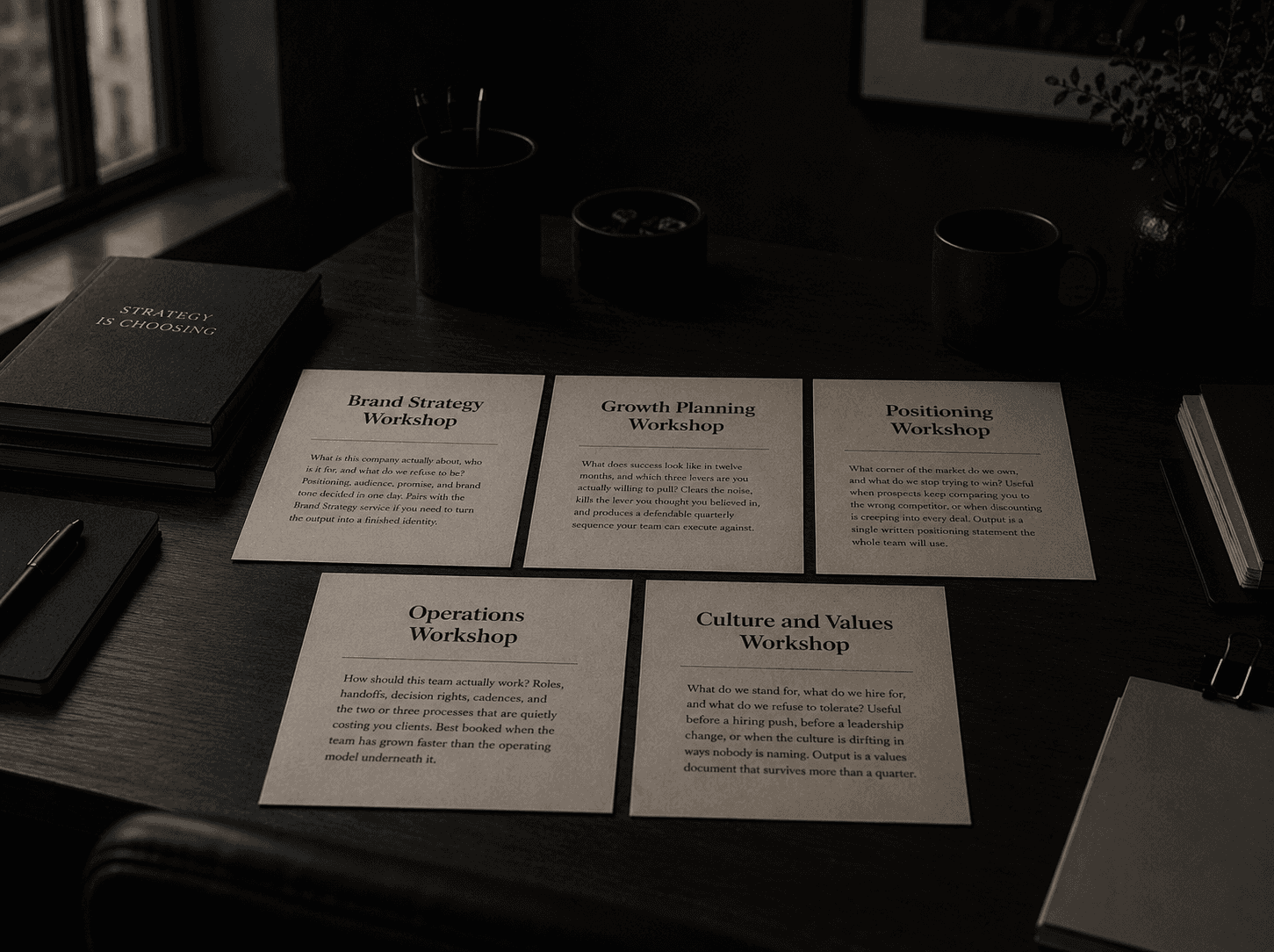
We facilitate five themes, each built around one decision your team cannot keep deferring.
These are the questions we have seen founder-led teams get the most leverage out of in a single working day. Every theme is scoped to produce a specific artifact you can hand to the rest of the team on Monday. If the real question sits between two themes, we shape a custom agenda before the session runs.
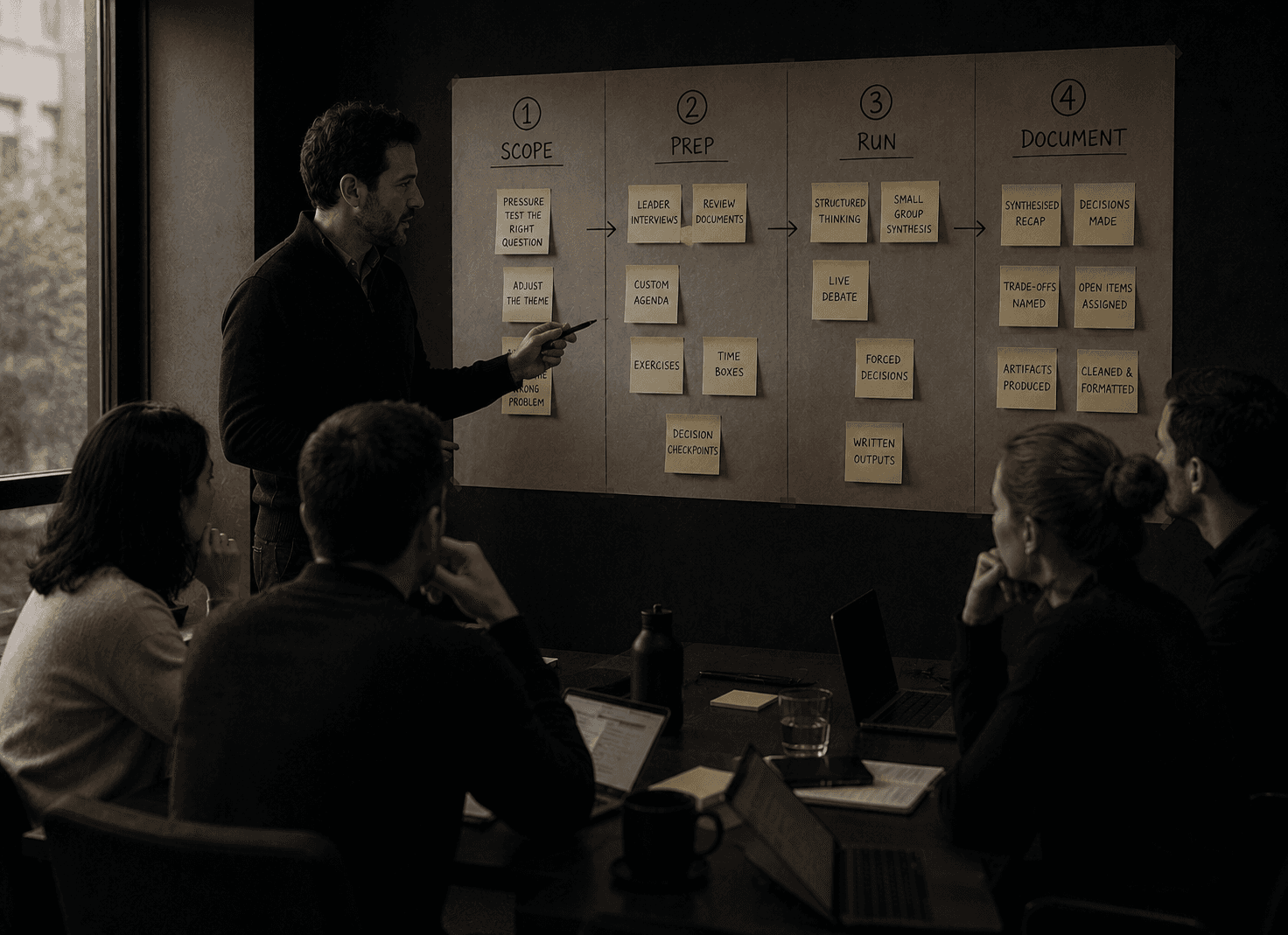
Four phases: Scope, Prep, Run, Document.
Workshops fail when they are run like meetings. Our sessions are structured like projects. The facilitation is directive, the time is managed aggressively, and the output is non-negotiable.
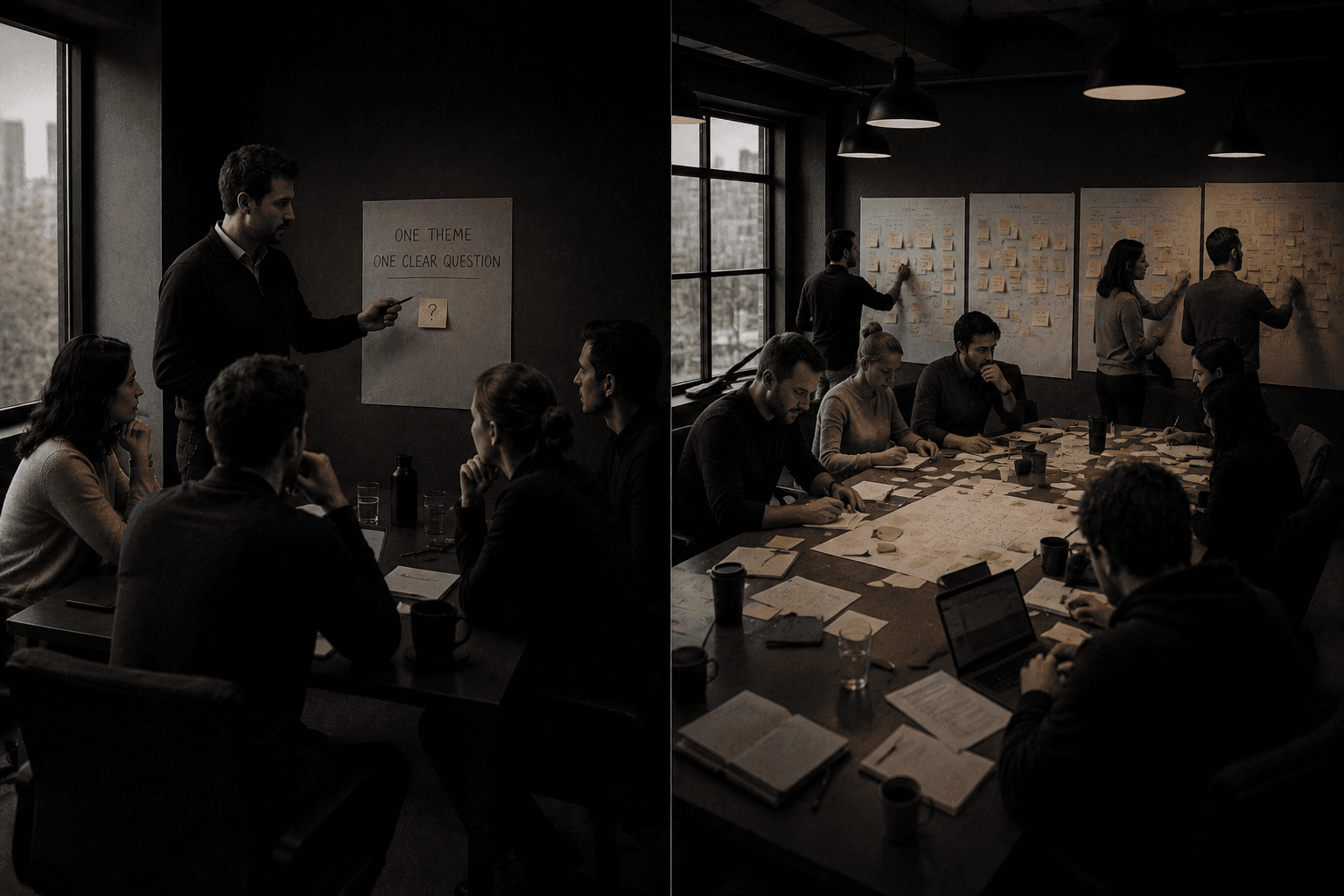
Half-day, full-day, virtual, or in person. The format follows the question.
Half-day sessions work best when the team already knows the question and needs a structured room to answer it. Full-day sessions work when two or more decisions compound on each other, or when the team has not had a real strategic conversation in over a quarter. Virtual works. In person works better for politically charged decisions.
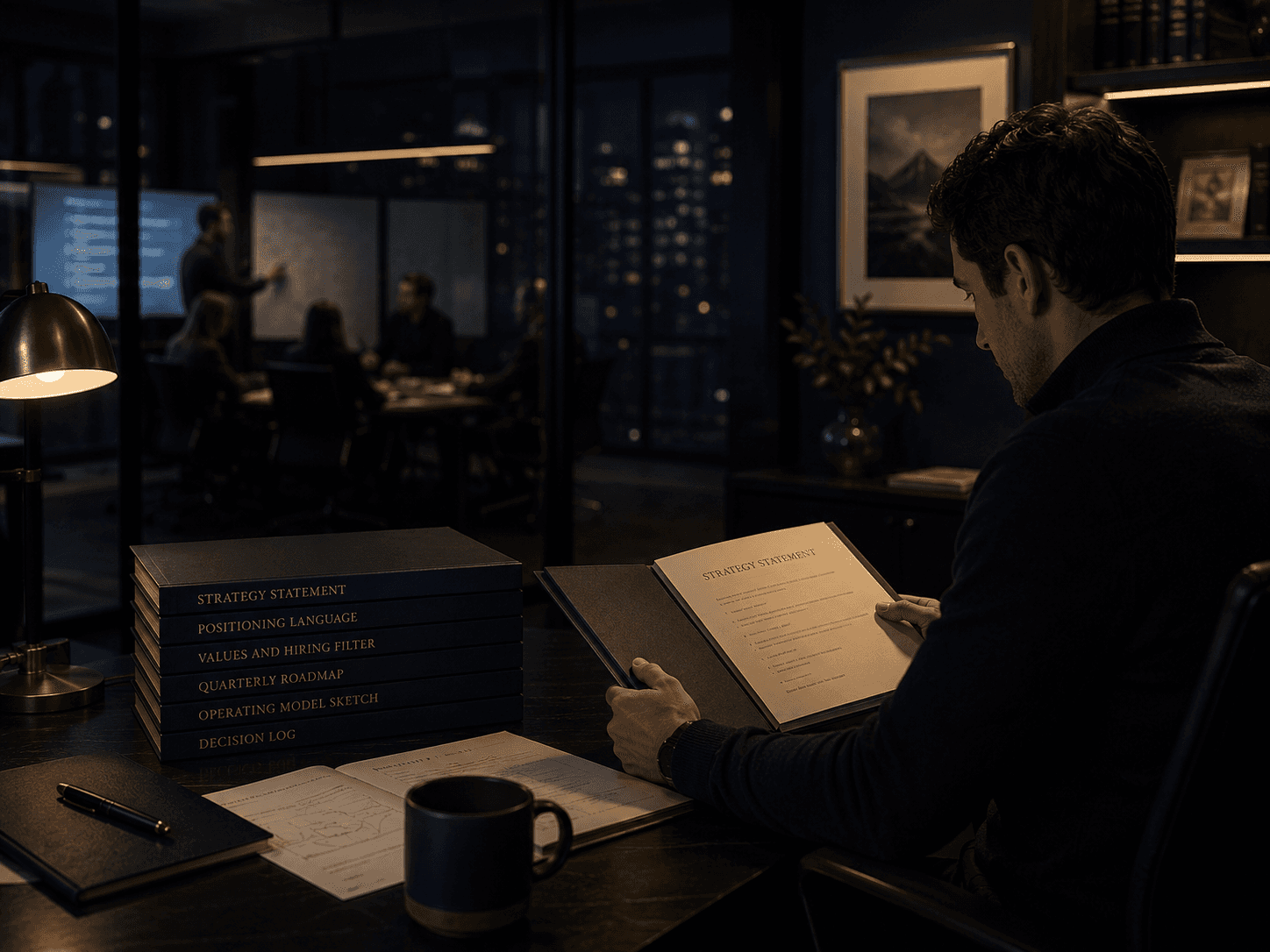
Workshops produce artifacts, not feelings.
A good workshop should survive contact with the rest of the week. Every session we run produces at least three of the following, and we name which ones up front during scope. If we cannot commit to the artifact, we will not run the session.

Six observable changes you should see within a month of the session.
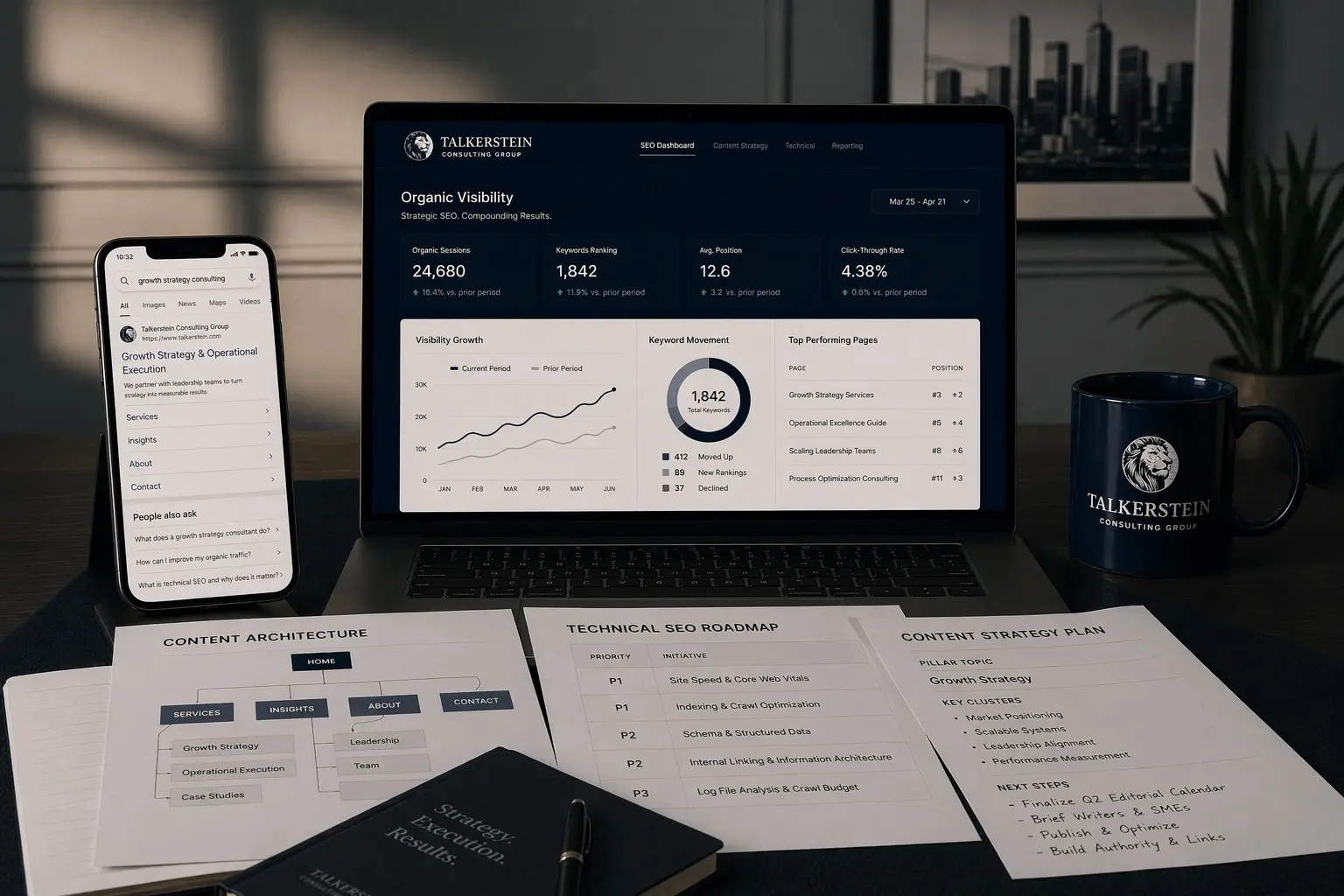
When a serious SEO engagement matures, the change shows up in more places than the ranking dashboard. Pipeline mix shifts. Paid dependency drops. Sales stops explaining who you are because prospects already read two of your pages on the way in. Leadership starts forecasting from organic, not guessing around it. The compounding begins to feel real rather than theoretical, and the monthly numbers stop depending on whoever is running ads that quarter.

A workshop works for specific situations. It is not the right tool for everything.
A workshop is a strong fit if
Your leadership team has a recurring disagreement that has not resolved itself in a quarter or more.
You are about to make a sizable investment or hiring decision and want the team aligned before you commit.
You need a defendable strategy, positioning, or growth plan you can point to and execute against.
You are willing to pre-read a few documents and complete a short intake before we run the session.
You can put your decision-makers in one room for three to eight hours without interruptions.
A workshop is not the right fit if
You want a feel-good offsite with trust-fall activities and optional strategy conversations.
You are not ready to commit the decision-makers to a single working day.
The real problem is execution capacity, not alignment. You need a build, not a conversation.
You need a three-month engagement and an ongoing fractional operator. Look at our Consulting formats instead.
Your team is in an active crisis and the room will spend the day debating who caused what.
What serious buyers usually ask.
How do we know if a workshop is the right move versus ongoing consulting?
A workshop solves a single strategic question in a single day. Ongoing consulting handles a stream of decisions over months and usually includes fractional operator support between calls. If you know the question and need alignment, book a workshop. If you have five questions that will compound over the next two quarters, consulting is the better shape. We will tell you which one fits on the intake call.
How long does it take from booking to running the session?
Typically two to three weeks of prep after the scope call. Two weeks is the floor. Compressed timelines reduce the quality of the output because we lose time to interview your leaders, review your documents, and build a custom agenda. We will only run a rushed session when the business cost of waiting is clearly higher than the cost of a lighter prep.
What team size works best?
Half-day sessions are strongest with six to twelve people. Full-day sessions handle eight to twenty. Fewer than six and you lose the diversity of perspective that makes the room useful. More than twenty and everyone stops contributing. Larger organisations usually run multiple workshops by function, stitched together with a leadership-level synthesis session at the end.
Can we customise the theme?
Yes. The five themes are the most common shapes. We regularly run custom workshops around the sales process, fundraising readiness, customer-success transformation, pricing strategy, and leadership team redesign. The constraint is that the theme has to produce a concrete artifact inside the day. If the question is too open-ended, we will recommend a diagnostic first.
What happens if the team does not reach an agreement in the room?
That is a normal and healthy outcome for some decisions. We do not force consensus. We name the disagreement clearly, surface the underlying assumptions on each side, and escalate to the decision-maker, usually the founder or CEO. The decision gets made, documented, and broadcast. The team leaves with clarity, which is what actually matters. False consensus is worse than an honest call.
Is this different from a retreat?
Yes, materially. Retreats are relaxation with light strategy. Workshops are concentrated work. There is no nature walk, no cooking class, and no icebreaker that takes forty minutes. The room is structured aggressively because your team has already lost months to unstructured conversation. Plenty of our clients book a retreat on top of a workshop. We do not run the retreat.
Can you run it virtually?
Yes, and many of our sessions run that way. Virtual sessions are roughly twenty percent faster because we use breakout rooms, real-time collaborative docs, and instant polling. We lose a little of the tactile energy and the hallway conversation. For high-trust teams this is a fair trade. For politically charged decisions or new leadership groups, we recommend in person.
What if we are not sure which theme to book?
Start with the intake call. We will ask a handful of sharp questions about the business and recommend the theme that solves the biggest problem you have right now. About a third of the time, the theme you called us about turns out not to be the one you actually need. We would rather adjust that before we scope than after.
What budget range should we expect?
Workshops sit in the mid-four to low-five-figure range depending on format, preparation depth, team size, and whether we travel. If the ROI of your next strategic call is modest, a workshop is almost certainly the wrong vehicle. The buyers who get the most out of this already understand that a day of aligned leadership time is worth orders of magnitude more than the invoice.
What usually happens after the workshop?
One of three paths. Some teams execute the plan independently and check back in a quarter later. Some book a follow-up consulting retainer to hold the team accountable to the roadmap. Others route specific workstreams from the session into our branding, website, or automation services. We do not pressure the next step. We tell you the honest version and let you choose.
Our Services

Quick Links

" height="149.2535067768008px" id="IOCTf08f5" width="1199.9520008715217px"/></svg>)