Consulting • Growth Planning

Growth without a plan is theatre. A plan without a roadmap is theatre in a different outfit.

Every growth-stage company wants to grow. Very few have named the three or four levers they are pulling to get there. Most run parallel experiments, chase quarterly trends, and end each year two thirds of the way to a target nobody was fully committed to in January.

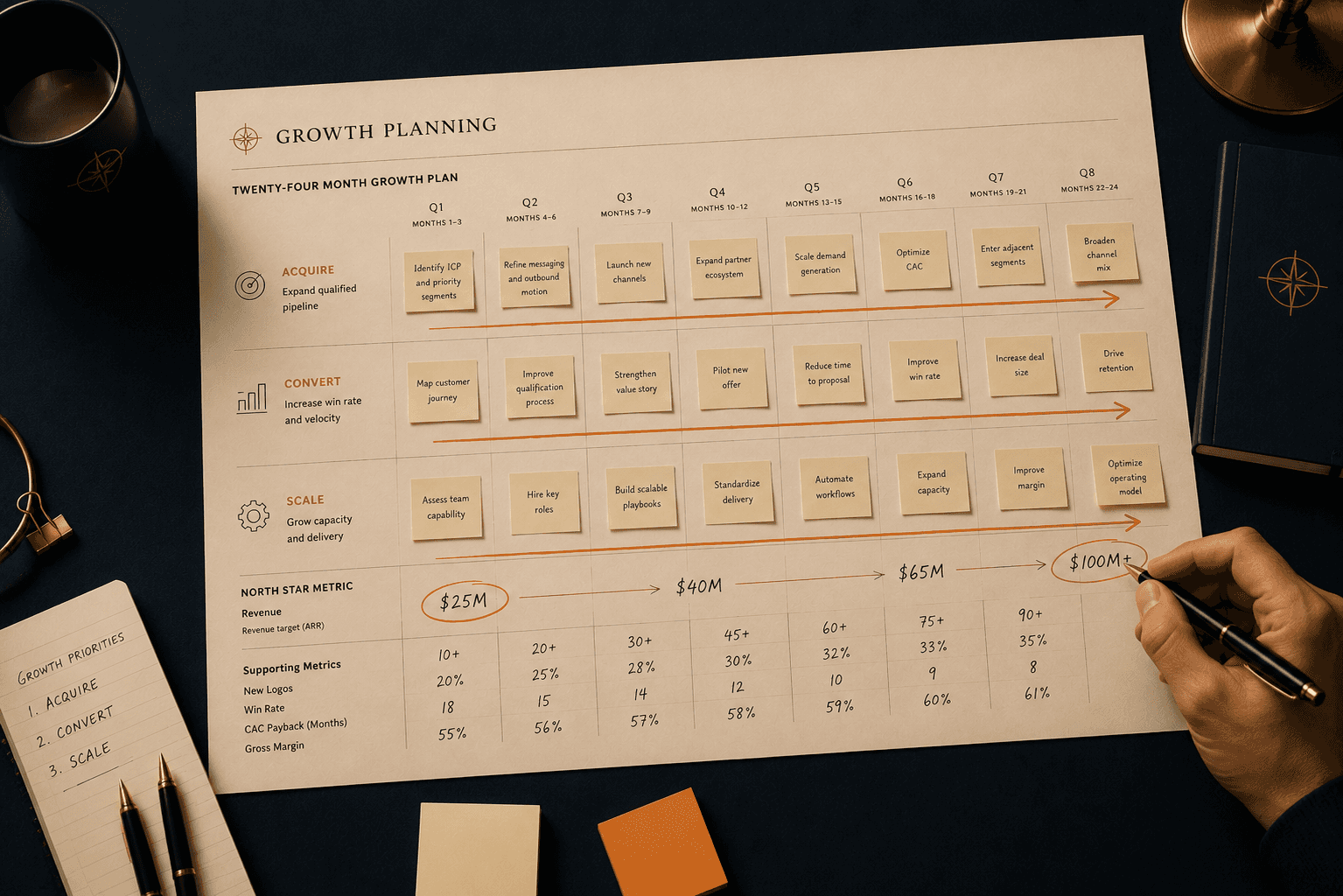
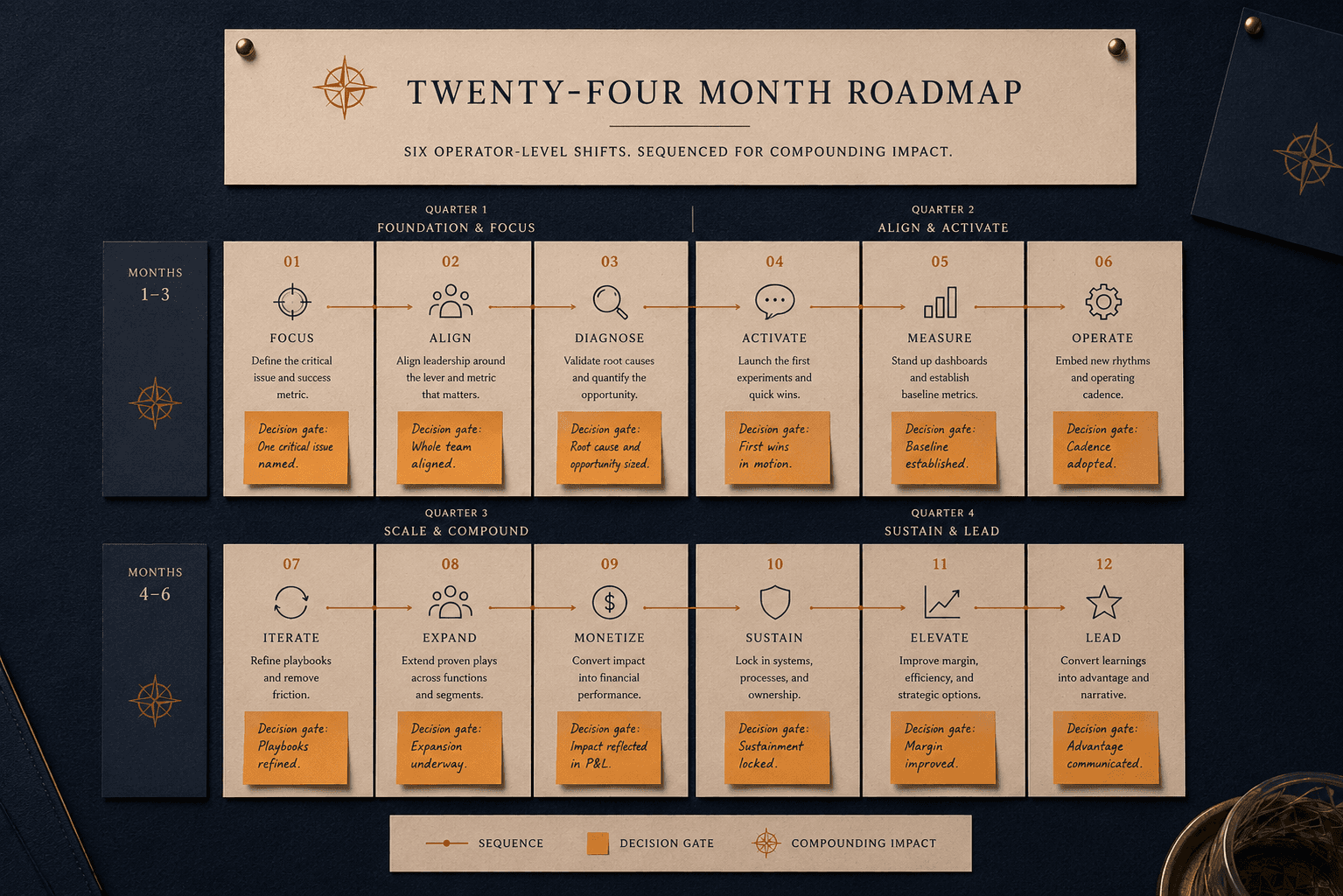
The growth plan fixes that. It is the working roadmap the leadership team runs the next twelve or twenty-four months against. It names the market opportunity the company is actually going for. It names the three or four levers that will get the company there. It sequences those levers across quarters, specifies the metric that decides whether each is working, and routes each lever into the team or partner that carries it.

What you end up with is a decision architecture. Every hiring conversation, every budget call, every agency engagement, and every quarterly review runs against it.
The image featured at the top of the about us page #1

A growth plan is a working roadmap, not an investor narrative in a lighter font.

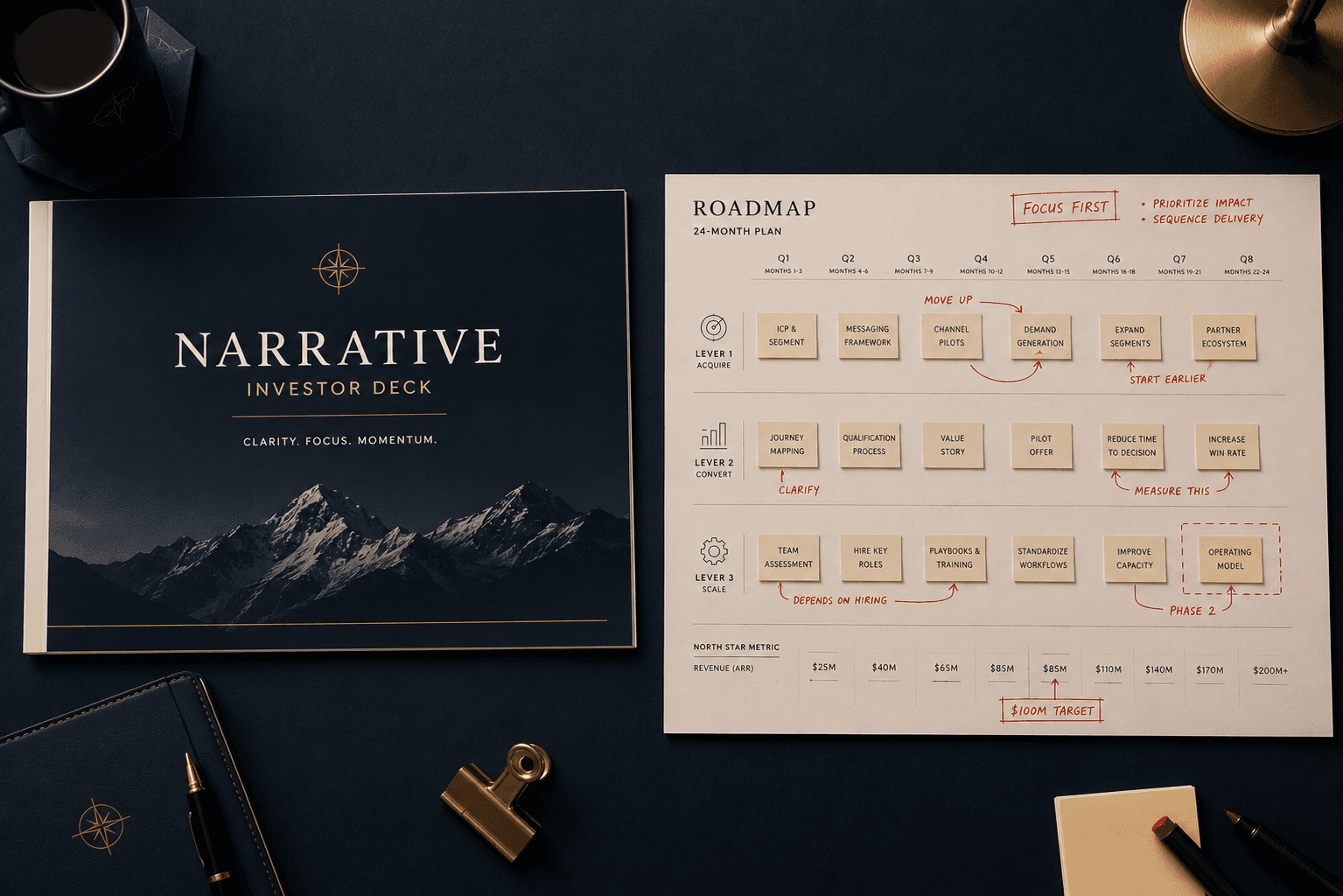
The most common failure mode in growth planning is confusion about what a plan is for. Founders hear the phrase "growth plan" and picture the investor deck. A thirty-page document with a five-year revenue curve and a market size slide with a triangle on it. That document is useful. It is also not a growth plan. It is a narrative. A narrative is something you present. A roadmap is something you run the year from.

A real growth plan reverses the default. It starts by naming the three or four levers the company will actually pull. It forces the trade-off of picking three out of eight and saying out loud what the company will not do this year. It sequences the levers across quarters with dependencies, metric targets, and the team each one routes through. It assumes the world will change, and it builds a quarterly review cadence where the plan gets adjusted on evidence, not on anxiety.
The image featured at the top of the about us page #1

What running without a real plan actually costs

Six quiet leaks when a growth-stage business defers the planning conversation too long.

  1. The team runs parallel experiments instead of compounding ones.

Without a named set of levers, every function picks its own priority. Sales runs outbound. Marketing runs a content push. Product ships a new feature. Ops overhauls the CRM. Twelve months of parallel effort produces six months of progress.

  1. The leadership team fractures around the strategic debate.

Every monthly meeting becomes a rerun of the same argument. Is our next move product or distribution. Should we go upmarket or deeper. Smart operators do not stay in companies where the direction is relitigated every thirty days. The quiet cost is the slow exit of the best people.

  1. Capital conversations lack a defensible story.

A founder walking into a raise without a roadmap is improvising in real time. Investors can feel it. The questions stop being about the plan and start being about the founder's confidence. A defensible plan shifts the conversation and makes capital cheaper.

  1. Opportunity costs compounds quietly.

Every dollar spent on a lever that never gets pulled hard enough to matter is a dollar not spent on the lever that would have worked. The winner in a category is almost never the team that worked harder. It is the team that chose fewer things and pulled them consistently.

  1. Hires get scoped against the month, not against the year.

A salesperson because the pipeline dipped. A marketer because conversion dipped. A product lead because the last feature slipped. Every hire is defensible alone. In aggregate the org looks shaped for the last three quarters of pain, not the next three quarters of opportunity.

  1. The business gets whipsawed by quarterly noise.

Without a shared read on where the bottleneck sits, every leadership meeting relitigates the same debate. Is it sales. Is it marketing. Is it product. The diagnostic replaces opinion loops with a shared source of truth.

  1. The team runs parallel experiments instead of compounding ones.

Without a named set of levers, every function picks its own priority. Sales runs outbound. Marketing runs a content push. Product ships a new feature. Ops overhauls the CRM. Twelve months of parallel effort produces six months of progress.

  1. The leadership team fractures around the strategic debate.

Every monthly meeting becomes a rerun of the same argument. Is our next move product or distribution. Should we go upmarket or deeper. Smart operators do not stay in companies where the direction is relitigated every thirty days. The quiet cost is the slow exit of the best people.

  1. Capital conversations lack a defensible story.

A founder walking into a raise without a roadmap is improvising in real time. Investors can feel it. The questions stop being about the plan and start being about the founder's confidence. A defensible plan shifts the conversation and makes capital cheaper.

  1. Opportunity costs compounds quietly.

Every dollar spent on a lever that never gets pulled hard enough to matter is a dollar not spent on the lever that would have worked. The winner in a category is almost never the team that worked harder. It is the team that chose fewer things and pulled them consistently.

  1. Hires get scoped against the month, not against the year.

A salesperson because the pipeline dipped. A marketer because conversion dipped. A product lead because the last feature slipped. Every hire is defensible alone. In aggregate the org looks shaped for the last three quarters of pain, not the next three quarters of opportunity.

  1. The business gets whipsawed by quarterly noise.

Without a shared read on where the bottleneck sits, every leadership meeting relitigates the same debate. Is it sales. Is it marketing. Is it product. The diagnostic replaces opinion loops with a shared source of truth.

  1. The team runs parallel experiments instead of compounding ones.

Without a named set of levers, every function picks its own priority. Sales runs outbound. Marketing runs a content push. Product ships a new feature. Ops overhauls the CRM. Twelve months of parallel effort produces six months of progress.

  1. Opportunity costs compounds quietly.

Every dollar spent on a lever that never gets pulled hard enough to matter is a dollar not spent on the lever that would have worked. The winner in a category is almost never the team that worked harder. It is the team that chose fewer things and pulled them consistently.

  1. The leadership team fractures around the strategic debate.

Every monthly meeting becomes a rerun of the same argument. Is our next move product or distribution. Should we go upmarket or deeper. Smart operators do not stay in companies where the direction is relitigated every thirty days. The quiet cost is the slow exit of the best people.

  1. Hires get scoped against the month, not against the year.

A salesperson because the pipeline dipped. A marketer because conversion dipped. A product lead because the last feature slipped. Every hire is defensible alone. In aggregate the org looks shaped for the last three quarters of pain, not the next three quarters of opportunity.

  1. Capital conversations lack a defensible story.

A founder walking into a raise without a roadmap is improvising in real time. Investors can feel it. The questions stop being about the plan and start being about the founder's confidence. A defensible plan shifts the conversation and makes capital cheaper.

  1. The business gets whipsawed by quarterly noise.

Without a shared read on where the bottleneck sits, every leadership meeting relitigates the same debate. Is it sales. Is it marketing. Is it product. The diagnostic replaces opinion loops with a shared source of truth.

The image featured at the top of the about us page #1

How we scope the work

Three engagement shapes. Same planning spine, different horizon and rollout depth.

Growth planning runs as its own engagement and also sits downstream of a diagnostic when the leadership team wants the priority fix held accountable through a full twelve or twenty-four month arc. All three shapes produce the same core output: a named market opportunity, three or four growth levers, a quarterly roadmap, metric accountability, and a routing plan into execution. What changes is the horizon, the depth of scenario work, and the length of the operating rhythm we run after delivery.
GP1

Twelve-Month Plan

A six to eight week engagement. A focused twelve-month growth plan for companies that already have the diagnosis done and need the next year sequenced. Three or four levers, quarterly milestones, metric targets, and an execution routing plan. The right shape when the leadership team has conviction about direction and needs the plan that turns conviction into a year of work.

I'm Interested

GP2

Twenty-Four-Month Plan

Most Common

An eight to ten week engagement. The default shape for companies planning a raise, a category move, or a multi-year expansion arc. Deeper scenario work, a longer horizon, and a year-one plus year-two structure. Matches the capital and hiring arcs a serious growth-stage business runs.

I'm Interested

GP3

 Plan and Quarterly Operating Rhythm

A six-month engagement with optional renewal. For companies that want the twenty-four month plan and a structured quarterly operating rhythm that holds the plan accountable through execution. Plan plus ongoing working sessions every quarter so the roadmap stays alive instead of becoming a PDF referenced only when an investor asks. The right shape when execution is strong but strategic discipline has historically slipped across the full year.

I'm Interested

GP1

Twelve-Month Plan

A six to eight week engagement. A focused twelve-month growth plan for companies that already have the diagnosis done and need the next year sequenced. Three or four levers, quarterly milestones, metric targets, and an execution routing plan. The right shape when the leadership team has conviction about direction and needs the plan that turns conviction into a year of work.

I'm Interested

GP2

Twenty-Four-Month Plan

Most Common

An eight to ten week engagement. The default shape for companies planning a raise, a category move, or a multi-year expansion arc. Deeper scenario work, a longer horizon, and a year-one plus year-two structure. Matches the capital and hiring arcs a serious growth-stage business runs.

I'm Interested

GP3

 Plan and Quarterly Operating Rhythm

A six-month engagement with optional renewal. For companies that want the twenty-four month plan and a structured quarterly operating rhythm that holds the plan accountable through execution. Plan plus ongoing working sessions every quarter so the roadmap stays alive instead of becoming a PDF referenced only when an investor asks. The right shape when execution is strong but strategic discipline has historically slipped across the full year.

I'm Interested

GP1

Twelve-Month Plan

A six to eight week engagement. A focused twelve-month growth plan for companies that already have the diagnosis done and need the next year sequenced. Three or four levers, quarterly milestones, metric targets, and an execution routing plan. The right shape when the leadership team has conviction about direction and needs the plan that turns conviction into a year of work.

I'm Interested

GP2

Twenty-Four-Month Plan

Most Common

An eight to ten week engagement. The default shape for companies planning a raise, a category move, or a multi-year expansion arc. Deeper scenario work, a longer horizon, and a year-one plus year-two structure. Matches the capital and hiring arcs a serious growth-stage business runs.

I'm Interested

GP3

 Plan and Quarterly Operating Rhythm

A six-month engagement with optional renewal. For companies that want the twenty-four month plan and a structured quarterly operating rhythm that holds the plan accountable through execution. Plan plus ongoing working sessions every quarter so the roadmap stays alive instead of becoming a PDF referenced only when an investor asks. The right shape when execution is strong but strategic discipline has historically slipped across the full year.

I'm Interested

The image featured at the bottom of the about us page

How the work actually runs. Four phases. You own the call. We do the market work, the scenario work, and the sequencing.

01 / Assess

We pressure-test what the leadership team already believes. A structured assessment across revenue, margin, retention, acquisition, and unit economics. A market opportunity read against the current segment, obvious adjacencies, and the capacity the team has to serve a wider surface. Stakeholder interviews to surface the levers already being considered internally. The phase ends with a shared view of the starting point, almost always slightly different from the view any single leader walked in with.

02 / Map

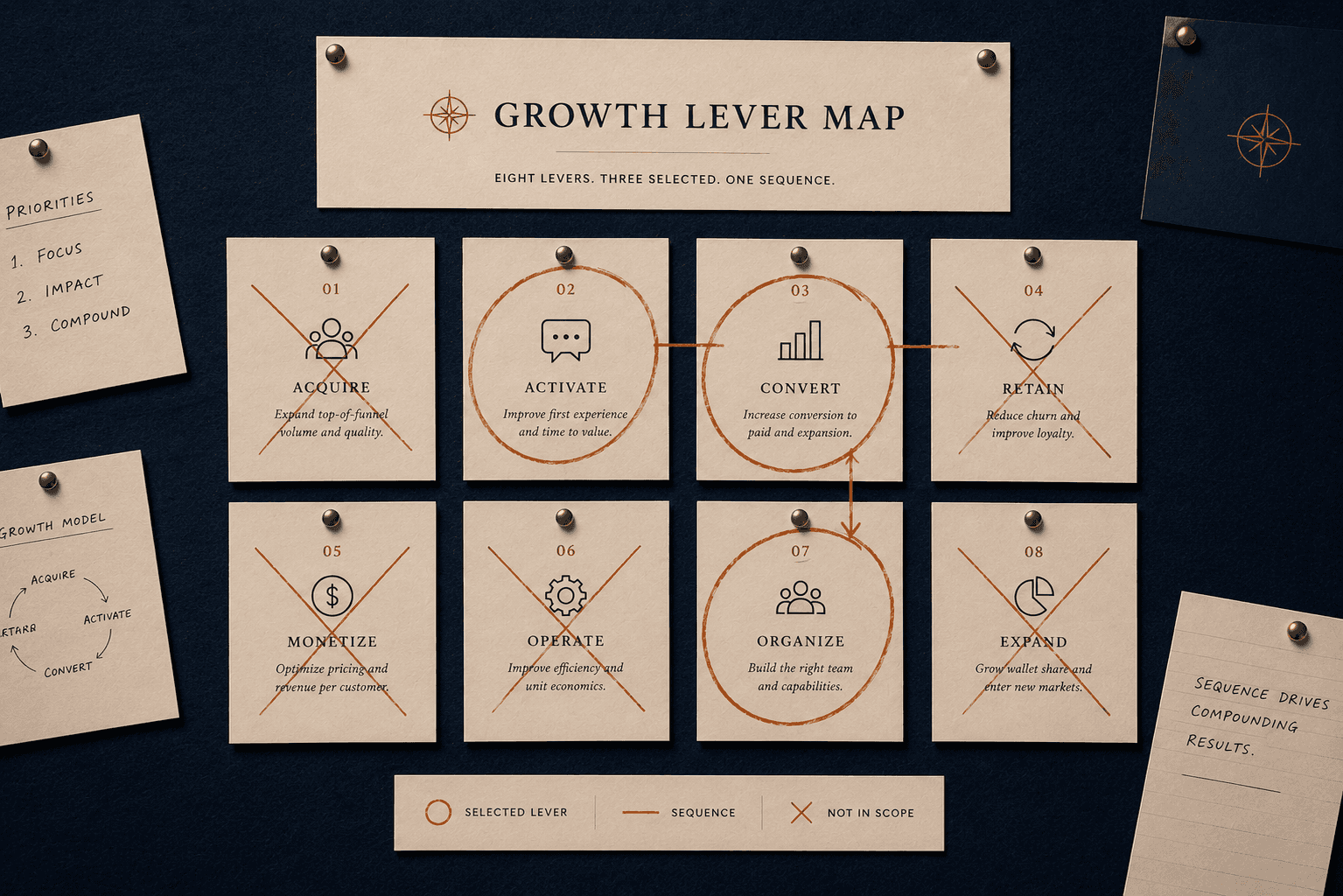
We map the full set of levers the business could plausibly pull over the horizon. Product expansion, distribution, partnerships, vertical moves, geographic expansion, pricing, enterprise motion, retention. Each is scored for addressable impact, cost to pull, time to first signal, and lever-on-lever interaction. The goal is to make sure the team is choosing from a complete map, not from the three levers most visible to the loudest voice.

03 / Sequence

We run the trade-off work. Three or four levers get picked. The rest get explicitly deprioritized so the plan has teeth. Chosen levers get sequenced across quarters with dependencies. Metric targets get set at the lever level. Resource implications get named. Most plans fail here because the team cannot commit to a smaller set. We hold the line.

04 / Activate

A growth plan that stays in the deck is a growth plan that failed. The final phase carries the work into the operating rhythm. A leadership rollout session. A quarterly review structure with clear decision gates. Routing into the partners who carry each lever. A board narrative draft so the plan is investor-legible. A thirty or sixty day post-delivery review. Activation is the product.

The image featured at the top of the about us page #1

Four commitments we refuse to compromise.
A plan is a working document, not a monument.

We design the plan to be edited, not framed. Quarterly reviews are scheduled into the delivery. A plan that cannot be changed is a plan that will be ignored the first time the world moves, which is usually by week four.

Quarterly accountability or nothing.

A plan without a quarterly review cadence drifts out of memory by mid-year and gets relitigated in December when the team reviews the numbers. Every plan we ship has quarterly metric targets, decision gates, and a review cadence built in. The cadence is the part that keeps the plan real.

Levers beat tactics, every time.

We will not deliver a plan built on twenty-seven initiatives. That is not a plan. It is a to-do list in business language. A real plan names three or four levers, specifies what each is supposed to move, and sequences the tactical work underneath them as support.

The plan has to route into execution.

A plan that does not specify who carries each lever does not survive contact with the week. We name the execution owner for each lever, whether that is internal, an agency partner, or a function that has not been hired yet. The plan is not done until every lever has an owner and a first ninety days.

A plan is a working document, not a monument.

We design the plan to be edited, not framed. Quarterly reviews are scheduled into the delivery. A plan that cannot be changed is a plan that will be ignored the first time the world moves, which is usually by week four.

Quarterly accountability or nothing.

A plan without a quarterly review cadence drifts out of memory by mid-year and gets relitigated in December when the team reviews the numbers. Every plan we ship has quarterly metric targets, decision gates, and a review cadence built in. The cadence is the part that keeps the plan real.

Levers beat tactics, every time.

We will not deliver a plan built on twenty-seven initiatives. That is not a plan. It is a to-do list in business language. A real plan names three or four levers, specifies what each is supposed to move, and sequences the tactical work underneath them as support.

The plan has to route into execution.

A plan that does not specify who carries each lever does not survive contact with the week. We name the execution owner for each lever, whether that is internal, an agency partner, or a function that has not been hired yet. The plan is not done until every lever has an owner and a first ninety days.

A plan is a working document, not a monument.

We design the plan to be edited, not framed. Quarterly reviews are scheduled into the delivery. A plan that cannot be changed is a plan that will be ignored the first time the world moves, which is usually by week four.

Levers beat tactics, every time.

We will not deliver a plan built on twenty-seven initiatives. That is not a plan. It is a to-do list in business language. A real plan names three or four levers, specifies what each is supposed to move, and sequences the tactical work underneath them as support.

Quarterly accountability or nothing.

A plan without a quarterly review cadence drifts out of memory by mid-year and gets relitigated in December when the team reviews the numbers. Every plan we ship has quarterly metric targets, decision gates, and a review cadence built in. The cadence is the part that keeps the plan real.

The plan has to route into execution.

A plan that does not specify who carries each lever does not survive contact with the week. We name the execution owner for each lever, whether that is internal, an agency partner, or a function that has not been hired yet. The plan is not done until every lever has an owner and a first ninety days.

The image featured at the top of the about us page #1

Six operator-level shifts across the first two quarters.

The monthly strategic debate quiets down because the levers and the sequencing have already been decided. Hiring gets sharper because each role is scoped against a named lever and the metric it is supposed to move. Budget allocation becomes a question of how much to invest against the named levers, not what to invest in at all. Board conversations compress because the founder can walk through the plan, the quarterly progress, and the lever-level evidence without improvising. Quarterly reviews stop being a rerun of every decision made in the last three months. A team that pulled three levers consistently for eighteen months will almost always out-compound a team that pulled ten levers inconsistently for the same period.

A twelve or twenty-four month roadmap the leadership team can run the year from.
A quarterly review cadence with decision gates that absorb noise without derailing the plan.
Sharper hiring and budget allocation scoped against the named levers.
Three or four named levers with sequencing, dependencies, and metric targets.
A board narrative draft aligned to the plan so investor updates stop being improvised.
Hours of leadership time returned every month because the same strategic debate is no longer being relitigated.
A twelve or twenty-four month roadmap the leadership team can run the year from.
A quarterly review cadence with decision gates that absorb noise without derailing the plan.
Sharper hiring and budget allocation scoped against the named levers.
Three or four named levers with sequencing, dependencies, and metric targets.
A board narrative draft aligned to the plan so investor updates stop being improvised.
Hours of leadership time returned every month because the same strategic debate is no longer being relitigated.
A twelve or twenty-four month roadmap the leadership team can run the year from.
Three or four named levers with sequencing, dependencies, and metric targets.
A quarterly review cadence with decision gates that absorb noise without derailing the plan.
A board narrative draft aligned to the plan so investor updates stop being improvised.
Sharper hiring and budget allocation scoped against the named levers.
Hours of leadership time returned every month because the same strategic debate is no longer being relitigated.
The image featured at the top of the about us page #1

Is growth planning the right engagement?

Strong fit if
  • Your leadership team is strong on execution but keeps relitigating direction every quarter.

  • You are planning a raise, a category move, or a multi-year expansion arc and the narrative needs to hold up.

  • You are scaling headcount and want hiring scoped against named levers rather than against last month's pain.

  • You have a diagnostic or a strong internal read on the priority, and you need the plan that turns it into a year of work.

  • You are willing to pick three or four levers and say out loud what the company will not pursue this year.

Probably not right if
  • You have not diagnosed the priority yet and need the bottleneck named first.

  • You want a plan that includes every growth lever in the category with no trade-offs made.

  • Your leadership team is not willing to commit to a single sequenced plan for at least two quarters.

  • You expect a fifty-page document with an aspirational revenue curve and no accountability attached.

  • You are mid-pivot and the strategic direction will not stabilize for another quarter or two.

What serious buyers ask before scoping a growth plan.

Is a growth plan the same as a business plan?

No. A business plan is a static document written for investors and filed within a week of being finished. A growth plan is a working roadmap the leadership team runs the year from, with quarterly accountability, metric targets, execution routing, and a review cadence built in. Designed to be edited, not preserved.

Do I need a diagnosis before a growth plan?

Sometimes. If the leadership team has strong conviction about the priority, the plan can start from that conviction. If the team has three competing explanations for the same performance pattern, a diagnostic first is almost always the right call. Running a plan on top of an unresolved diagnosis gets rewritten in Q2.

What if the market changes in the middle of the plan?

The plan is built to absorb change. Quarterly review cadence, lever-level scoring, and decision gates are built in. The discipline is reviewing the plan explicitly every quarter, adjusting the levers that stopped working, and protecting the ones still compounding.

Who from our team needs to be in the planning sessions?

Founder or CEO, the head of sales, the head of marketing, the head of product, and whoever owns finance or operations. Usually four to six people total. The customer-facing leaders are the part of the room we will not let go missing.

What if we disagree with the lever recommendation?

That is part of the process. We present lever options alongside the trade-off analysis. The team debates, interrogates, and owns the final call. Our job is to make sure the levers you pick are defensible, sequenced, and scoped against a plausible execution capacity.

Can you help execute the plan after we build it?

Yes. We run the quarterly operating rhythm as part of a GP3 engagement, and we can route specific levers into our execution services where there is fit. If a lever is better served by a different specialist or an internal hire, we say so and route accordingly.

How detailed is the quarterly roadmap?

Detailed enough to guide the operating cadence, light enough to remain legible. Each quarter is specified at the lever level with milestone targets, metric targets, and dependencies. Weekly work is the job of the execution owner.

Can the plan be used in investor conversations?

Yes, and it usually changes the conversation meaningfully. A plan with named levers, quarterly accountability, and metric-level sequencing sends a very different signal than a narrative with aspirational growth curves and no mechanism. We produce a redacted investor version on request.

How often should we revisit the plan?

Quarterly for review, annually for a full re-plan, and any time a major external event shifts the assumption set.

How often should we revisit the plan?

Quarterly for review, annually for a full re-plan, and any time a major external event shifts the assumption set.

When is a growth plan worth doing now versus later?

Now, if the team is relitigating direction every monthly meeting, if you are preparing a raise inside the next two quarters, if you are scaling headcount, or if the last year produced motion without compounding. Later, if the business is mid-pivot and the direction will not stabilize for another quarter, or if the priority bottleneck has not been diagnosed yet.

Our Services

What Our Partners Think

They are highly supportive! I feel completely supported in every part of my marketing. They are a wonderful team of people each bring in their own talents and strengths. They are responsive and eager to please and it's been a pleasure working with them.

Tova, Toronto

Co-owner of FRINGE boutique

What Our Partners Think

They are highly supportive! I feel completely supported in every part of my marketing. They are a wonderful team of people each bring in their own talents and strengths. They are responsive and eager to please and it's been a pleasure working with them.

Tova, Toronto

Co-owner of FRINGE boutique

Let's Work Together

What Our Partners Think

They are highly supportive! I feel completely supported in every part of my marketing. They are a wonderful team of people each bring in their own talents and strengths. They are responsive and eager to please and it's been a pleasure working with them.

Tova, Toronto

Co-owner of FRINGE boutique

What Our Partners Think

They are highly supportive! I feel completely supported in every part of my marketing. They are a wonderful team of people each bring in their own talents and strengths. They are responsive and eager to please and it's been a pleasure working with them.

Tova, Toronto

Co-owner of FRINGE boutique

Let's Work Together