Branding • Brand Strategy • System implementation

Strategy before design. Always. No exceptions.

Most founders think they have a brand problem. A tired logo. A website that is showing its age. A pitch deck that no longer fits. They scope a redesign, spend a mid five-figure budget on polished surfaces, and eighteen months later the sales team is still fighting the same objection. The real problem was never the logo. The real problem was that nobody inside the company could finish the sentence. We are the company that _____. Brand strategy is the work that finishes that sentence. It is the positioning layer that decides what your brand stands for, who it is built for, what it refuses to do, and why a serious buyer should pick you over the three other vendors on their shortlist. Every design decision, every messaging choice, every hiring conversation, every pricing discussion stands on it. This page covers what strategy actually is, how we work through it, what comes out the other side, and why we refuse to open a design file until the strategy is locked.

The image featured at the top of the about us page #1

You cannot design a brand without a strategy to design from.

The fastest way to waste a branding budget is to skip strategy and jump to design. Most agencies are happy to let you. Design is visible. Design is easy to approve. Design is what most founders think they are paying for. So the work runs the wrong way: three concept directions, a round of feedback, a refined logo, a color palette, a typography system, templates, sign off. Everyone claps. Six months later the sales cycle still takes the same number of touches, the pricing conversation still feels like a negotiation from zero, and the new hires still describe the company in seven different ways on their LinkedIn headlines. The design is fine. The brand is not.

Strategy reverses the order. Before any designer opens a file, we answer the questions that decide whether design can even work: Who is this for. What do they already believe? What are they choosing between? What do we want them to think that they do not currently think? What can we credibly claim that the next three competitors on their list cannot. What will we stop saying, stop selling, and stop trying to be. Those answers become the brief that every downstream decision has to answer to. Design becomes fast when strategy is clear, and expensive when strategy is vague. This is not a philosophical point. It is an accounting one.

The image featured at the top of the about us page #1

You lose deals to conviction, not to features. And conviction lives in strategy.

The cost of weak positioning almost never shows up as a line item anyone can point at. It shows up as a slightly longer sales cycle, a slightly higher discount rate, a slightly worse close ratio, and a slightly higher CAC, compounded month after month. None of those get flagged as a brand problem. All of them trace back to the same root: the buyer does not have a sharp reason to choose you. These are the six quiet leaks we see almost every time we audit a serious business that has put off the strategy conversation.
Sales cycles run a meeting or two longer than they should.

Every meeting starts with the rep explaining what the company does. The explanation is slightly different each time. The buyer leaves needing one more call to feel sure. Over a year, that extra call per deal silently steals quarterly pipeline targets and keeps the sales team busy in ways that do not close revenue.

Marketing spend converts worse than it should.

Paid acquisition, outbound, content, and events all depend on a consistent promise. When the promise rewrites itself between channels, attribution gets harder and conversion quietly drags. The agency blames the creative. The creative team blames the offer. The offer blames the market. The actual cause is that nobody locked the positioning six quarters ago.

Internal teams tell three different versions of the company story.

Sales says one thing. Marketing says a second thing. Product says a third. Finance tells investors a fourth. Every one of those versions is technically true, and each one weakens the others. The company sounds bigger and less sure of itself in every meeting it shows up to, which is the opposite of what you want your brand to do.

Pricing slides downhill on every third deal.

Without a defensible position, the easiest negotiating lever is price. Buyers can feel when the seller has no internal story for why the price is what it is. Discounts show up as common requests instead of exception requests. The full-rack cases get quietly rarer while the team convinces itself the market just got more competitive.

Hiring pulls the wrong candidates through the funnel.

Great talent picks employers for the same reason buyers pick vendors: a clear reason to care. When the mission is fuzzy, the resumes arrive fuzzy too. You fill roles with the wrong version of the person you needed, train them for six months, and then rewrite the job when they leave. A clear brand attracts a sharper candidate pool before the recruiter even opens a req.

Strategy debt compounds every quarter you defer it.

Websites get rewritten around the fuzzy version. Sales decks drift further from what the product does. Campaign concepts pile on top of each other without ever resolving what the brand actually promises. The cost of fixing positioning goes up, not down, the longer the company runs without it. The repair bill is paid in design hours, sales hours, leadership hours, and quarters of flat growth.

Sales cycles run a meeting or two longer than they should.

Every meeting starts with the rep explaining what the company does. The explanation is slightly different each time. The buyer leaves needing one more call to feel sure. Over a year, that extra call per deal silently steals quarterly pipeline targets and keeps the sales team busy in ways that do not close revenue.

Marketing spend converts worse than it should.

Paid acquisition, outbound, content, and events all depend on a consistent promise. When the promise rewrites itself between channels, attribution gets harder and conversion quietly drags. The agency blames the creative. The creative team blames the offer. The offer blames the market. The actual cause is that nobody locked the positioning six quarters ago.

Internal teams tell three different versions of the company story.

Sales says one thing. Marketing says a second thing. Product says a third. Finance tells investors a fourth. Every one of those versions is technically true, and each one weakens the others. The company sounds bigger and less sure of itself in every meeting it shows up to, which is the opposite of what you want your brand to do.

Pricing slides downhill on every third deal.

Without a defensible position, the easiest negotiating lever is price. Buyers can feel when the seller has no internal story for why the price is what it is. Discounts show up as common requests instead of exception requests. The full-rack cases get quietly rarer while the team convinces itself the market just got more competitive.

Hiring pulls the wrong candidates through the funnel.

Great talent picks employers for the same reason buyers pick vendors: a clear reason to care. When the mission is fuzzy, the resumes arrive fuzzy too. You fill roles with the wrong version of the person you needed, train them for six months, and then rewrite the job when they leave. A clear brand attracts a sharper candidate pool before the recruiter even opens a req.

Strategy debt compounds every quarter you defer it.

Websites get rewritten around the fuzzy version. Sales decks drift further from what the product does. Campaign concepts pile on top of each other without ever resolving what the brand actually promises. The cost of fixing positioning goes up, not down, the longer the company runs without it. The repair bill is paid in design hours, sales hours, leadership hours, and quarters of flat growth.

Sales cycles run a meeting or two longer than they should.

Every meeting starts with the rep explaining what the company does. The explanation is slightly different each time. The buyer leaves needing one more call to feel sure. Over a year, that extra call per deal silently steals quarterly pipeline targets and keeps the sales team busy in ways that do not close revenue.

Pricing slides downhill on every third deal.

Without a defensible position, the easiest negotiating lever is price. Buyers can feel when the seller has no internal story for why the price is what it is. Discounts show up as common requests instead of exception requests. The full-rack cases get quietly rarer while the team convinces itself the market just got more competitive.

Marketing spend converts worse than it should.

Paid acquisition, outbound, content, and events all depend on a consistent promise. When the promise rewrites itself between channels, attribution gets harder and conversion quietly drags. The agency blames the creative. The creative team blames the offer. The offer blames the market. The actual cause is that nobody locked the positioning six quarters ago.

Hiring pulls the wrong candidates through the funnel.

Great talent picks employers for the same reason buyers pick vendors: a clear reason to care. When the mission is fuzzy, the resumes arrive fuzzy too. You fill roles with the wrong version of the person you needed, train them for six months, and then rewrite the job when they leave. A clear brand attracts a sharper candidate pool before the recruiter even opens a req.

Internal teams tell three different versions of the company story.

Sales says one thing. Marketing says a second thing. Product says a third. Finance tells investors a fourth. Every one of those versions is technically true, and each one weakens the others. The company sounds bigger and less sure of itself in every meeting it shows up to, which is the opposite of what you want your brand to do.

Strategy debt compounds every quarter you defer it.

Websites get rewritten around the fuzzy version. Sales decks drift further from what the product does. Campaign concepts pile on top of each other without ever resolving what the brand actually promises. The cost of fixing positioning goes up, not down, the longer the company runs without it. The repair bill is paid in design hours, sales hours, leadership hours, and quarters of flat growth.

The image featured at the bottom of the about us page

Three engagement shapes. Same positioning spine, different depth and speed.

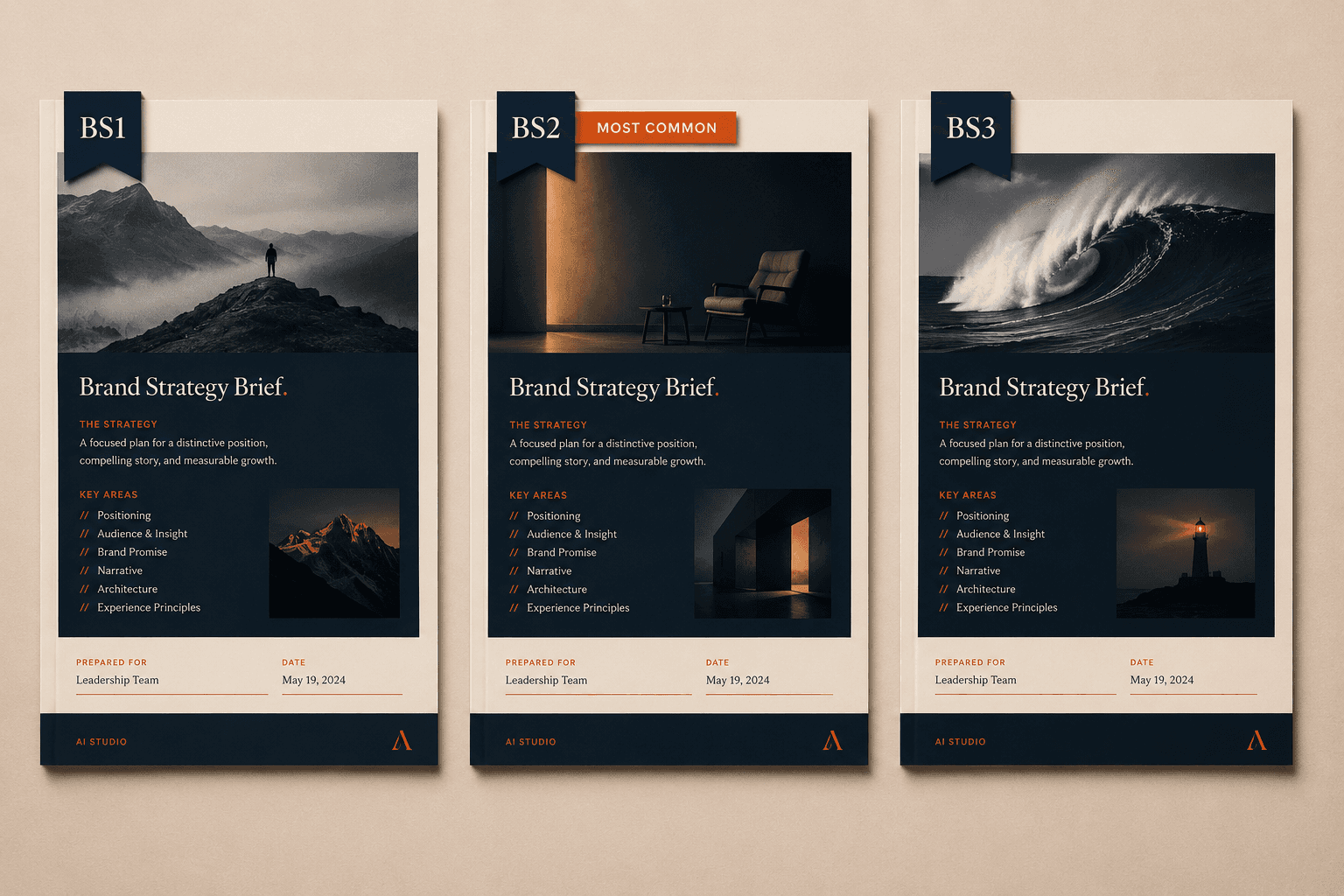
Brand strategy runs as its own engagement and is also the foundation of our B2 and B3 branding tiers. Most clients enter through one of three shapes. The right shape depends on how much the company has outgrown its founder-era story, how many stakeholders need to agree on the answer, and how far downstream we need to carry the strategy before a design or messaging conversation starts. All three shapes produce a defensible positioning framework and a brand brief your team can actually work from. What changes is the depth of discovery, the number of stakeholders in the room, and how much downstream implementation support is included.

BS1

Positioning Sprint

Focused three-week engagement. A tight positioning sprint for founder-led companies with one decision maker and a clear commercial pressure. We audit the market, interview a handful of customers, run one working session, and deliver the positioning spine and brand brief. The fastest way to resolve a specific positioning problem.

What's Included?

BS2

Strategy Foundation

Most Common

Six to eight week engagement. The default shape for growth-stage companies carrying positioning debt across multiple teams. Deeper discovery, a full stakeholder alignment process, a tested positioning framework, and a complete messaging system the sales and marketing teams can use without a translator. The shape most engagements land in.

What's Included?

BS3

Strategy and Rollout

Ten to fourteen week engagement. For companies that need to finish the positioning work and then carry it into the surfaces that matter most: website, sales deck, key campaigns, and internal enablement. Strategy plus supervised rollout across the highest-stakes artifacts so the thinking does not sit in a PDF nobody opens.

What's Included?

BS1

Positioning Sprint

Focused three-week engagement. A tight positioning sprint for founder-led companies with one decision maker and a clear commercial pressure. We audit the market, interview a handful of customers, run one working session, and deliver the positioning spine and brand brief. The fastest way to resolve a specific positioning problem.

What's Included?

BS2

Strategy Foundation

Most Common

Six to eight week engagement. The default shape for growth-stage companies carrying positioning debt across multiple teams. Deeper discovery, a full stakeholder alignment process, a tested positioning framework, and a complete messaging system the sales and marketing teams can use without a translator. The shape most engagements land in.

What's Included?

BS3

Strategy and Rollout

Ten to fourteen week engagement. For companies that need to finish the positioning work and then carry it into the surfaces that matter most: website, sales deck, key campaigns, and internal enablement. Strategy plus supervised rollout across the highest-stakes artifacts so the thinking does not sit in a PDF nobody opens.

What's Included?

BS1

Positioning Sprint

Focused three-week engagement. A tight positioning sprint for founder-led companies with one decision maker and a clear commercial pressure. We audit the market, interview a handful of customers, run one working session, and deliver the positioning spine and brand brief. The fastest way to resolve a specific positioning problem.

What's Included?

BS2

Strategy Foundation

Most Common

Six to eight week engagement. The default shape for growth-stage companies carrying positioning debt across multiple teams. Deeper discovery, a full stakeholder alignment process, a tested positioning framework, and a complete messaging system the sales and marketing teams can use without a translator. The shape most engagements land in.

What's Included?

BS3

Strategy and Rollout

Ten to fourteen week engagement. For companies that need to finish the positioning work and then carry it into the surfaces that matter most: website, sales deck, key campaigns, and internal enablement. Strategy plus supervised rollout across the highest-stakes artifacts so the thinking does not sit in a PDF nobody opens.

What's Included?

The image featured at the top of the about us page #1

Four phases. You own the direction. We do the research, the synthesis, and the hard trade-offs.

01 Audit

We map the category as it actually exists, not as the pitch deck describes it. Top competitors and adjacent ones. Current positioning across your surfaces. Customer interview bank with win, loss, and churn accounts. Internal stakeholder interviews across leadership, sales, and marketing. The output is a diagnosis document: what the market believes today, what your current position is whether you meant it or not, and where the room to own a defensible angle actually sits.

02 Frame

We shape the positioning work into options, not opinions. Typically two viable directions, each backed by a category frame, a target, a promise, and a proof architecture. Each direction carries trade-offs and implications for what the company must stop doing to own it. You and the leadership team pressure-test the options in a working session. You pick one. We do not outsource the call.

03 Build

We turn the chosen direction into a working system. Positioning statement, category frame, value pillars, messaging hierarchy, proof architecture, and the sales and marketing adaptations that make it usable. A brand brief that gives your downstream teams a clear standard to design, write, and sell against. An internal narrative your leadership team can repeat in their sleep.

04 Roll out

Strategy that sits in a PDF is strategy that fails. The final phase carries the work into the surfaces and conversations where the business actually runs. A rollout session with your commercial team, a review of the first applications on site and deck, and a sixty-day check-in to audit what is landing and what is being quietly ignored. The positioning gets sharper the first three times it is used in a live deal. We stay close for that window.

The image featured at the top of the about us page #1

Four commitments we refuse to compromise.

Strategy is built from evidence, not from opinion.

We will not hand you a positioning document written out of a workshop on sticky notes. Every claim in the framework traces back to customer interviews, competitive artifacts, and category data we can show you. The test of a positioning choice is whether it holds up against what buyers actually do, not against what the leadership team finds inspiring in a meeting.

Good strategy names what the company refuses to do.

Every real positioning choice is also a refusal. What you will not sell. Who you will not serve. What category you will not compete in. The refusal is where the trade-off sits, and trade-offs are where brand strength comes from. We will name the refusals out loud before the engagement ends, and we will make sure the leadership team has signed off on them.

A position must be defensible, not just differentiated.

Being different is easy. Being defensibly different is the work. If a competitor could claim the same position tomorrow and make it stick, it is not a position. We push hard on what only you can credibly own, which usually means making the scope narrower and the claim sharper than the leadership team was initially comfortable with.

Strategy that is not usable is strategy that fails.

A framework your sales team cannot hold in their head, a messaging hierarchy your marketing team has to translate every time, or a brief your designers politely ignore are all variations of the same failure. We write strategy to be operational. If the team cannot use it within thirty days of delivery, we did not finish the job.

Strategy is built from evidence, not from opinion.

We will not hand you a positioning document written out of a workshop on sticky notes. Every claim in the framework traces back to customer interviews, competitive artifacts, and category data we can show you. The test of a positioning choice is whether it holds up against what buyers actually do, not against what the leadership team finds inspiring in a meeting.

Good strategy names what the company refuses to do.

Every real positioning choice is also a refusal. What you will not sell. Who you will not serve. What category you will not compete in. The refusal is where the trade-off sits, and trade-offs are where brand strength comes from. We will name the refusals out loud before the engagement ends, and we will make sure the leadership team has signed off on them.

A position must be defensible, not just differentiated.

Being different is easy. Being defensibly different is the work. If a competitor could claim the same position tomorrow and make it stick, it is not a position. We push hard on what only you can credibly own, which usually means making the scope narrower and the claim sharper than the leadership team was initially comfortable with.

Strategy that is not usable is strategy that fails.

A framework your sales team cannot hold in their head, a messaging hierarchy your marketing team has to translate every time, or a brief your designers politely ignore are all variations of the same failure. We write strategy to be operational. If the team cannot use it within thirty days of delivery, we did not finish the job.

Strategy is built from evidence, not from opinion.

We will not hand you a positioning document written out of a workshop on sticky notes. Every claim in the framework traces back to customer interviews, competitive artifacts, and category data we can show you. The test of a positioning choice is whether it holds up against what buyers actually do, not against what the leadership team finds inspiring in a meeting.

A position must be defensible, not just differentiated.

Being different is easy. Being defensibly different is the work. If a competitor could claim the same position tomorrow and make it stick, it is not a position. We push hard on what only you can credibly own, which usually means making the scope narrower and the claim sharper than the leadership team was initially comfortable with.

Good strategy names what the company refuses to do.

Every real positioning choice is also a refusal. What you will not sell. Who you will not serve. What category you will not compete in. The refusal is where the trade-off sits, and trade-offs are where brand strength comes from. We will name the refusals out loud before the engagement ends, and we will make sure the leadership team has signed off on them.

Strategy that is not usable is strategy that fails.

A framework your sales team cannot hold in their head, a messaging hierarchy your marketing team has to translate every time, or a brief your designers politely ignore are all variations of the same failure. We write strategy to be operational. If the team cannot use it within thirty days of delivery, we did not finish the job.

The image featured at the top of the about us page #1

The operator-level shift a strong positioning foundation produces.

Companies that finish the strategy work and carry it into their surfaces tend to see the same pattern inside ninety days. The story starts telling itself more consistently in meetings. Sales cycles compress a meeting or two at the front end because the buyer arrives with a clearer mental model of what this company is. Pricing conversations get easier because there is an internal story for the price. Marketing concepts stop having the same debate about tone and angle every sprint. Hiring pitches sharpen. Leadership meetings stop relitigating what the company is. The downstream effect is that design, website, campaign, and sales decisions get cheaper because they now have a brief to answer to. The brand stops costing time and starts returning it.

A positioning statement the leadership team can repeat without looking at a document.
A brand brief that gives downstream design and copy decisions a clear standard.
Fewer pricing concessions because the price has an internal story that holds up.
A messaging hierarchy the sales and marketing teams use without rewriting it every month.
Shorter sales cycles and fewer back-to-basics meetings at the start of every deal.
Less positioning debate inside the team, which returns hours of leadership time every month.
A positioning statement the leadership team can repeat without looking at a document.
A brand brief that gives downstream design and copy decisions a clear standard.
Fewer pricing concessions because the price has an internal story that holds up.
A messaging hierarchy the sales and marketing teams use without rewriting it every month.
Shorter sales cycles and fewer back-to-basics meetings at the start of every deal.
Less positioning debate inside the team, which returns hours of leadership time every month.
A positioning statement the leadership team can repeat without looking at a document.
A messaging hierarchy the sales and marketing teams use without rewriting it every month.
A brand brief that gives downstream design and copy decisions a clear standard.
Shorter sales cycles and fewer back-to-basics meetings at the start of every deal.
Fewer pricing concessions because the price has an internal story that holds up.
Less positioning debate inside the team, which returns hours of leadership time every month.
The image featured at the top of the about us page #1

Is this the right engagement?

Work with us if
  • Your company has outgrown its founder-era story and nobody inside the building can agree on the new one.

  • Your sales team is closing deals on effort rather than on conviction, and your close rates have flattened.

  • You are repositioning to enter a new market, defend against a new competitor, or support a pricing move.

  • You are about to raise, sell, or go through a governance event and the narrative has to hold up to scrutiny.

  • Your leadership team is willing to make the trade-offs a real positioning choice requires.

Skip this engagement if
  • You are pre-revenue and the money should be going into distribution rather than into strategy right now.

  • You want a two-hour workshop and a deck, not a framework the team can actually use.

  • The leadership team is not willing to name what the company will stop doing to own a sharper position.

  • You are looking for an outside team to arrive at a positioning the founder has already quietly decided on.

  • Your category is shifting fast enough that any positioning built today will need to be rebuilt in a quarter.

What serious buyers usually ask.

How long does a real brand strategy engagement take?

Between three and fourteen weeks, depending on the shape. A BS1 positioning sprint runs three weeks. A BS2 strategy foundation runs six to eight weeks. A BS3 strategy plus rollout runs ten to fourteen weeks. Anything shorter than three weeks is a workshop, not a strategy engagement, and any vendor promising to finish real positioning work in a week is selling a deck rather than a decision.

We already did a branding exercise two years ago. Do we need to redo it?

Maybe. The first diagnosis question in any of our engagements is whether the existing positioning is still defensible or whether the company has quietly outgrown it. Sometimes the answer is a refinement and a stronger rollout. Sometimes the answer is a repositioning. We will tell you which before you commit to scope, and we will not manufacture a bigger project than the business needs.

Is this only for startups or early-stage companies?

No. The companies that get the most value are often between five and fifty million in revenue, where the founder-era story stopped working and the leadership team has started telling the story differently across functions. Scaled companies usually carry the most positioning debt because nobody has had the authority or the air cover to resolve it.

What happens if we disagree with the direction you recommend?

That is part of the process, and we build space for it. We present two viable directions with their trade-offs, and we make a recommendation. The leadership team debates, interrogates, and ultimately owns the call. Our job is to make sure whatever direction you pick is defensible, evidence-backed, and operationally usable. Your job is to commit to it.

Do we need a visual rebrand after the strategy work?

Not always, and not by default. A surprising number of strategy engagements conclude that the visual identity is fine and the problem was never design. Some conclude the visual identity needs refinement. Some conclude a full rebrand is overdue. We answer the visual question after the strategy work is done, not before, and not as a way to pad the engagement.

Who from our team needs to be in the room?

Founders or CEO, the head of sales, the head of marketing, and anyone making recurring customer-facing promises. Usually three to five people total. Large groups dilute the work. Very small groups miss the customer-facing perspective. If the right decision makers cannot commit their time, we will tell you the engagement is not ready to start yet.

How do you handle the customer interview piece?

We run the interviews ourselves, typically eight to twelve across current customers, churned accounts, and target prospects. We record, transcribe, and synthesize. We will not outsource the interviews to an agency junior. The interview work is where most of the strategy actually gets resolved, which is why it is not a step we hand off.

What does pricing look like, and what budget does a real engagement sit in?

Pricing is scoped against shape, stakeholder count, and rollout depth. We cover the budget range on the discovery call so neither side wastes a proposal cycle. As a rough shape, a serious strategy engagement is a mid five-figure commitment, not a light retainer. Companies trying to run real positioning work on a token budget tend to end up with a deck that does not change anything downstream.

What does a strong engagement usually turn into next?

The most common paths are a website rebuild against the new messaging, a sales enablement sprint, a visual identity refresh, or a campaign concept build. Sometimes all four over twelve months. The engagement scope always treats strategy as the upstream piece. We do not force downstream work, and we do not start it until the strategy is locked.

How much involvement does the leadership team need to give during the engagement?

Expect six to ten hours of leadership time spread across the engagement. That includes two or three working sessions, interview availability, and reviewing drafts. Less time than that means the strategy will be weak. More time than that usually means the scope has crept beyond positioning and into operations. We will hold the line on that balance.

What tends to make strategy engagements go well, and what tends to slow them down?

Engagements go well when the leadership team is willing to name refusals, the founder is not running private parallel positioning work during the engagement, and the team treats the output as a framework to use rather than a PDF to archive. Engagements slow down when the founder keeps relitigating decisions the team already agreed to, when the customer interview list is thin, or when an external event like a fundraise or a board change midway shifts the scope. We will flag those risks early and adapt honestly when they appear.

Our Services
What Our Partners Think

They are highly supportive! I feel completely supported in every part of my marketing. They are a wonderful team of people each bring in their own talents and strengths. They are responsive and eager to please and it's been a pleasure working with them.

Tova, Toronto

Co-owner of FRINGE boutique

What Our Partners Think

They are highly supportive! I feel completely supported in every part of my marketing. They are a wonderful team of people each bring in their own talents and strengths. They are responsive and eager to please and it's been a pleasure working with them.

Tova, Toronto

Co-owner of FRINGE boutique

Let's Work Together

What Our Partners Think

They are highly supportive! I feel completely supported in every part of my marketing. They are a wonderful team of people each bring in their own talents and strengths. They are responsive and eager to please and it's been a pleasure working with them.

Tova, Toronto

Co-owner of FRINGE boutique

What Our Partners Think

They are highly supportive! I feel completely supported in every part of my marketing. They are a wonderful team of people each bring in their own talents and strengths. They are responsive and eager to please and it's been a pleasure working with them.

Tova, Toronto

Co-owner of FRINGE boutique

Let's Work Together