AI Implementation • Workflows • Operations

You do not need more AI. You need AI that actually runs inside the work your team is already doing.

Most AI initiatives stall in the same place. The tools get bought. The demo looks impressive in a boardroom. A small group of enthusiasts use it for a fortnight. Then the work quietly reverts, because the tool was never wired into how the team actually operates and nobody is accountable for whether it is saving time or quietly making things worse. Our job is to stop that pattern from repeating in your business. We diagnose where AI can realistically compound and where it cannot. We run tight, measurable pilots. We only move to production when the numbers say it is worth the change. Implementation is not a technical problem. It is a workflow problem wearing a software costume, and it rewards serious thinking in exactly the places most vendors skip.
The image featured at the top of the about us page #1

You did not buy the wrong tool. You skipped the workflow redesign.

AI is not software. Software replaces a click with a different click. AI replaces a judgement with a different judgement, and that shift forces you to rethink who decides what, what good looks like, and how mistakes are caught before they reach a customer. Teams that treat AI as a plug-in keep the old workflow and bolt a tool onto the side. The tool generates output that the workflow was never designed to receive. Content teams end up editing more than they saved. Sales teams get drafts they would not send. Operations teams get summaries nobody can act on.

The implementations that work look different. They begin with a workflow that has been explicitly redesigned to use AI output, with review gates, ownership, and measurement built in. The tool is the last decision, not the first. That is not a technical preference. It is the only way the numbers land on the right side of the ledger, and the only way your team ends up trusting what you ship.
The image featured at the top of the about us page #1

Badly deployed AI damages the parts of the business you cannot afford to lose.

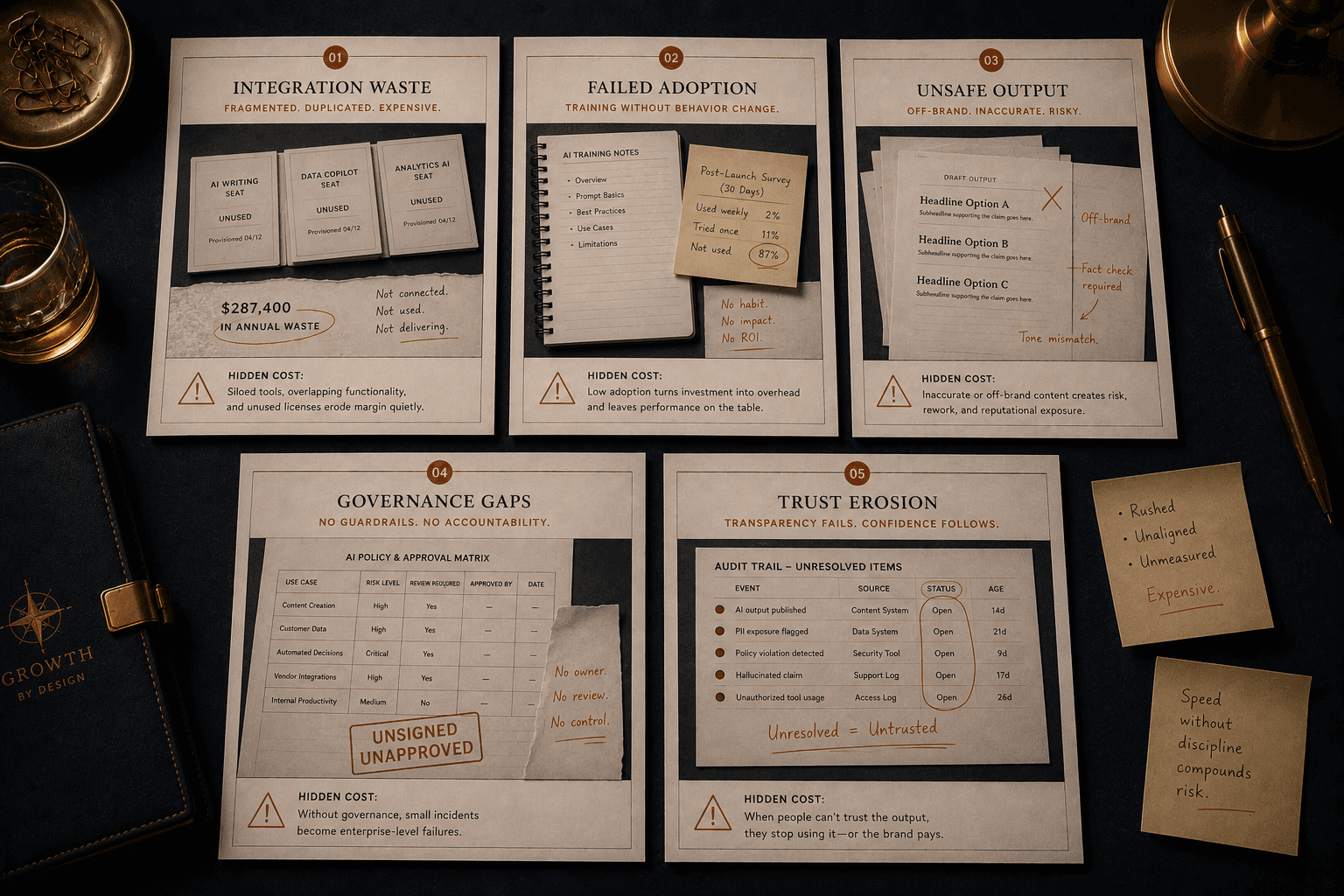
The headline risk of AI is hallucination. The real risk is slower and harder to recover from. Teams that deploy AI without guardrails drift on brand voice, accidentally promise things to customers the business cannot deliver, generate reports leadership starts treating as ground truth, and lose internal trust in the exact tools you want them to adopt next. Every one of those problems can be designed out. Most of them cannot be recovered from once they are in motion. The fix is boring and structural. It is not a better model.
Integration cost

Tools that do not wire into the existing stack become dead weight. A year later, you are still paying for seats nobody uses, and the team is quietly more cynical about the next pitch.

Output cost

Hallucinated facts, off-brand voice, and generic drafts end up in front of customers. The damage lives in trust, not just in a metric. Brand repair is far more expensive than brand protection.

Adoption cost

Your team rejects AI that makes their work harder or feels unsafe. Once a team has abandoned a tool, they are twice as hard to move the next time. Trust compounds in both directions.

Governance cost

Without an audit trail and review gates, AI output becomes legally and reputationally hard to defend. Your in-house counsel will not thank you, and neither will your insurers.

Integration cost

Tools that do not wire into the existing stack become dead weight. A year later, you are still paying for seats nobody uses, and the team is quietly more cynical about the next pitch.

Adoption cost

Your team rejects AI that makes their work harder or feels unsafe. Once a team has abandoned a tool, they are twice as hard to move the next time. Trust compounds in both directions.

Output cost

Hallucinated facts, off-brand voice, and generic drafts end up in front of customers. The damage lives in trust, not just in a metric. Brand repair is far more expensive than brand protection.

Governance cost

Without an audit trail and review gates, AI output becomes legally and reputationally hard to defend. Your in-house counsel will not thank you, and neither will your insurers.

Integration cost

Tools that do not wire into the existing stack become dead weight. A year later, you are still paying for seats nobody uses, and the team is quietly more cynical about the next pitch.

Output cost

Hallucinated facts, off-brand voice, and generic drafts end up in front of customers. The damage lives in trust, not just in a metric. Brand repair is far more expensive than brand protection.

Adoption cost

Your team rejects AI that makes their work harder or feels unsafe. Once a team has abandoned a tool, they are twice as hard to move the next time. Trust compounds in both directions.

Governance cost

Without an audit trail and review gates, AI output becomes legally and reputationally hard to defend. Your in-house counsel will not thank you, and neither will your insurers.

The image featured at the top of the about us page #1

Three stages. Each one proves itself before the next one is scoped.

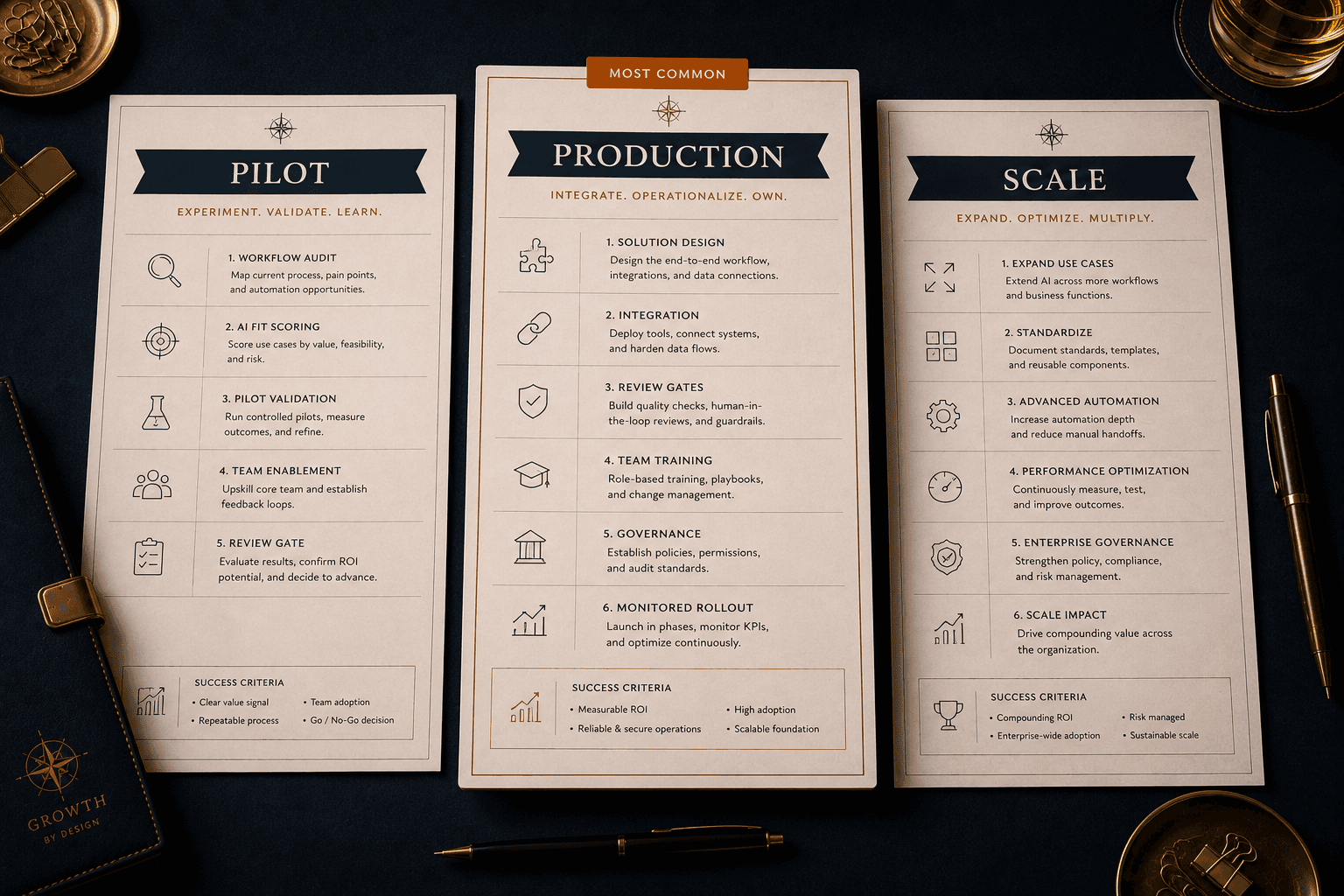
We scope AI implementation in three stages, because the right level of investment is almost never clear at the start. Most teams should not leap straight to production. Most teams should also not get stuck in pilot forever. The stages are designed so each produces a clear decision to continue, adjust, or stop. That is the only honest way to do this work. The commitment grows in line with the evidence, not in line with a sales conversation.
PILOT

Exploration phase

Discovery driven

A controlled, measured test inside one business unit. The purpose is to prove or disprove AI fit before scope is expanded, and to leave you with honest data either way.

  • Workflow audit across one business unit

  • AI fit scoring on a shortlist of candidate use cases

  • One focused pilot running four to six weeks

  • Baseline metrics and success definition agreed up front

  • Team training on the specific tool and process change

  • Written go or no-go decision document at the end of the pilot

I'm Interested

PRODUCTION

Core implementation

Most Common

Full deployment

A primary workflow moved fully onto AI, with integration, guardrails, training, and measurement. The stage most serious businesses should aim for.

  • Full workflow documentation and redesign

  • Multi-tool integration across ChatGPT, Claude, Zapier, CRM, and analytics

  • Custom prompts, review gates, and output validation

  • Team training and living internal documentation

  • Thirty to sixty days of monitoring and tuning after go-live

  • Quality assurance gates and explicit exception handling

I'm Interested

SCALE

Enterprise Rollout

Multi-team deployment with governance

The system expanded across multiple teams, workflows, or business units, with shared standards, governance, and reporting. Right for leadership teams ready to treat AI as a board-level capability.

  • Everything in Production

  • Multi-team rollout and change coordination

  • Governance framework and internal AI policy

  • Custom integrations and shared APIs across units

  • Advanced monitoring, anomaly detection, and usage analytics

  • Leadership reporting and quarterly governance reviews

I'm Interested

PILOT

Exploration phase

Discovery driven

A controlled, measured test inside one business unit. The purpose is to prove or disprove AI fit before scope is expanded, and to leave you with honest data either way.

  • Workflow audit across one business unit

  • AI fit scoring on a shortlist of candidate use cases

  • One focused pilot running four to six weeks

  • Baseline metrics and success definition agreed up front

  • Team training on the specific tool and process change

  • Written go or no-go decision document at the end of the pilot

I'm Interested

PRODUCTION

Core implementation

Most Common

Full deployment

A primary workflow moved fully onto AI, with integration, guardrails, training, and measurement. The stage most serious businesses should aim for.

  • Full workflow documentation and redesign

  • Multi-tool integration across ChatGPT, Claude, Zapier, CRM, and analytics

  • Custom prompts, review gates, and output validation

  • Team training and living internal documentation

  • Thirty to sixty days of monitoring and tuning after go-live

  • Quality assurance gates and explicit exception handling

I'm Interested

SCALE

Enterprise Rollout

Multi-team deployment with governance

The system expanded across multiple teams, workflows, or business units, with shared standards, governance, and reporting. Right for leadership teams ready to treat AI as a board-level capability.

  • Everything in Production

  • Multi-team rollout and change coordination

  • Governance framework and internal AI policy

  • Custom integrations and shared APIs across units

  • Advanced monitoring, anomaly detection, and usage analytics

  • Leadership reporting and quarterly governance reviews

I'm Interested

PILOT

Exploration phase

Discovery driven

A controlled, measured test inside one business unit. The purpose is to prove or disprove AI fit before scope is expanded, and to leave you with honest data either way.

  • Workflow audit across one business unit

  • AI fit scoring on a shortlist of candidate use cases

  • One focused pilot running four to six weeks

  • Baseline metrics and success definition agreed up front

  • Team training on the specific tool and process change

  • Written go or no-go decision document at the end of the pilot

I'm Interested

PRODUCTION

Core implementation

Most Common

Full deployment

A primary workflow moved fully onto AI, with integration, guardrails, training, and measurement. The stage most serious businesses should aim for.

  • Full workflow documentation and redesign

  • Multi-tool integration across ChatGPT, Claude, Zapier, CRM, and analytics

  • Custom prompts, review gates, and output validation

  • Team training and living internal documentation

  • Thirty to sixty days of monitoring and tuning after go-live

  • Quality assurance gates and explicit exception handling

I'm Interested

SCALE

Enterprise Rollout

Multi-team deployment with governance

The system expanded across multiple teams, workflows, or business units, with shared standards, governance, and reporting. Right for leadership teams ready to treat AI as a board-level capability.

  • Everything in Production

  • Multi-team rollout and change coordination

  • Governance framework and internal AI policy

  • Custom integrations and shared APIs across units

  • Advanced monitoring, anomaly detection, and usage analytics

  • Leadership reporting and quarterly governance reviews

I'm Interested

The image featured at the bottom of the about us page

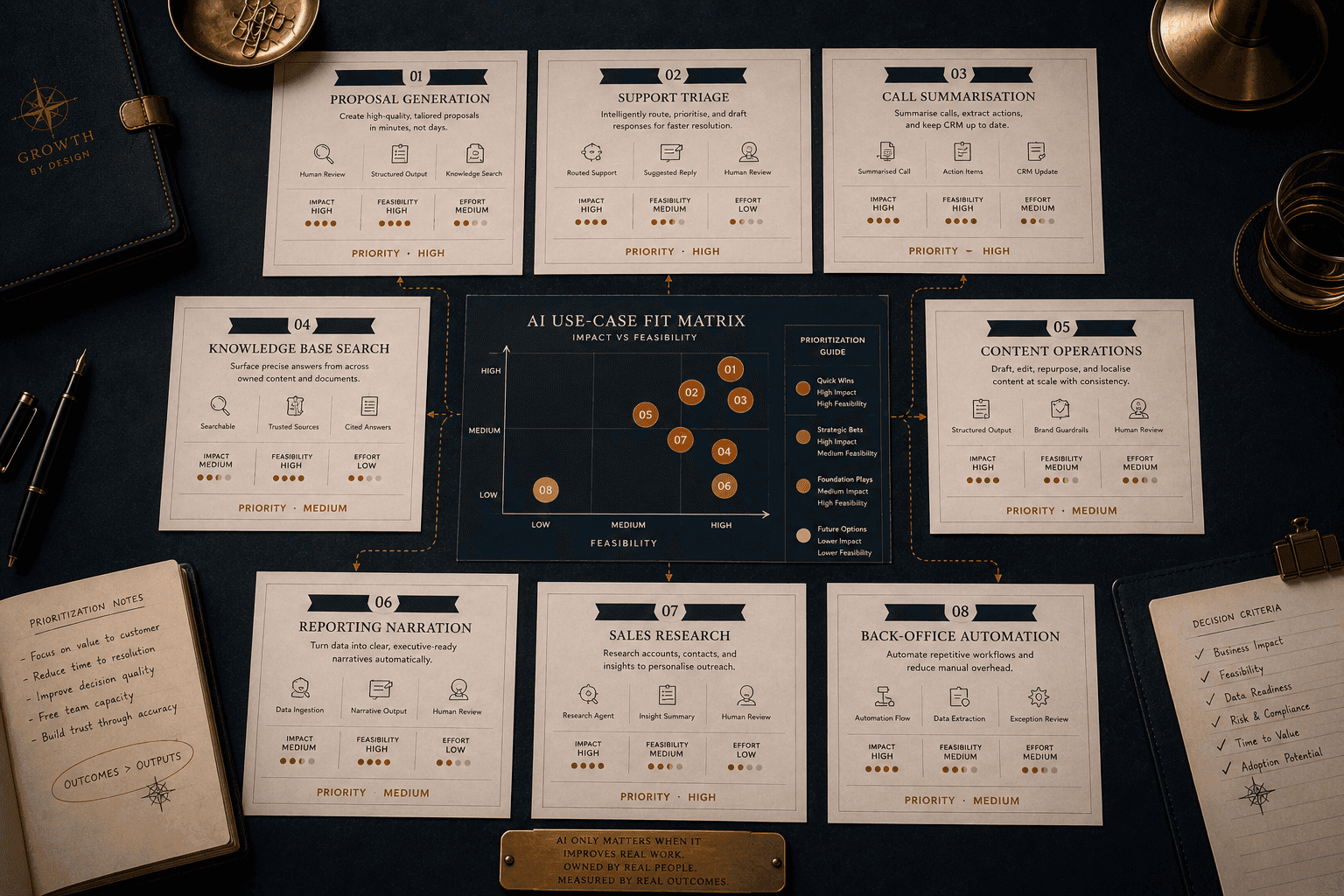
The workflows that tend to pay back fastest.

These are not the only places AI can help. They are the places where we most often see real commercial impact inside ninety days, across the kinds of service, B2B, and operations-heavy businesses we work with. If you recognise three or more of these, the honest answer is that a Pilot is likely worth it.
Proposal and quote generation

Structured input, structured output, with a human review gate. Time to first draft drops from hours to minutes. Margin drift drops with it because the pricing logic lives in the system, not in the memory of whichever rep wrote the last good proposal.

Meeting and call summarisation

Clean, searchable summaries of every sales call, support call, or internal meeting, with action items and follow-up drafts ready for a human to edit and send.

Content operations

AI-assisted drafting with a brand-voice layer and an editorial gate. The goal is a shorter, better edit, not an unedited publish. Volume without a drop in voice quality.

Sales research and outbound prep

Account briefs generated from public signals and internal data, delivered to a rep before a call instead of half-finished in a separate doc nobody opens.

Customer support triage

AI drafts the first response and routes anything uncertain to a human. Speed of first response improves without offloading judgement to the model on anything that matters.

Knowledge base and internal search

A grounded, policy-aware internal assistant trained on your documentation. New hires get productive faster. Institutional memory stops walking out the door when a senior person leaves.

Reporting and analytics narration

Structured data summarised into a narrative humans actually read. Done carefully, it turns a dashboard nobody checks into a weekly read leadership starts to trust.

Operations and back-office automation

Structured document intake, invoice extraction, and routine back-office classification, with a human-in-the-loop for anything low-confidence or out of policy.

Proposal and quote generation

Structured input, structured output, with a human review gate. Time to first draft drops from hours to minutes. Margin drift drops with it because the pricing logic lives in the system, not in the memory of whichever rep wrote the last good proposal.

Customer support triage

AI drafts the first response and routes anything uncertain to a human. Speed of first response improves without offloading judgement to the model on anything that matters.

Meeting and call summarisation

Clean, searchable summaries of every sales call, support call, or internal meeting, with action items and follow-up drafts ready for a human to edit and send.

Knowledge base and internal search

A grounded, policy-aware internal assistant trained on your documentation. New hires get productive faster. Institutional memory stops walking out the door when a senior person leaves.

Content operations

AI-assisted drafting with a brand-voice layer and an editorial gate. The goal is a shorter, better edit, not an unedited publish. Volume without a drop in voice quality.

Reporting and analytics narration

Structured data summarised into a narrative humans actually read. Done carefully, it turns a dashboard nobody checks into a weekly read leadership starts to trust.

Sales research and outbound prep

Account briefs generated from public signals and internal data, delivered to a rep before a call instead of half-finished in a separate doc nobody opens.

Operations and back-office automation

Structured document intake, invoice extraction, and routine back-office classification, with a human-in-the-loop for anything low-confidence or out of policy.

Proposal and quote generation

Structured input, structured output, with a human review gate. Time to first draft drops from hours to minutes. Margin drift drops with it because the pricing logic lives in the system, not in the memory of whichever rep wrote the last good proposal.

Meeting and call summarisation

Clean, searchable summaries of every sales call, support call, or internal meeting, with action items and follow-up drafts ready for a human to edit and send.

Content operations

AI-assisted drafting with a brand-voice layer and an editorial gate. The goal is a shorter, better edit, not an unedited publish. Volume without a drop in voice quality.

Sales research and outbound prep

Account briefs generated from public signals and internal data, delivered to a rep before a call instead of half-finished in a separate doc nobody opens.

Customer support triage

AI drafts the first response and routes anything uncertain to a human. Speed of first response improves without offloading judgement to the model on anything that matters.

Knowledge base and internal search

A grounded, policy-aware internal assistant trained on your documentation. New hires get productive faster. Institutional memory stops walking out the door when a senior person leaves.

Reporting and analytics narration

Structured data summarised into a narrative humans actually read. Done carefully, it turns a dashboard nobody checks into a weekly read leadership starts to trust.

Operations and back-office automation

Structured document intake, invoice extraction, and routine back-office classification, with a human-in-the-loop for anything low-confidence or out of policy.

The image featured at the top of the about us page #1

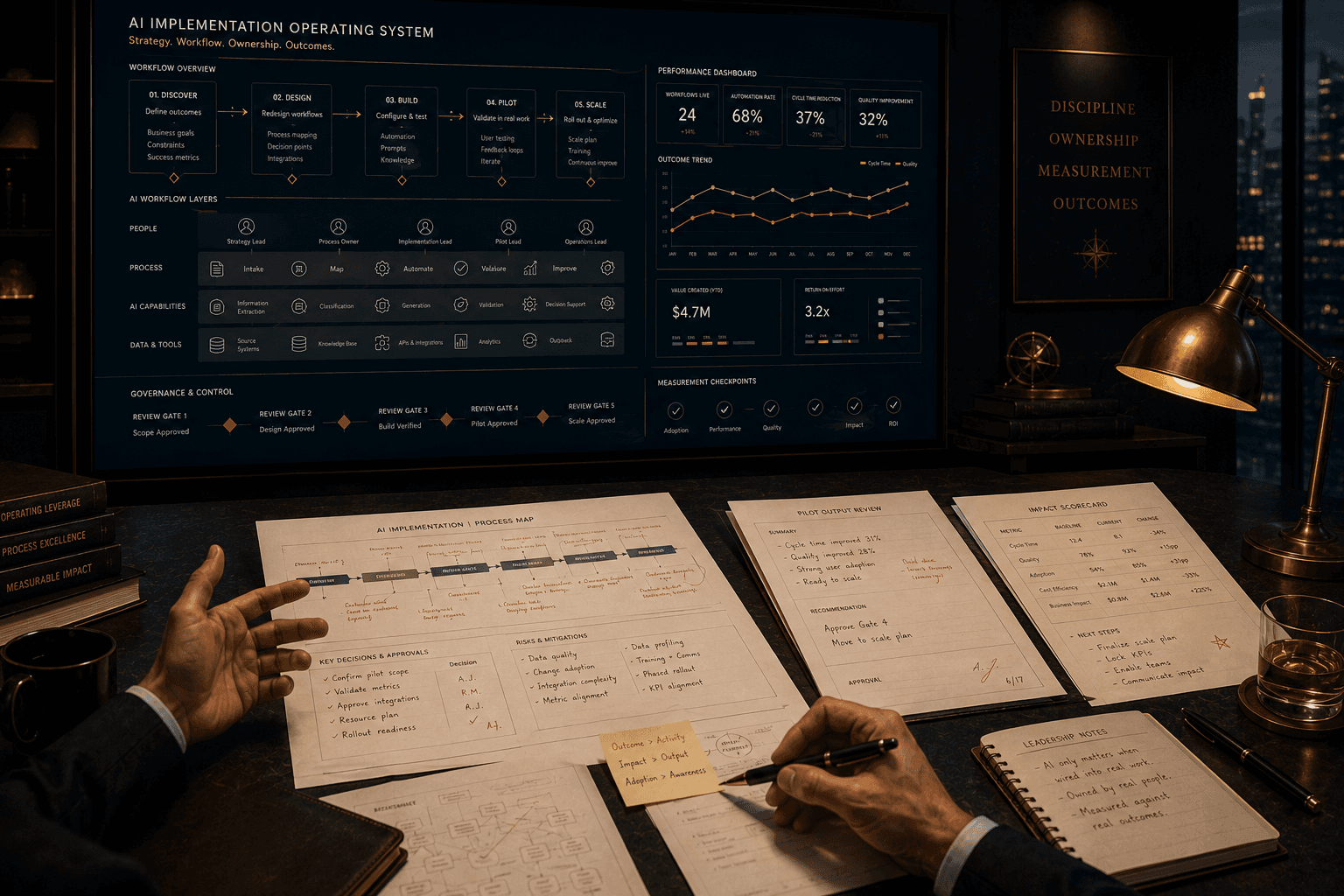
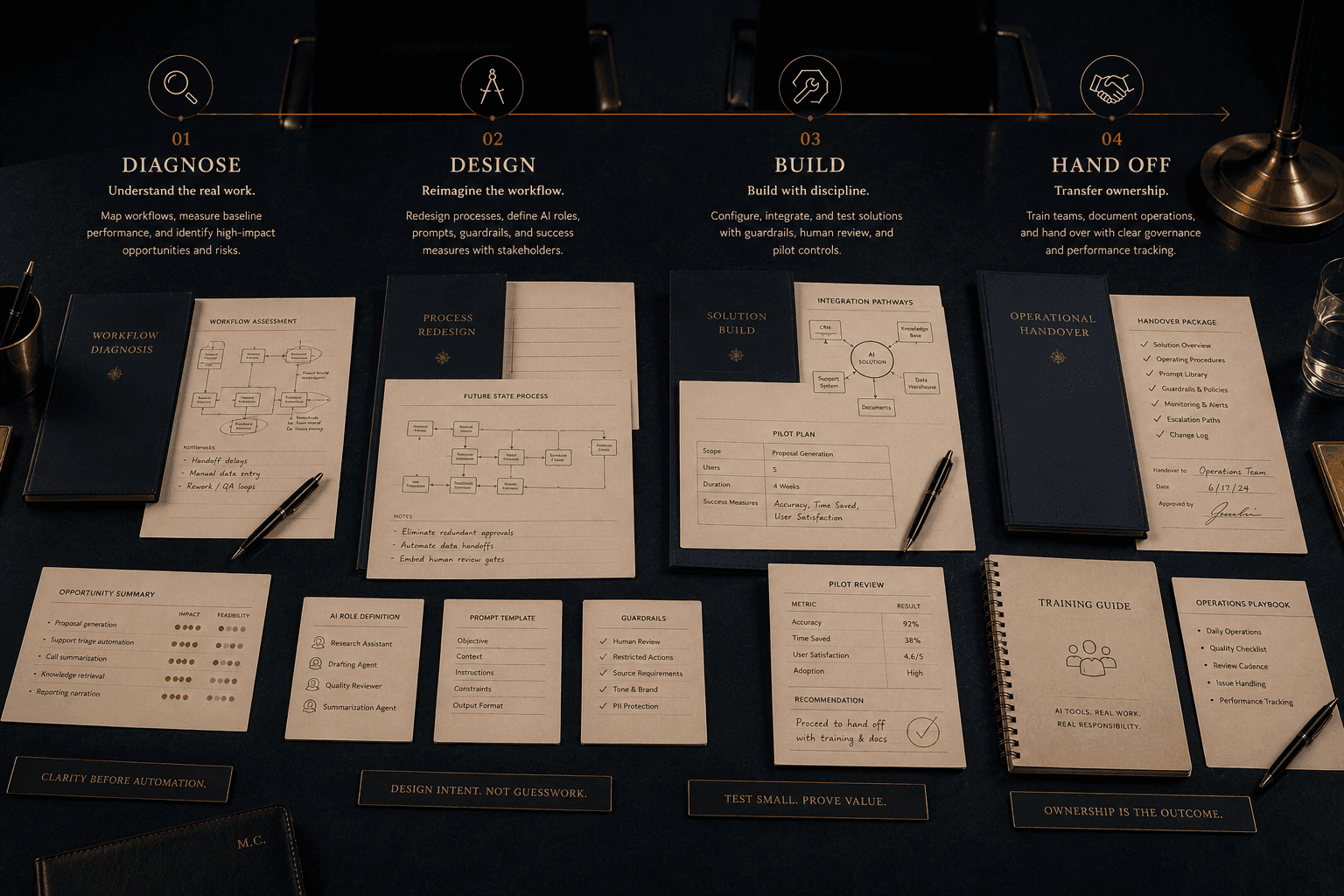
Four phases. Clear scope. Measured every week.

01  Diagnose

We map the target workflow end to end, interview the people who actually do the work, and score candidate use cases against a simple AI fit matrix. Not every task should be automated. The diagnosis is what stops us from spending on the wrong ones, and it is the short phase most vendors skip.

02  Design

We redesign the workflow with AI in place. We write the prompts, set the guardrails, define the review gates, and agree the success metrics with the team lead. Stakeholders sign off on the new workflow before we touch a tool.

03  Build

We configure tools, wire integrations, run a controlled pilot, and measure every output against the pre-AI baseline. Nothing ships that cannot defend itself against the version of the workflow you had before we arrived.

04  Hand off

We roll out to the full team, train, monitor for a set window, and hand over documentation. Your team owns the system and the measurement. We stay available under a Care Plan if that is the right arrangement, and we step away cleanly if it is not.
The image featured at the top of the about us page #1

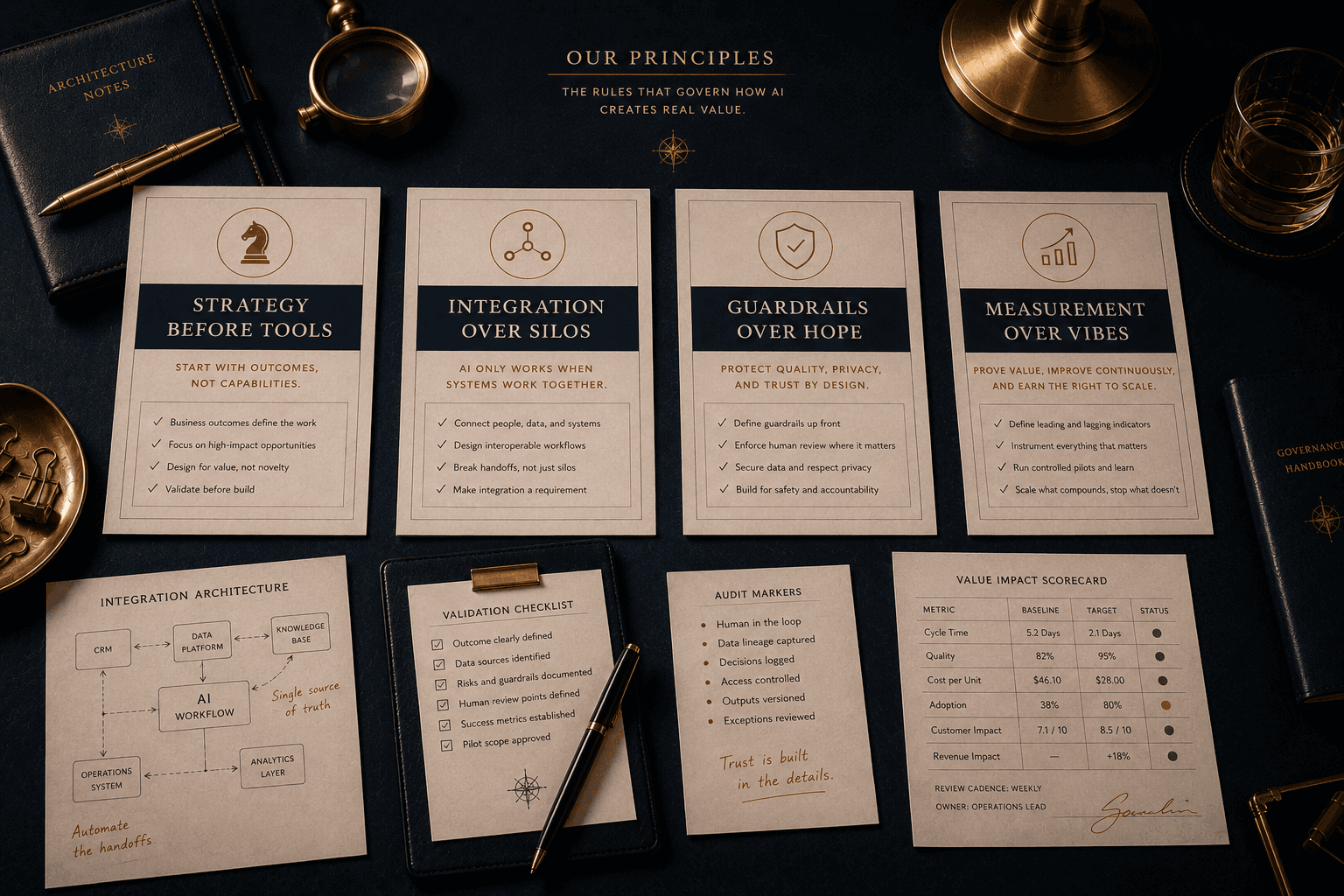
Four rules we will not break.

Strategy before tools.

The workflow change is the decision. The tool is a consequence. We will not pick the tool first, no matter how strong the vendor relationship or how loud the demo.

Guardrails over hope.

We do not trust raw AI output. Every workflow has review gates, validation steps, and an explicit plan for what happens when the model is wrong. Hope is not a rollout strategy.

Integration over silos.

Tools that do not wire into your stack become shelfware. Every AI system we ship is integrated end to end, or we will not ship it.

Measurement over vibes.

We track time saved, quality, adoption, and cost impact every week. If the numbers are flat by week six, we say so on the record and recommend what to change.

Strategy before tools.

The workflow change is the decision. The tool is a consequence. We will not pick the tool first, no matter how strong the vendor relationship or how loud the demo.

Integration over silos.

Tools that do not wire into your stack become shelfware. Every AI system we ship is integrated end to end, or we will not ship it.

Guardrails over hope.

We do not trust raw AI output. Every workflow has review gates, validation steps, and an explicit plan for what happens when the model is wrong. Hope is not a rollout strategy.

Measurement over vibes.

We track time saved, quality, adoption, and cost impact every week. If the numbers are flat by week six, we say so on the record and recommend what to change.

Strategy before tools.

The workflow change is the decision. The tool is a consequence. We will not pick the tool first, no matter how strong the vendor relationship or how loud the demo.

Guardrails over hope.

We do not trust raw AI output. Every workflow has review gates, validation steps, and an explicit plan for what happens when the model is wrong. Hope is not a rollout strategy.

Integration over silos.

Tools that do not wire into your stack become shelfware. Every AI system we ship is integrated end to end, or we will not ship it.

Measurement over vibes.

We track time saved, quality, adoption, and cost impact every week. If the numbers are flat by week six, we say so on the record and recommend what to change.

The image featured at the top of the about us page #1

What the business looks like ninety days after a well-run Production build.

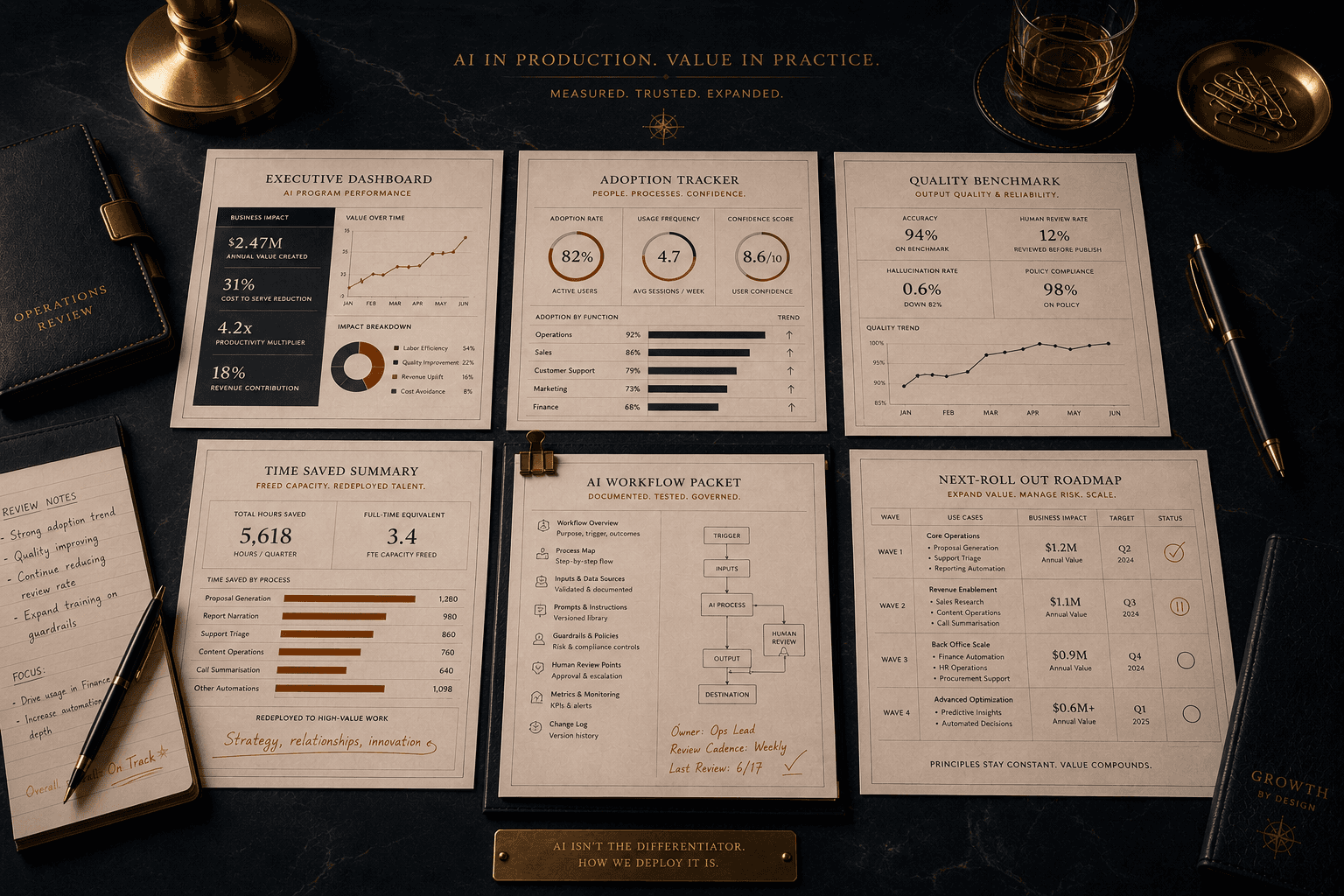
The pattern we see after a proper Production engagement is consistent enough to describe here. Your team spends less time on low-judgement tasks and more on the ones that actually needed a human in the first place. Your leadership can quote a number on AI impact without having to hedge. The rest of the team gets visibly less anxious about AI, because they have watched a controlled rollout work once and can imagine what the next one looks like. That confidence is worth more than any single workflow.
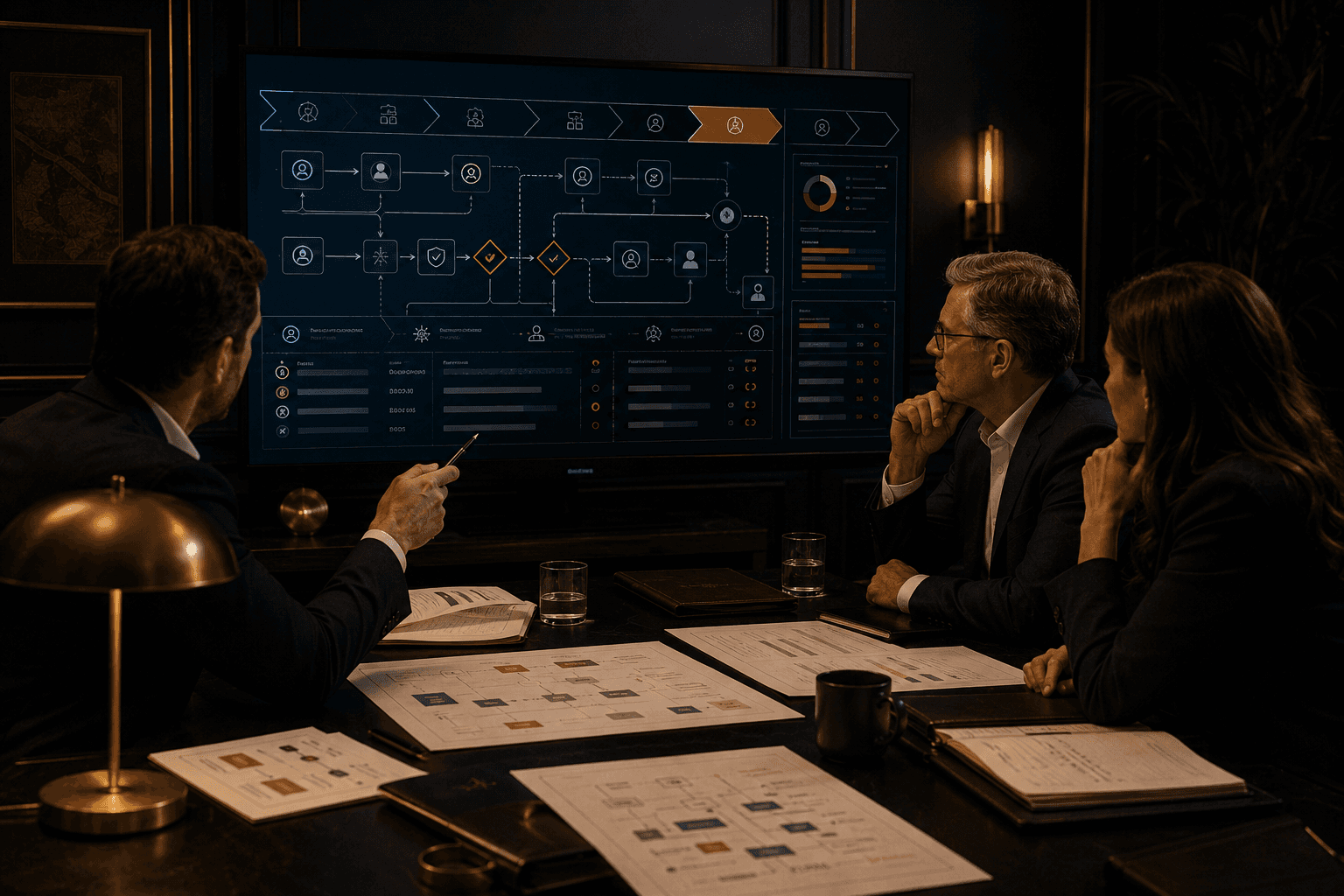
The targeted workflow is measurably faster, week over week, against the baseline you agreed.
Adoption is broad inside the team, not confined to two or three enthusiasts.
Leadership has a weekly or monthly report they can actually trust, with clear wins and misses.
Quality sits at or above the human baseline, defended by a review gate your team designed.
The system is fully documented and owned by your team, not held hostage by an external vendor.
The next AI rollout inside the business gets cheaper and faster, because the organisation has learned how to land one.
The targeted workflow is measurably faster, week over week, against the baseline you agreed.
Quality sits at or above the human baseline, defended by a review gate your team designed.
Adoption is broad inside the team, not confined to two or three enthusiasts.
The system is fully documented and owned by your team, not held hostage by an external vendor.
Leadership has a weekly or monthly report they can actually trust, with clear wins and misses.
The next AI rollout inside the business gets cheaper and faster, because the organisation has learned how to land one.
The targeted workflow is measurably faster, week over week, against the baseline you agreed.
Adoption is broad inside the team, not confined to two or three enthusiasts.
Leadership has a weekly or monthly report they can actually trust, with clear wins and misses.
Quality sits at or above the human baseline, defended by a review gate your team designed.
The system is fully documented and owned by your team, not held hostage by an external vendor.
The next AI rollout inside the business gets cheaper and faster, because the organisation has learned how to land one.
The image featured at the top of the about us page #1

Is this the right next step for you?

Work with us if

You know AI could save time but do not yet know where the highest-value use cases sit.

  • You have tried tools before and they did not stick with the team.

  • You need to scale a workflow but cannot hire fast enough to do it manually.

  • You are pre-implementation and want to avoid an expensive, public failure.

  • You are prepared to let your team change the shape of their week while the system settles in.

Do not work with us if

You want a tool bought and left on a shelf with no workflow change on your side.

  • You expect AI to replace judgement, relationships, or craft that only humans can do well.

  • You want an enterprise-wide rollout on day one with no pilot data behind it.

  • You are not willing to let your team shape the design of the new workflow.

  • You expect a single round of prompts to handle every edge case in your business forever.

Eleven questions buyers usually have but rarely ask out loud.

How do we know if AI is actually a good fit for our workflow?

That is what the Pilot phase is for. We score candidate workflows against an AI fit matrix that looks at repeatability, decision complexity, acceptable error rate, and measurable baseline. If nothing scores well, we say that on the record and recommend against a build. Not every workflow should be automated. We would rather tell you no early than sell you a project that underwhelms.

How long does AI implementation take?

Pilot runs four to six weeks. Production runs eight to twelve weeks depending on workflow complexity and integration depth. Scale takes three to six months and is sequenced across teams, not launched on a single date. We do not compress those timelines. The measurement windows are what make the outputs defensible.

What if AI does not improve things?

That is precisely why the Pilot stage exists. If the pilot shows no commercially meaningful impact, you do not pay for Production and we recommend against it on the record. We have killed pilots and will do so again. That is the point of having one.

Will this cost more than it saves?

Not if the scoping is honest. The Pilot is designed to prove or disprove the return on investment before the larger spend. Most Production builds pay back inside six to nine months through time saved, conversion lifted, or error cost reduced. We will show you the working before Production begins, not after.

Do you train our team or just hand it off?

Training is built in. We run team workshops, document the workflow with screenshots and decision rules, and stay for thirty to sixty days of monitoring. By the end of that window your team owns the system, not us. If we have done our job, you will not need us on call.

What tools do you use?

We start from the workflow and choose the tool last. ChatGPT, Claude, Zapier, Make, the OpenAI and Anthropic APIs, Go High Level, and custom-built agents are all in our regular kit. We do not have a preferred vendor. We use what fits your process, your security posture, and your budget.

What happens when the model hallucinates or breaks something?

That is what guardrails are for. Every workflow ships with prompt constraints, human review checkpoints where appropriate, and output validation. We also ship an explicit fallback for low-confidence output. Nothing goes to a customer without a human-reviewed path unless the workflow explicitly permits it and the risk has been signed off in writing.

Can you work with our existing stack?

Yes. CRM, email, project tools, the data warehouse, ticketing, finance systems. Integration is the hard part of this work. It is also the part most vendors skip, which is why so many AI pilots fail to cross into production. We do not skip it.

How do we measure success?

We set metrics in phase one: time saved, quality at parity or better, adoption, cost impact, and any customer-facing metric the workflow touches. We track weekly during Pilot and monthly during Production. The report is written honestly, wins and misses both, not marketing.

What if our team is nervous about AI replacing their jobs?

That conversation is part of the engagement. We are direct with teams about what AI does and does not do, and we design rollouts so humans end up measurably better off, not anxiously monitoring a black box. Honest framing beats reassurance every time.

What budget range usually makes sense here?

Pilot is the lighter spend, scoped up front and priced flat. Production sits in the mid to high five figures depending on workflow complexity, integration depth, and team size. Scale is bespoke and quoted after a diagnostic. We never quote before we have diagnosed, because dishonest scoping is the reason most AI projects disappoint.

Our Services
What Our Partners Think

They are highly supportive! I feel completely supported in every part of my marketing. They are a wonderful team of people each bring in their own talents and strengths. They are responsive and eager to please and it's been a pleasure working with them.

Tova, Toronto

Co-owner of FRINGE boutique

What Our Partners Think

They are highly supportive! I feel completely supported in every part of my marketing. They are a wonderful team of people each bring in their own talents and strengths. They are responsive and eager to please and it's been a pleasure working with them.

Tova, Toronto

Co-owner of FRINGE boutique

Let's Work Together

What Our Partners Think

They are highly supportive! I feel completely supported in every part of my marketing. They are a wonderful team of people each bring in their own talents and strengths. They are responsive and eager to please and it's been a pleasure working with them.

Tova, Toronto

Co-owner of FRINGE boutique

What Our Partners Think

They are highly supportive! I feel completely supported in every part of my marketing. They are a wonderful team of people each bring in their own talents and strengths. They are responsive and eager to please and it's been a pleasure working with them.

Tova, Toronto

Co-owner of FRINGE boutique

Let's Work Together