Websites • Website Rebuild • System Implementations

The site did its job three years ago. Now it is costing you deals you do not see losing.

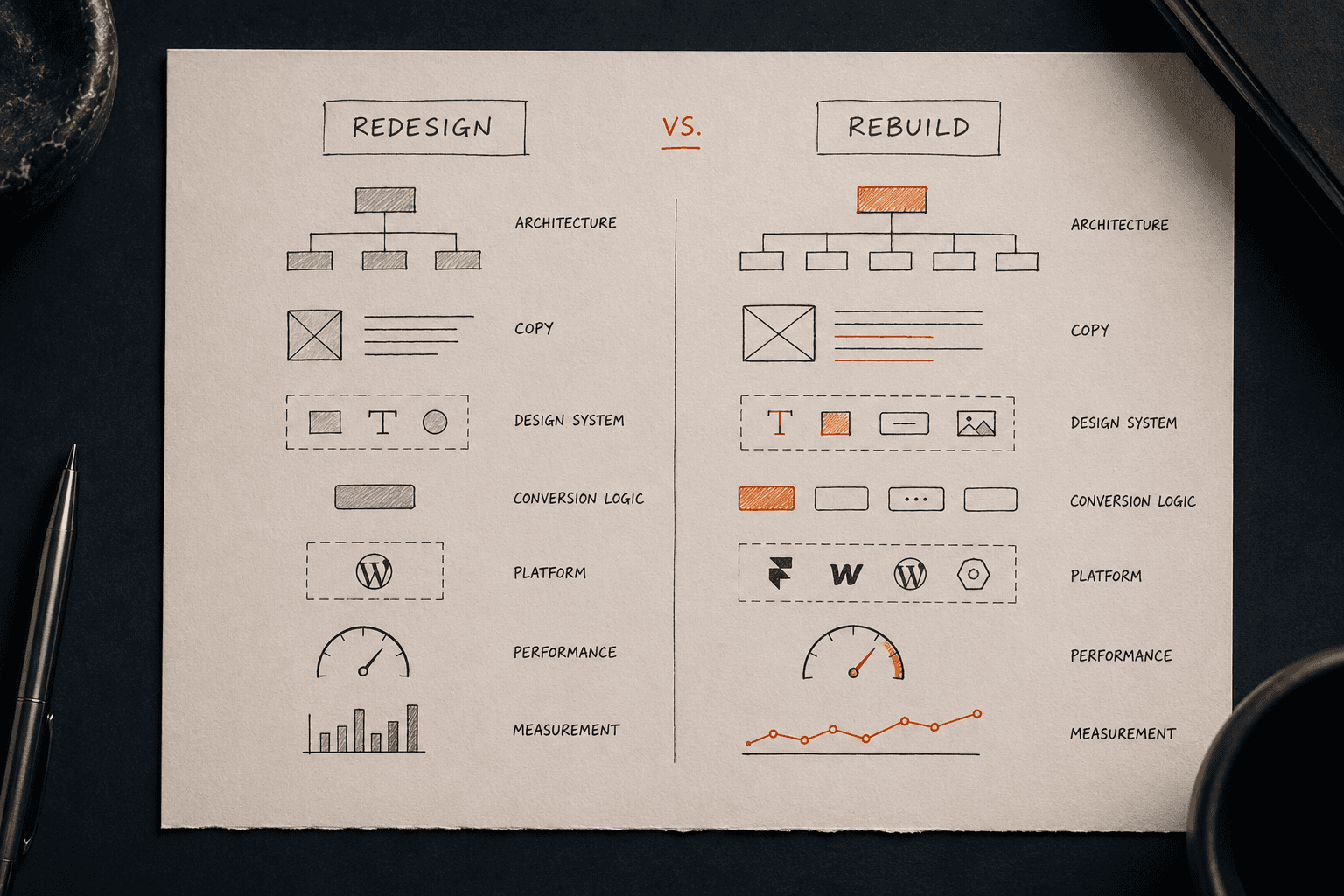
A rebuild is not a redesign. A redesign paints over the same structure. A rebuild replaces the structure itself: the architecture, the funnel logic, the copy, the technical foundation, the measurement. The visible result is a better-looking website. The commercial result is a site that finally matches the company you have become and the buyers you actually want to reach.

Most founders wait too long. The site keeps taking form fills, keeps showing up in search, keeps looking roughly like a website, and so the problem stays invisible until a deal is lost on a sleeker competitor or the sales team starts apologising for the site on every call. By that point, the cost of the delay is already in the pipeline.

The image featured at the top of the about us page #1

Why a rebuild is the right move

You are not redecorating. You are replacing the operating surface of your sales motion.

A weak website does not page you at 2am. It does not crash. It just quietly taxes every other part of the business. Paid spend works harder than it should. Sales repeats itself on every call. Content lands on pages that cannot convert. Champions have nothing worth forwarding internally. You pay the cost in slower cycles, smaller deals, and a team that has to carry the site instead of being carried by it.

The question is not "does my site look dated". The question is "is my site the commercial infrastructure this business needs in its next stage". If the gap is honest and structural, a rebuild is the right move. If it is cosmetic, a refresh is cheaper and faster. The diagnostic call sorts which one you actually need.

The image featured at the top of the about us page #1

The signals a rebuild is overdue

You do not need a full audit to feel most of these.
  1. The homepage no longer matches the sales pitch.

Your positioning has evolved, your pricing has moved, your product has grown. The site still speaks in the voice of the company from three years ago. Every serious buyer hits a mismatch within 30 seconds.

  1. The site cannot carry a forwarding moment.

A champion inside a buying committee tries to send one page, one case study, or one comparison internally. There is nothing on the current site that will survive that forwarding moment intact.

  1. Small changes take too long and break other pages.

The CMS is brittle. The design system is inconsistent. Every small edit becomes a migration. Your team has stopped suggesting updates because nothing ships cleanly.

  1. Your team apologises for the site on sales calls.

That sentence is the most expensive sentence in the company. It leaks confidence, resets the buyer's expectation downward, and turns a pitch into a defensive conversation before you have said anything.

  1. The funnel leaks without pattern.

You are running paid traffic, content marketing, outbound, or referrals into the same site. Results are inconsistent by channel in a way that only the site can explain. The landing surface is cancelling the work upstream.

  1. Analytics is unreadable.

You cannot tell which page moved revenue. Attribution is broken, events are stale, and the reporting is either missing or nobody trusts it. The site cannot answer the basic commercial question of what is working.

  1. The homepage no longer matches the sales pitch.

Your positioning has evolved, your pricing has moved, your product has grown. The site still speaks in the voice of the company from three years ago. Every serious buyer hits a mismatch within 30 seconds.

  1. The site cannot carry a forwarding moment.

A champion inside a buying committee tries to send one page, one case study, or one comparison internally. There is nothing on the current site that will survive that forwarding moment intact.

  1. Small changes take too long and break other pages.

The CMS is brittle. The design system is inconsistent. Every small edit becomes a migration. Your team has stopped suggesting updates because nothing ships cleanly.

  1. Your team apologises for the site on sales calls.

That sentence is the most expensive sentence in the company. It leaks confidence, resets the buyer's expectation downward, and turns a pitch into a defensive conversation before you have said anything.

  1. The funnel leaks without pattern.

You are running paid traffic, content marketing, outbound, or referrals into the same site. Results are inconsistent by channel in a way that only the site can explain. The landing surface is cancelling the work upstream.

  1. Analytics is unreadable.

You cannot tell which page moved revenue. Attribution is broken, events are stale, and the reporting is either missing or nobody trusts it. The site cannot answer the basic commercial question of what is working.

  1. The homepage no longer matches the sales pitch.

Your positioning has evolved, your pricing has moved, your product has grown. The site still speaks in the voice of the company from three years ago. Every serious buyer hits a mismatch within 30 seconds.

  1. Your team apologises for the site on sales calls.

That sentence is the most expensive sentence in the company. It leaks confidence, resets the buyer's expectation downward, and turns a pitch into a defensive conversation before you have said anything.

  1. The site cannot carry a forwarding moment.

A champion inside a buying committee tries to send one page, one case study, or one comparison internally. There is nothing on the current site that will survive that forwarding moment intact.

  1. The funnel leaks without pattern.

You are running paid traffic, content marketing, outbound, or referrals into the same site. Results are inconsistent by channel in a way that only the site can explain. The landing surface is cancelling the work upstream.

  1. Small changes take too long and break other pages.

The CMS is brittle. The design system is inconsistent. Every small edit becomes a migration. Your team has stopped suggesting updates because nothing ships cleanly.

  1. Analytics is unreadable.

You cannot tell which page moved revenue. Attribution is broken, events are stale, and the reporting is either missing or nobody trusts it. The site cannot answer the basic commercial question of what is working.

The image featured at the top of the about us page #1

What a rebuild actually replaces

Seven layers, replaced together, so the new site reads as one commercial system.

Architecture.

The sitemap, the page hierarchy, the navigation. We redraw it around how your buyer actually moves, not around how the old site grew by accretion.

Design system.

A new visual system tied to the current brand, not the old one. Type, colour, component library, imagery direction, motion behaviour. Designed once, applied consistently, documented for your team to use without us.

Platform.

We move you to the right platform for your stage and team: Framer, Webflow, WordPress, or a custom headless setup. The platform is chosen by fit, not by preference.

Measurement.

Analytics rebuilt so attribution is clean, events are honest, and the dashboard your team actually uses tells the truth. Measurement is treated as a build deliverable, not a post-launch afterthought.

Copy.

Every page rewritten from the new positioning down. Not "tightened" or "polished" - rewritten. Copy carries more of the conversion job than design does, and copy from three years ago rarely survives a rebuild cleanly.

Conversion logic.

Every CTA, every form, every decision point reworked around a single question: what is the best next step for this specific visitor right now. Not a generic "contact us" button on every page.

Performance.

Page weight cut, images optimised, third-party scripts audited, Core Web Vitals brought into the green. Speed is not a nice-to-have; it is a ranking and conversion factor that the old site was losing on silently.

Architecture.

The sitemap, the page hierarchy, the navigation. We redraw it around how your buyer actually moves, not around how the old site grew by accretion.

Design system.

A new visual system tied to the current brand, not the old one. Type, colour, component library, imagery direction, motion behaviour. Designed once, applied consistently, documented for your team to use without us.

Platform.

We move you to the right platform for your stage and team: Framer, Webflow, WordPress, or a custom headless setup. The platform is chosen by fit, not by preference.

Measurement.

Analytics rebuilt so attribution is clean, events are honest, and the dashboard your team actually uses tells the truth. Measurement is treated as a build deliverable, not a post-launch afterthought.

Copy.

Every page rewritten from the new positioning down. Not "tightened" or "polished" - rewritten. Copy carries more of the conversion job than design does, and copy from three years ago rarely survives a rebuild cleanly.

Conversion logic.

Every CTA, every form, every decision point reworked around a single question: what is the best next step for this specific visitor right now. Not a generic "contact us" button on every page.

Performance.

Page weight cut, images optimised, third-party scripts audited, Core Web Vitals brought into the green. Speed is not a nice-to-have; it is a ranking and conversion factor that the old site was losing on silently.

Architecture.

The sitemap, the page hierarchy, the navigation. We redraw it around how your buyer actually moves, not around how the old site grew by accretion.

Copy.

Every page rewritten from the new positioning down. Not "tightened" or "polished" - rewritten. Copy carries more of the conversion job than design does, and copy from three years ago rarely survives a rebuild cleanly.

Design system.

A new visual system tied to the current brand, not the old one. Type, colour, component library, imagery direction, motion behaviour. Designed once, applied consistently, documented for your team to use without us.

Conversion logic.

Every CTA, every form, every decision point reworked around a single question: what is the best next step for this specific visitor right now. Not a generic "contact us" button on every page.

Platform.

We move you to the right platform for your stage and team: Framer, Webflow, WordPress, or a custom headless setup. The platform is chosen by fit, not by preference.

Performance.

Page weight cut, images optimised, third-party scripts audited, Core Web Vitals brought into the green. Speed is not a nice-to-have; it is a ranking and conversion factor that the old site was losing on silently.

Measurement.

Analytics rebuilt so attribution is clean, events are honest, and the dashboard your team actually uses tells the truth. Measurement is treated as a build deliverable, not a post-launch afterthought.

How a rebuild does not lose your seo. The most common fear. The most solvable problem, if it is planned from day one.

Every old URL maps to a new one before migration. Every redirect is written in advance, not improvised at launch. Search engines follow those redirects and credit the authority of the old URL to the new one. Internal links are rewritten. Structured data is preserved and upgraded. Sitemaps are re-submitted. Rankings are monitored weekly for the first six weeks post-launch.

Done properly, a rebuild either preserves your organic position or improves it, because the new site is faster, cleaner, and more relevant. Done carelessly, a rebuild can cost years of organic equity inside a single weekend. The difference is process discipline, not luck. Our rebuild process is written to protect organic traffic as a primary constraint, not a secondary concern
The image featured at the top of the about us page #1

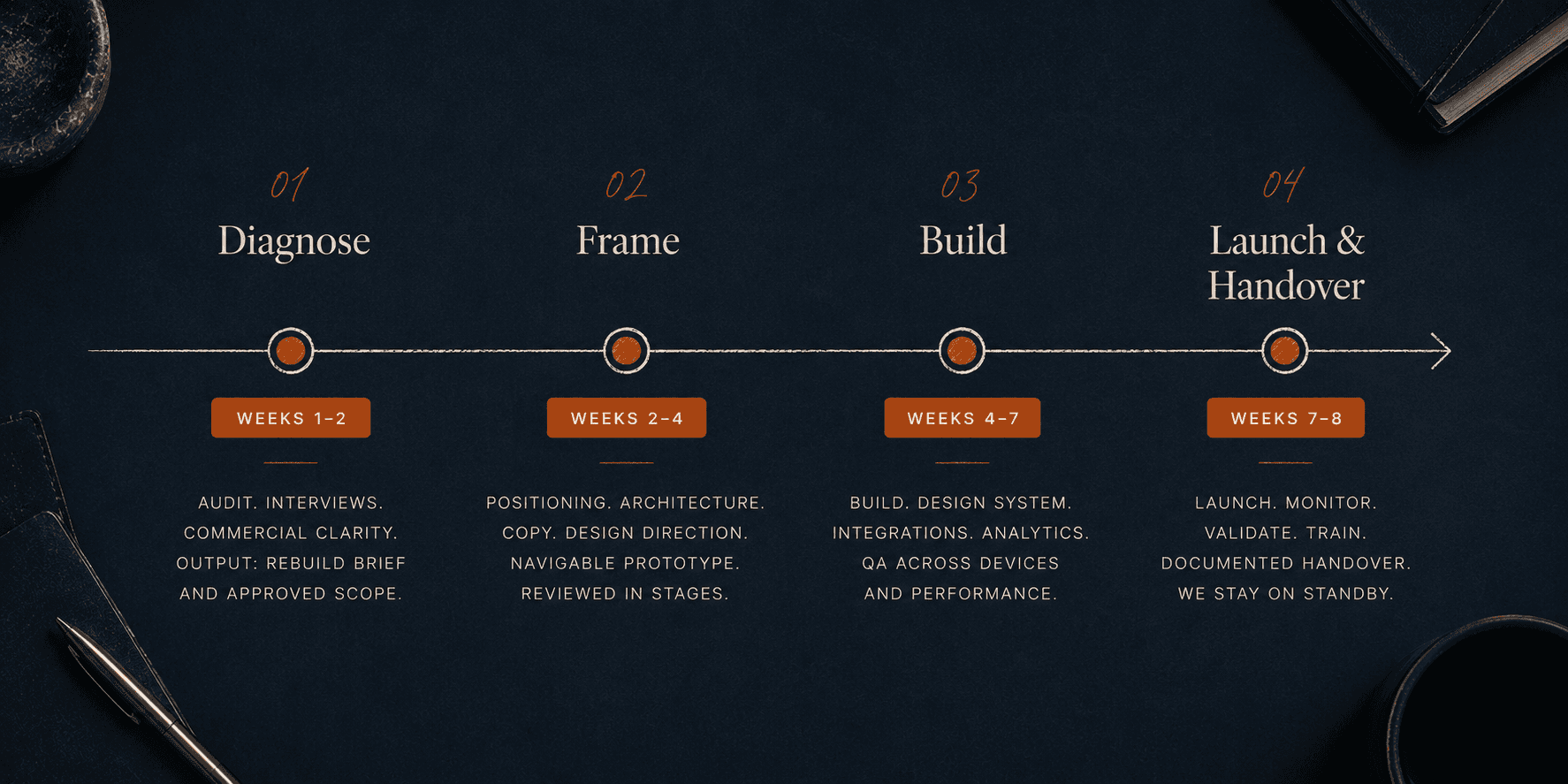
How the work moves. Four phases. Rebuild, not rebuild-and-pray.

Phase 1 / Diagnose (weeks 1 to 2)

We audit the current site: analytics, search performance, user flows, CMS health, tech stack, and commercial function. We interview the founder, the sales team, and where relevant, a few customers. We surface the real commercial problem the rebuild needs to solve. Output is a written rebuild brief, a scoping range, and an approved scope of work.

Phase 2 / Frame (weeks 2 to 4)

Positioning is sharpened. Page architecture is drawn. Copy is written. Design direction is locked. A navigable prototype is built in the real design tool so you can click through the site before anything is coded. Stakeholders review in stages, not at the end, so the build never goes sideways late.

Phase 3 / Build (weeks 4 to 7)

The site is built on the chosen platform. Design system, components, page templates, forms, integrations, analytics, and redirects all in parallel. You see progress weekly on a staging URL. We run QA across browsers, devices, and performance targets before any launch date is accepted.

Phase 4 / Launch and handover (week 7 to 8)

Redirects deployed, DNS cut over, site monitored for the first fortnight, rankings watched, forms tested live, analytics validated, team trained on the CMS. Handover is written, not verbal, and your team owns the site after it ships. We stay on standby during the settling window.
The image featured at the top of the about us page #1

How we think about rebuilds. Four non-negotiables on every rebuild, regardless of tier.

Keep what works. Rebuild the rest.

A rebuild is not a reset. If the blog is ranking, if a sales asset is converting, if a specific flow already works, we migrate and upgrade it. We do not rebuild around ego.

No visible downtime. Ever.

Cut-overs are planned on a low-traffic window, redirects are live before DNS flips, and rollback is ready if a surprise lands. You never lose a day of inbound leads to our launch.

Launch on a calendar date, not a finish-when-ready date.

A rebuild that slips past its launch window costs more than the cost overrun. It costs momentum. We scope honestly and hold the date.

The team you hire is the team who ships it.

The diagnostic lead stays on through design and build. You are not handed to a junior pod the moment you sign. Continuity is the quiet reason rebuilds succeed.

Keep what works. Rebuild the rest.

A rebuild is not a reset. If the blog is ranking, if a sales asset is converting, if a specific flow already works, we migrate and upgrade it. We do not rebuild around ego.

No visible downtime. Ever.

Cut-overs are planned on a low-traffic window, redirects are live before DNS flips, and rollback is ready if a surprise lands. You never lose a day of inbound leads to our launch.

Launch on a calendar date, not a finish-when-ready date.

A rebuild that slips past its launch window costs more than the cost overrun. It costs momentum. We scope honestly and hold the date.

The team you hire is the team who ships it.

The diagnostic lead stays on through design and build. You are not handed to a junior pod the moment you sign. Continuity is the quiet reason rebuilds succeed.

Keep what works. Rebuild the rest.

A rebuild is not a reset. If the blog is ranking, if a sales asset is converting, if a specific flow already works, we migrate and upgrade it. We do not rebuild around ego.

Launch on a calendar date, not a finish-when-ready date.

A rebuild that slips past its launch window costs more than the cost overrun. It costs momentum. We scope honestly and hold the date.

No visible downtime. Ever.

Cut-overs are planned on a low-traffic window, redirects are live before DNS flips, and rollback is ready if a surprise lands. You never lose a day of inbound leads to our launch.

The team you hire is the team who ships it.

The diagnostic lead stays on through design and build. You are not handed to a junior pod the moment you sign. Continuity is the quiet reason rebuilds succeed.

The image featured at the top of the about us page #1

What changes inside the first 90 days

Observable shifts, not claims.

Page load times improve measurably. Core Web Vitals move into the green. Search engines see the speed and the rankings stabilise or improve.
Form completion rate rises even where traffic stays flat. Better UX means fewer abandoned submissions.
Paid traffic converts better. Same ad spend produces more qualified leads because the landing surface finally holds up its end.
Mobile bounce rate drops. Visitors stay longer because the site no longer frustrates them on a phone.
The sales team stops opening calls with an apology about the site. Pitches start from a position of confidence rather than catch-up.
Content performance lifts. Blog posts, resources, and case studies work harder because the site around them is worth staying on.
Page load times improve measurably. Core Web Vitals move into the green. Search engines see the speed and the rankings stabilise or improve.
Form completion rate rises even where traffic stays flat. Better UX means fewer abandoned submissions.
Paid traffic converts better. Same ad spend produces more qualified leads because the landing surface finally holds up its end.
Mobile bounce rate drops. Visitors stay longer because the site no longer frustrates them on a phone.
The sales team stops opening calls with an apology about the site. Pitches start from a position of confidence rather than catch-up.
Content performance lifts. Blog posts, resources, and case studies work harder because the site around them is worth staying on.
Page load times improve measurably. Core Web Vitals move into the green. Search engines see the speed and the rankings stabilise or improve.
Mobile bounce rate drops. Visitors stay longer because the site no longer frustrates them on a phone.
Form completion rate rises even where traffic stays flat. Better UX means fewer abandoned submissions.
The sales team stops opening calls with an apology about the site. Pitches start from a position of confidence rather than catch-up.
Paid traffic converts better. Same ad spend produces more qualified leads because the landing surface finally holds up its end.
Content performance lifts. Blog posts, resources, and case studies work harder because the site around them is worth staying on.
The image featured at the top of the about us page #1

Is this the right engagement?

Strong fit if
  • Your company changed materially in the last two years. The site did not.

  • Your current site is built on a platform your team cannot operate without external help.

  • The sales motion depends on forwardability and the site cannot carry it.

  • Paid and content channels are live but the website is the bottleneck.

  • You are preparing for a pricing move, a repositioning, a new product, or a fundraise. The site has to be ready.

Probably not right if
  • You are pre-product-market-fit and the positioning is still moving weekly.

  • The real problem is brand strategy, not the website. Solve that first at /brand-strategy.

  • You want a visual refresh only. A refresh is cheaper and faster. Start at /visual-identity.

  • You want the cheapest possible vendor. We are not that vendor.

FAQ

What is the difference between a rebuild and a redesign?

A redesign keeps the existing structure and changes the surface: colours, type, maybe some new imagery. A rebuild replaces the structure itself: architecture, copy, platform, conversion logic, and measurement. A redesign takes two to four weeks. A rebuild takes seven to ten. A redesign lifts visual quality. A rebuild lifts commercial performance. If the problem is cosmetic, redesign. If the problem is structural, rebuild.

Will we lose our search rankings during the migration?

Not if the rebuild is planned properly. Every old URL gets mapped to a new URL before launch, every redirect is tested, internal links are rewritten, and search engines are pinged on the day. Rankings are monitored weekly for six weeks after launch. In most cases, organic traffic either holds flat or improves because the new site is faster and better targeted. SEO preservation is written into the statement of work as a primary constraint.

Can we keep our domain?

Yes. The domain stays. What gets replaced is the site underneath. Brand authority, backlinks, and search history all stay with the domain. Visitors only notice that the site looks and works better.

Do we have to migrate all our existing content?

No. Part of a rebuild is deciding what carries forward and what is retired. We audit every page of the existing site for traffic, conversion, and strategic value. High-performing pages are upgraded and migrated. Low-value pages are redirected or dropped. Dead weight on a new site still drags performance; we do not carry it forward out of habit.

Who writes the new copy?

We do, as part of the rebuild. Copy carries more of the conversion job than design, and a new site with old copy is a visual upgrade without a commercial one. We interview the founder and the sales team, audit the current site and the competition, and write every page from the new positioning down. Your team reviews, edits, and approves. You never get handed a blank CMS and asked to fill it yourself.

What platform will the new site be on?

Whatever fits your team and your needs best. In practice, most rebuilds land on Framer, Webflow, or WordPress. If the site needs deeper integration or custom logic, we move into a headless setup with a modern front-end framework. Platform is a fit question, not a religion. We recommend the platform at the end of the diagnostic, not before.

How long does a rebuild take?

Most rebuilds take seven to ten weeks end to end. Smaller brochure sites can land inside six. Larger B2B or eCommerce rebuilds with heavy integration can stretch to twelve. We scope honestly after the diagnostic call and hold the date once it is set.

What happens after launch?

We stay on standby for two weeks after launch to monitor rankings, fix any redirect edge cases, and validate form and analytics behaviour in the wild. After that, some clients move to a care plan for ongoing optimisation, some move to a paid or content programme that now has a site worth sending traffic to, and some operate the site on their own team. All three are supported.

Who on your team will actually do the work?

The principal who runs your diagnostic stays on through design and build. You do not get passed to a junior pod once the contract is signed. Continuity is one of the reasons rebuilds ship cleanly and on time.

Who on your team will actually do the work?

The principal who runs your diagnostic stays on through design and build. You do not get passed to a junior pod once the contract is signed. Continuity is one of the reasons rebuilds ship cleanly and on time.

What investment range should we expect?

Most rebuilds sit at our W2 or W3 tier, with W4 reserved for sites requiring custom development, multi-region architecture, or heavy integration work. The diagnostic call produces a real scoping range. No ballparks from the cold.

Our Services

What Our Partners Think

They are highly supportive! I feel completely supported in every part of my marketing. They are a wonderful team of people each bring in their own talents and strengths. They are responsive and eager to please and it's been a pleasure working with them.

Tova, Toronto

Co-owner of FRINGE boutique

What Our Partners Think

They are highly supportive! I feel completely supported in every part of my marketing. They are a wonderful team of people each bring in their own talents and strengths. They are responsive and eager to please and it's been a pleasure working with them.

Tova, Toronto

Co-owner of FRINGE boutique

Let's Work Together

What Our Partners Think

They are highly supportive! I feel completely supported in every part of my marketing. They are a wonderful team of people each bring in their own talents and strengths. They are responsive and eager to please and it's been a pleasure working with them.

Tova, Toronto

Co-owner of FRINGE boutique

What Our Partners Think

They are highly supportive! I feel completely supported in every part of my marketing. They are a wonderful team of people each bring in their own talents and strengths. They are responsive and eager to please and it's been a pleasure working with them.

Tova, Toronto

Co-owner of FRINGE boutique

Let's Work Together