
custom AI Agents • Workflows • Operations
A custom AI agent is not a chatbot. It is a trained operator that runs a specific job inside your business on repeat.
Custom AI agents for Toronto & GTA businesses — trained operators that run a real job on repeat.
General chatbots are trained on the internet. They are confident, friendly, and often wrong about your business. A custom agent is the opposite. It is trained on your documents, your playbook, and your rules. It answers the way you would answer. It qualifies a lead the way your best rep qualifies a lead. It drafts a proposal that sounds like your company, not like a generic assistant. It is connected to the systems where the work actually happens, and it operates inside guardrails your team can defend in a leadership meeting. The difference is not the model. The difference is how much of your business is baked into it.
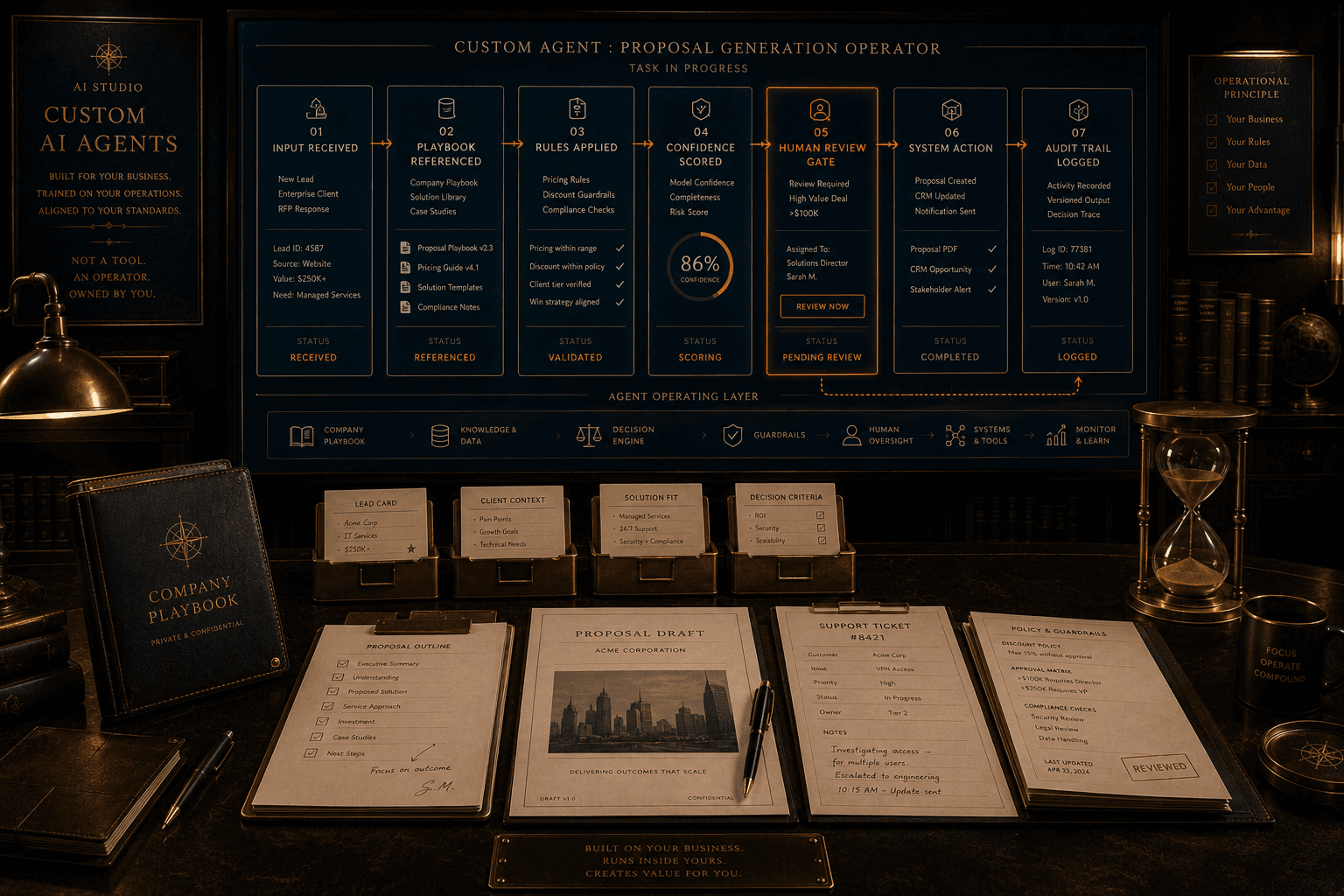
Off-the-shelf tools answer any question. A custom agent answers your question the right way.
A general-purpose AI tool is a remarkable piece of technology that knows almost nothing about your company. It does not know your product nuances, your brand voice, your pricing rules, or the policy reasons behind them. It does not know which customer segments get which tier, which objections are disqualifying and which are opportunities, or which promises your delivery team can actually keep. When you deploy a generic tool into a business context, the output is shaped by the training data of the internet, not by the standards of your company. The result sounds good in isolation and falls apart on contact with your customers.
A custom agent fixes that at the design layer, not the prompt layer. It is trained on your documents. It runs inside a workflow that has been explicitly redesigned to use its output. It is integrated with the systems where the work happens. It has guardrails, review gates, and escalation paths that match your risk tolerance. And it is measured against your baseline, not against a vendor demo. That is why custom agents hold up in production when off-the-shelf tools quietly get abandoned.
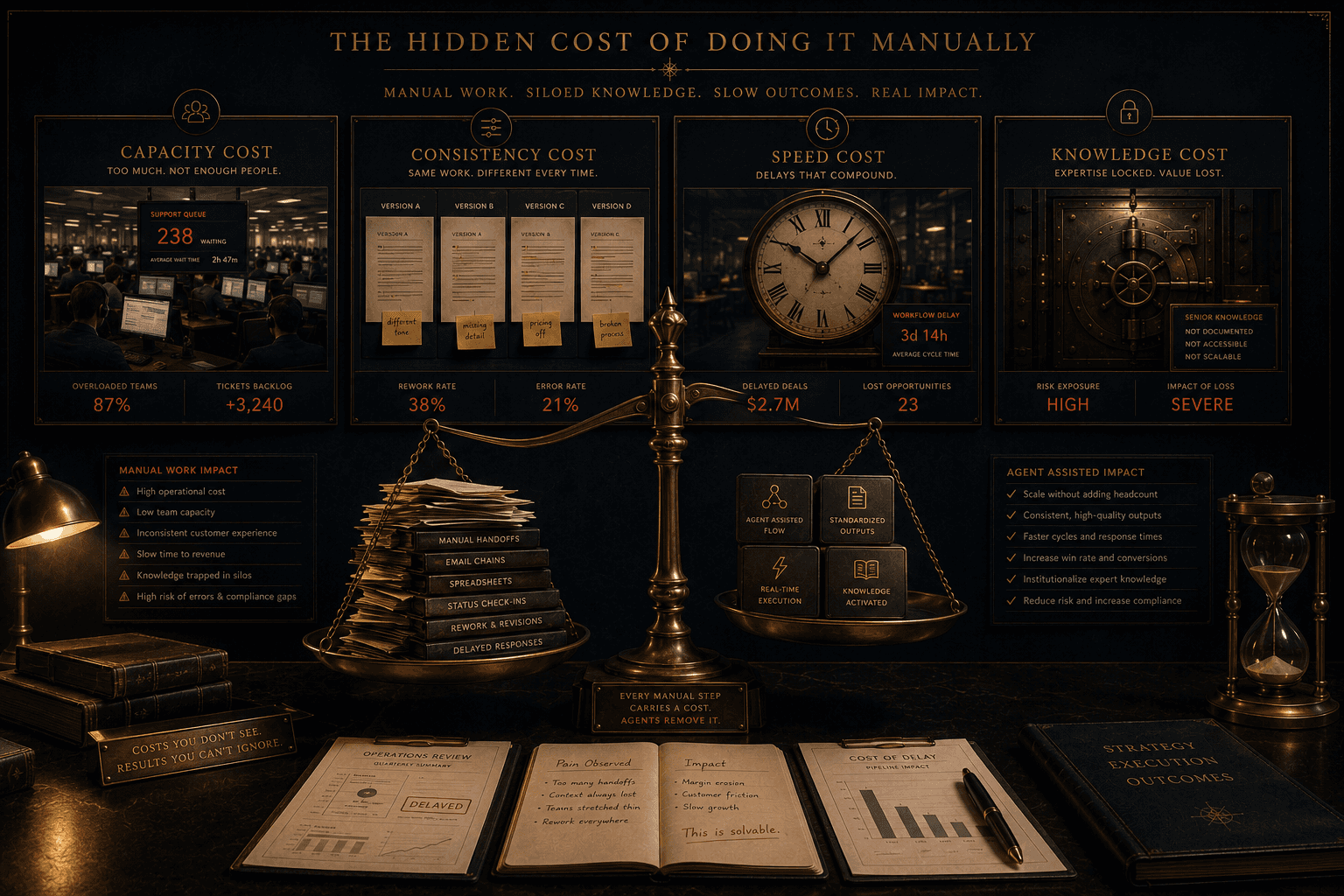
Work that should run itself stays on your payroll, year after year.
The cost of not having the right agents in place is rarely discussed as a line item, because it does not look like anything on the income statement. It looks like a support team that never catches up. A sales team that spends half its week on admin rather than conversations. A research function that pulls the same reports every Monday. An operations team that manually classifies documents that have not changed format in three years. Each of those is a job that could be carried by a properly scoped agent, with a human owner watching the quality. The longer the gap stays open, the more normal the cost feels.
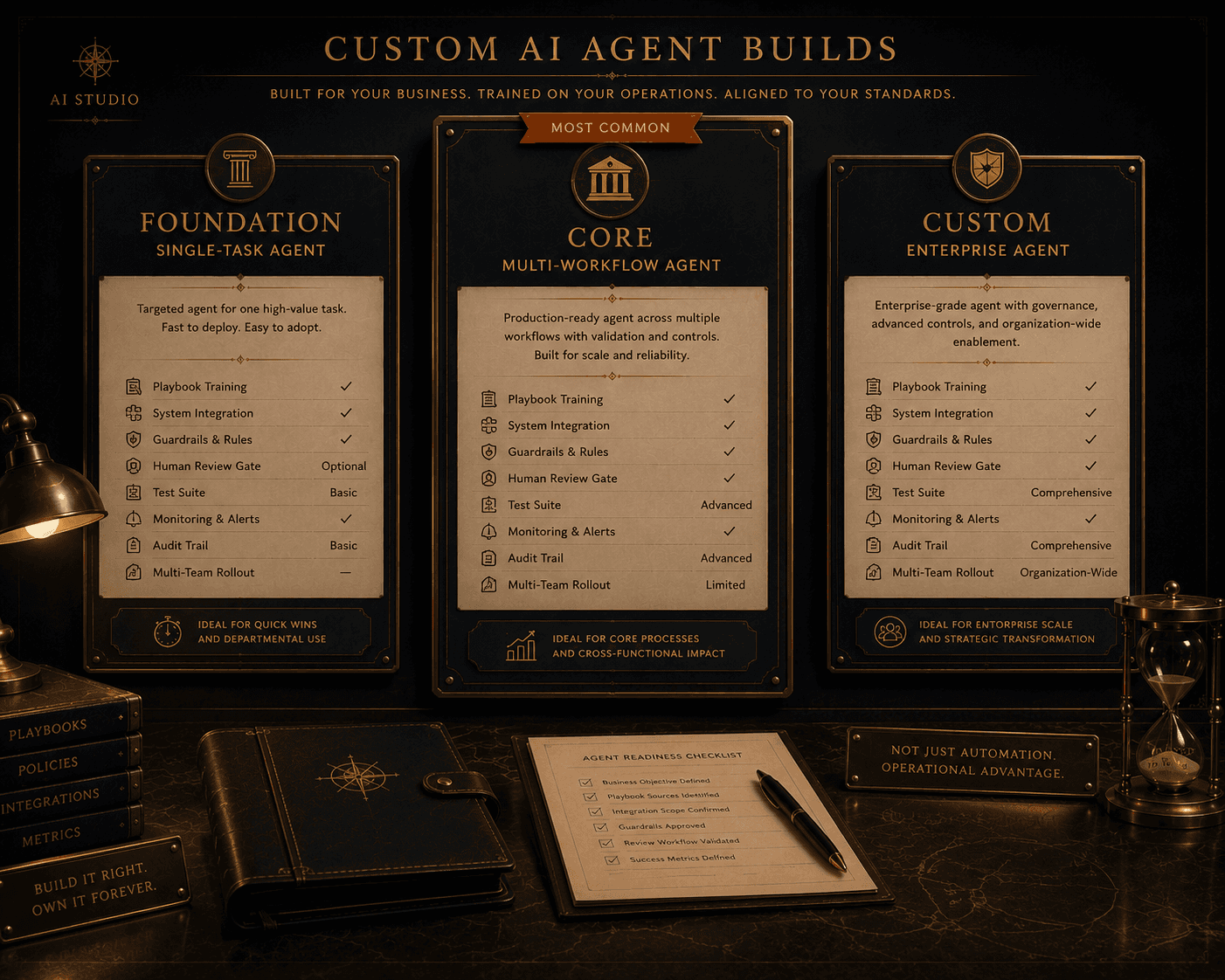
A trained operator, not a chatbot in a box.
We build agents in three tiers, depending on how much of the workflow the agent is being asked to carry and how many systems it needs to touch. All three start from the same principle: the agent is trained on your business, not the internet. What changes is the scope of the workflow, the depth of the integration, and the sophistication of the guardrails around what the agent can and cannot do on its own. We work primarily with GPT and Claude models, deployed through your own accounts or ours, with integration into Go High Level, your CRM, Slack, email, ticketing, and the tools your team already uses.
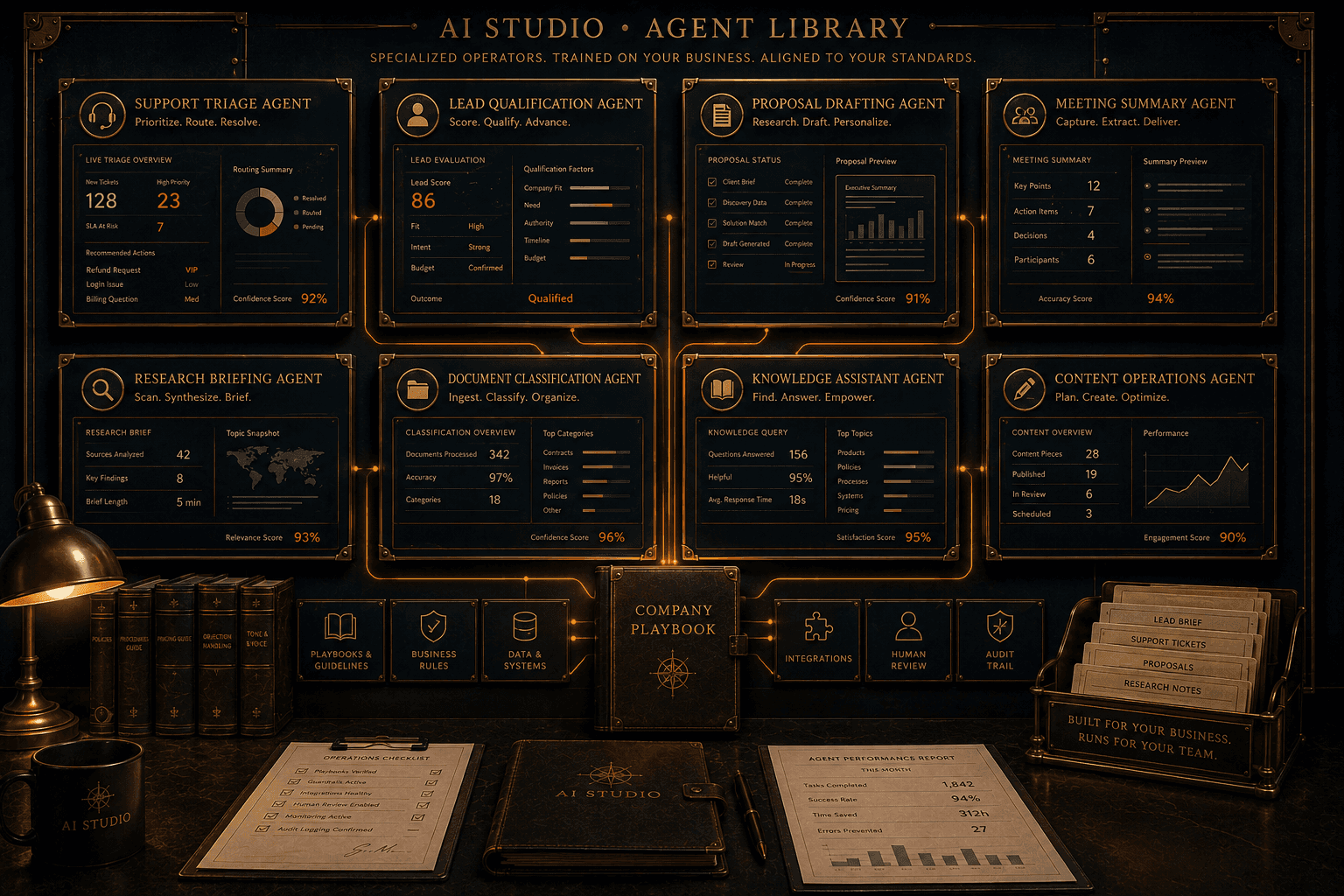
The agent shapes that keep earning their keep.
These are the agent patterns we build most often, across service, B2B, and operations-heavy businesses. They are not products. They are starting shapes. Every build is customised to your playbook, your stack, and the specific risk appetite of the team that will own it.
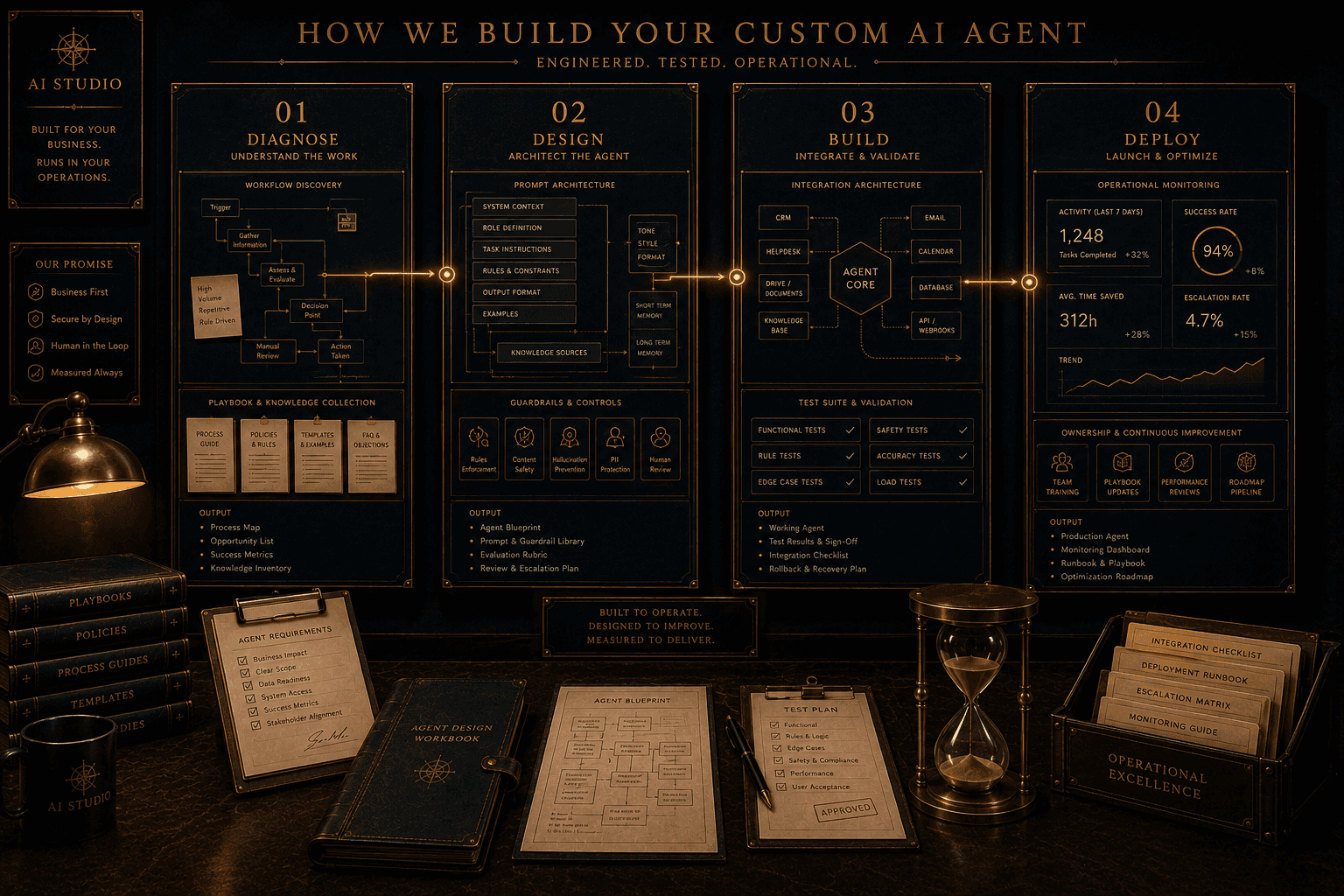
Four phases. Custom to your workflow. Built to scale.
01 Diagnose
We map the workflow the agent will carry, collect the playbooks and rules that govern it, and gather the data needed for training. We agree the success metrics in writing with the team that will own the agent, not just with the sponsor.
02 Design
We design the prompts, the guardrails, the review gates, the escalation logic, and the integration architecture. We draft it all in plain English first so the team can catch weak assumptions before we build anything. You sign off on the design before a single line of integration is written.
03 Build
We train the agent, wire the integrations, run the structured test suite, and stress-test the guardrails against realistic edge cases. Nothing goes to production until the agent holds up under the same inputs your team sees on a real day.
04 Deploy
Go live, monitor performance daily in the first week, weekly in the next month, and hand over documentation and ownership. We are on call for the monitoring window and available under a Care Plan after that. Your team owns the agent, the data, and the decision to change it.
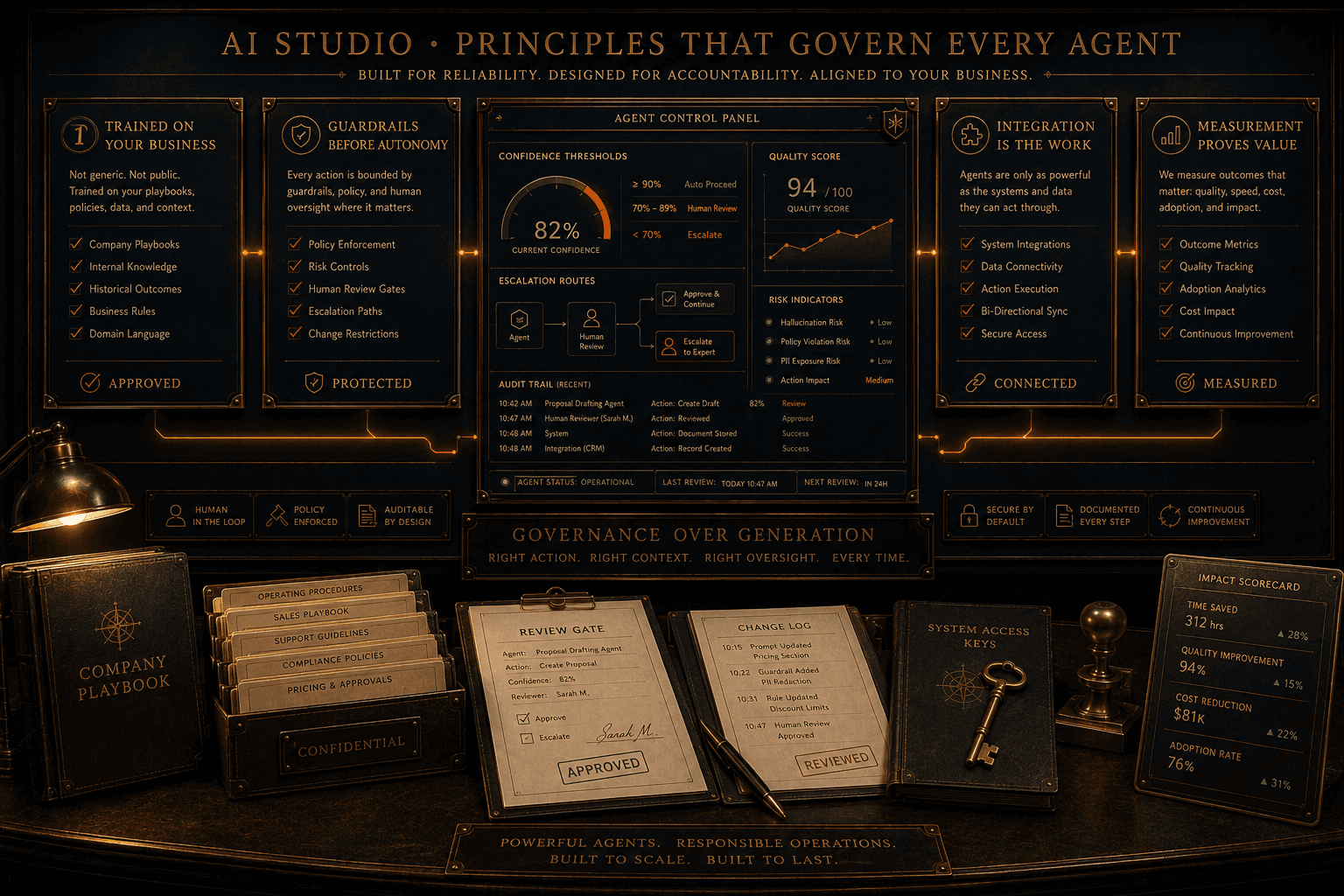
Four rules we will not compromise on.
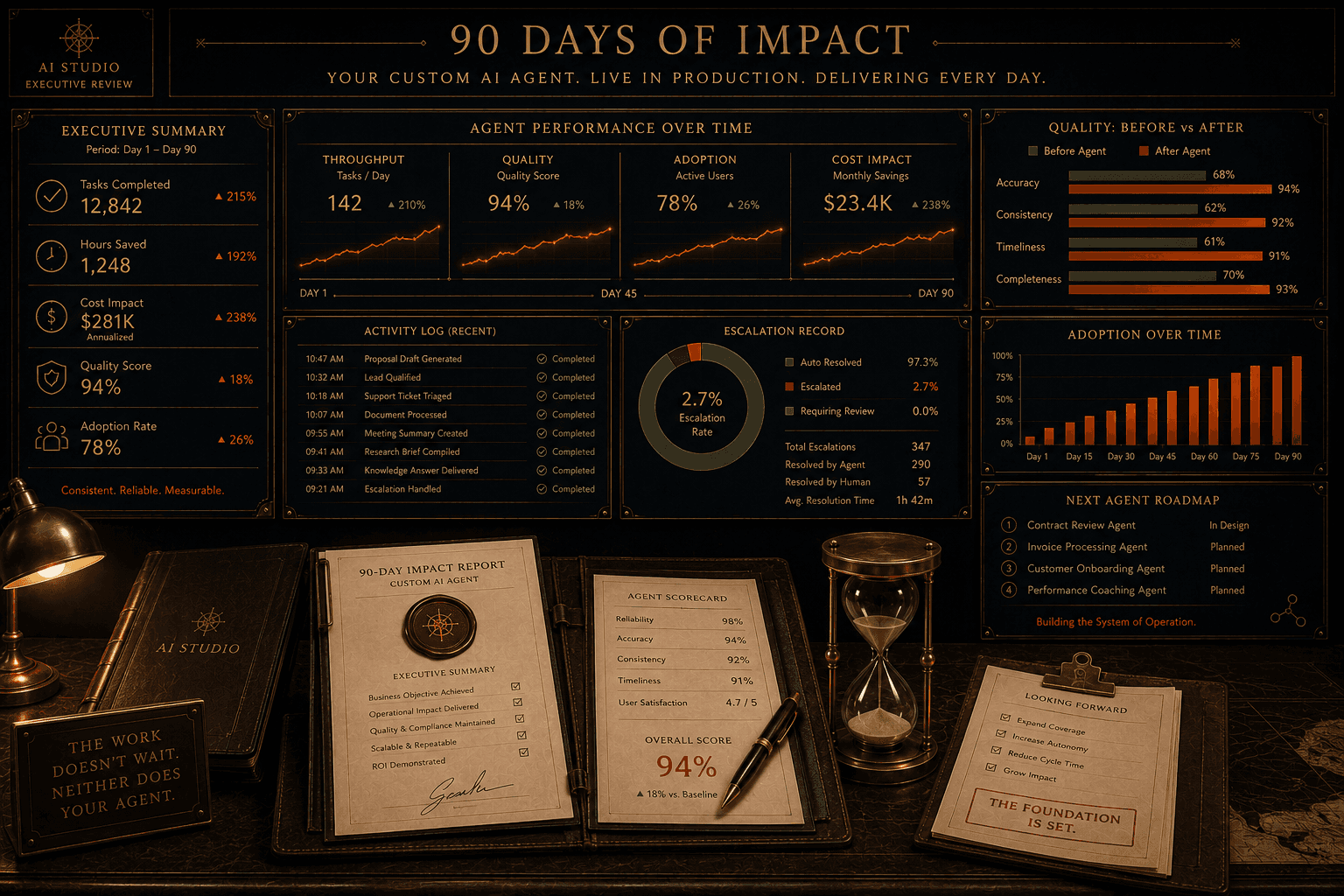
What a properly scoped custom agent changes inside ninety days.
A well-built custom agent does not make the work disappear. It moves it. The repeatable, rule-bound parts of the job get carried by the system. The human parts get more attention, not less. After the first full quarter of a working agent, leadership tends to describe the change in very specific terms rather than abstract ones. The noise level of the work drops. The team has room to think again. The weekly number the agent was built to move stops being a stretch and starts being a baseline.

Is this the right next step for you?
Work with us if
You have a repeatable workflow that follows a playbook and absorbs meaningful hours each week.
You have clear rules and documented policies the agent can be trained on.
You want the agent integrated into the systems where the work actually happens, not siloed in a separate tool.
You need to scale capacity without hiring linearly against the workload.
You are prepared to assign an internal owner who will review the agent's output and maintain the quality bar.
Do not work with us if
The work the agent would do requires a fresh human judgement every time, with no repeatable pattern underneath.
Your process changes weekly and there is no stable version to train against.
You do not have documentation and are not willing to create it as part of the build.
You want a general-purpose chatbot rather than a focused operational agent.
You are not willing to accept a pilot-then-scale sequence and insist on enterprise rollout on day one.
Eleven questions buyers usually have but rarely ask out loud.
What kind of tasks can an agent actually carry?
Anything rule-based and repeatable. Drafting first responses to support questions from your knowledge base. Qualifying leads against your criteria. Preparing research briefs from public signals and internal data. Extracting fields from documents and routing them. Summarising calls and meetings. Drafting proposals from a structured brief. If you have a playbook that a new hire could follow after a week of training, an agent can follow it too, faster and more consistently.
How accurate will the agent be?
Accuracy depends on the workflow, the quality of the training material, and the agreed tolerance for escalation. We set the target in writing at the start of the build. Low-risk drafting workflows tolerate more variance because a human reviewer is part of the flow. Higher-risk workflows have tighter confidence thresholds and stricter guardrails. We always ship with a measurement plan, so you can see the accuracy in real numbers instead of relying on a vendor claim.
What happens when the agent makes a mistake?
That is what guardrails exist for. Mission-critical actions have human review gates. High-stakes decisions require explicit approval. Low-confidence outputs escalate to a named person with full context. Every build has an explicit fallback path and an audit trail, so when something does go wrong you know exactly what happened, why, and what changes next.
Can the agent learn and improve over time?
Yes, with structure. Foundation agents learn through scheduled retraining on new examples. Core and Custom agents support structured feedback loops where human reviewers rate outputs and the agent is improved on that basis. Learning is governed, not automatic, because an agent that updates itself without review is a liability, not an asset.
How long until the agent pays for itself?
Most Foundation builds pay back within the first quarter after go-live through the hours they free up on the team. Core builds typically pay back inside six to nine months depending on the workflow they carry and the size of the team using them. Custom builds are scoped to a business case we agree up front rather than a generic payback window.
Can the agent handle our unique processes?
If you can explain the process to a new hire, we can train an agent on it. What we need is a written playbook, a set of examples, and access to the systems the work happens in. If the process lives only in one senior person's head, part of the engagement is helping you get it out into a form an agent and a new hire can both use.
What about data security and privacy?
Agents can be deployed inside your own cloud environment or through your own model accounts, so the data never leaves your control. We can operate on private deployments of GPT and Claude, and we can design workflows that never send sensitive fields to a third-party model. Security posture is a design constraint we work within, not something we tack on at the end.
Do we own the agent, or is it a service?
Foundation and Core agents are yours to run. You own the prompts, the integrations, the documentation, and the logs. Custom agents typically come with a retainer partnership if the business wants us to keep training and expanding the system, but you still own the underlying asset. We are not building lock-in. We are building leverage.
How involved does our team need to be during the build?
More involved than most vendors will tell you. Expect a named internal owner, plus three to five hours a week from a subject-matter expert during training. Less than that and we risk building an agent that matches a sanitised version of your workflow rather than the real one. The builds that go well are the ones where the internal team shapes the design, not just approves it.
What does this cost?
Foundation is the lighter spend, scoped up front and priced flat once the workflow is defined. Core sits in the mid five figures depending on integration depth and training scope. Custom is bespoke and quoted after a diagnostic, because enterprise agents vary too widely to price in the abstract. We never quote before we have walked the workflow with you. Dishonest scoping is how agent projects disappoint.
How does this relate to AI Implementation or Reporting Dashboards?
A Custom AI Agent is one output of an AI Implementation engagement. The Implementation page describes the full framework from diagnosis through production. The Agent page is the execution layer for a specific workflow. Reporting Dashboards sit on top of both, so leadership can see what the agents are actually doing for the business without chasing screenshots.
Our Services





Quick Links


" height="149.2535067768008px" id="IOCTf08f5" width="1199.9520008715217px"/></svg>)