
Automation • Client Onboarding
The first thirty days decide whether the client stays. Most teams leave them to chance.
Client onboarding automation for Toronto service & SaaS teams.
Onboarding is not a document. It is the period where a new client is quietly deciding whether the thing they just paid for is going to work. They notice every delay. They read every email. They remember the first time your team asks for information you already have. Most service and software businesses treat onboarding as an administrative inconvenience between sales and delivery, held together by whichever team member is least likely to forget. That is how churn starts before the work does. Onboarding automation puts the client on a clear, fast, documented path from signed contract to first value, and it gives your team the time and information to make the human part of the relationship actually feel human.
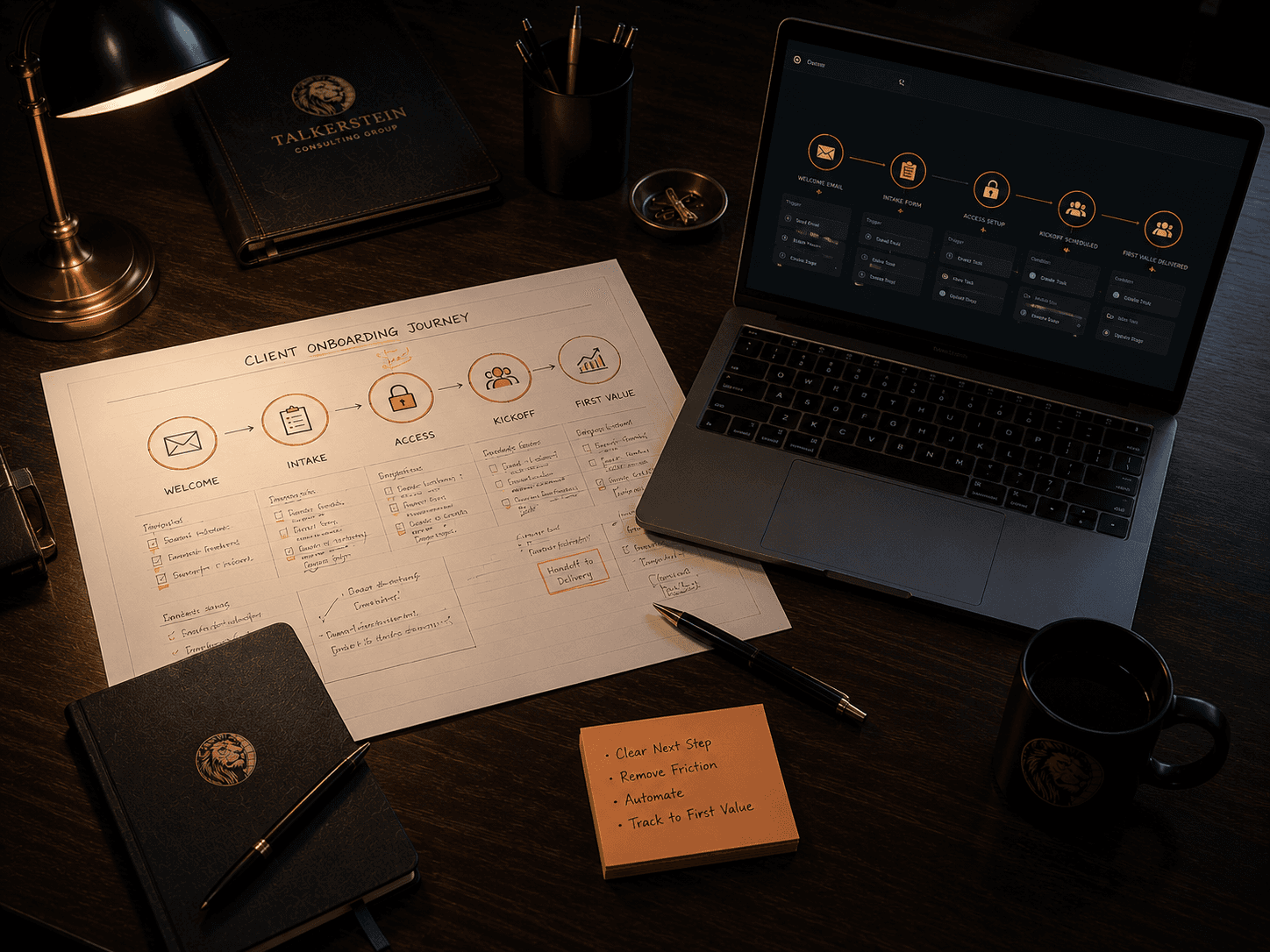
You are losing clients inside a process you do not measure.
Ask most operators how their onboarding is performing and the answer will be a shrug, a vague number, or a description of the intake form. Ask them what the median time is from contract signature to first value, and most will not know. Ask how many clients actually complete every onboarding step, and it will be a guess. The reason this matters is that unmanaged onboarding does not produce loud failures. It produces quiet ones. Clients who never fully onboard limp through the relationship with half the context, lower satisfaction, and a much shorter lifetime. They do not complain. They cancel at the twelve month mark and blame the product. The real cause was a first month that never quite resolved. Automation is the tool that makes the onboarding process visible, measurable, and improvable, rather than a black box the team is always rebuilding from memory.

What manual onboarding actually costs
The cost of a broken first month shows up twelve months later.
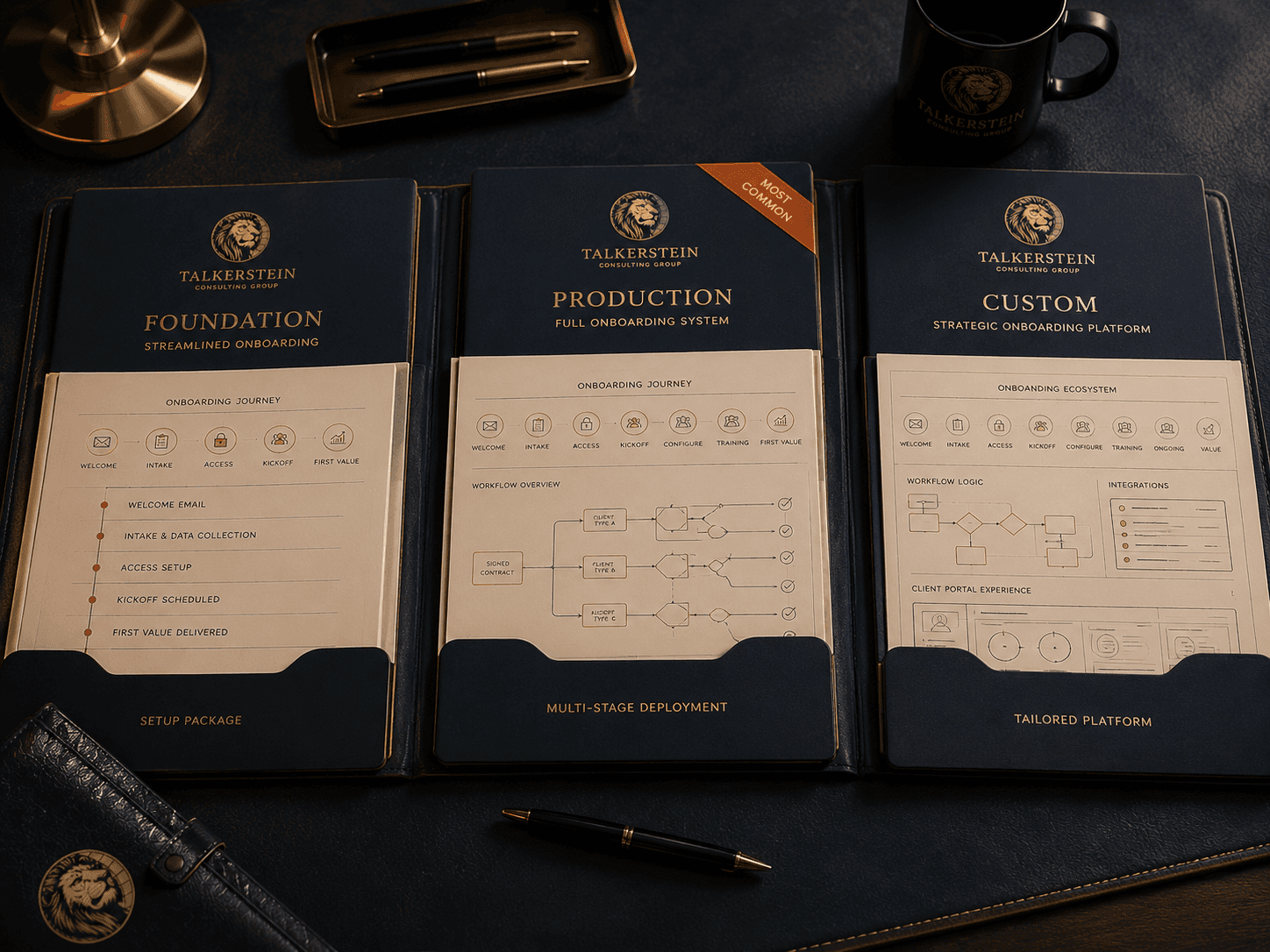
A documented onboarding system, scoped to the shape of your business.
We scope client onboarding automation in three tiers. Most service businesses land in the middle tier because their scale has outgrown their old intake form but their onboarding is still mostly linear. Teams with multiple products, multiple client types, or multiple regions usually need the upper tier from day one. Every tier is built on the tools you already run, not a parallel stack the team has to learn from scratch.
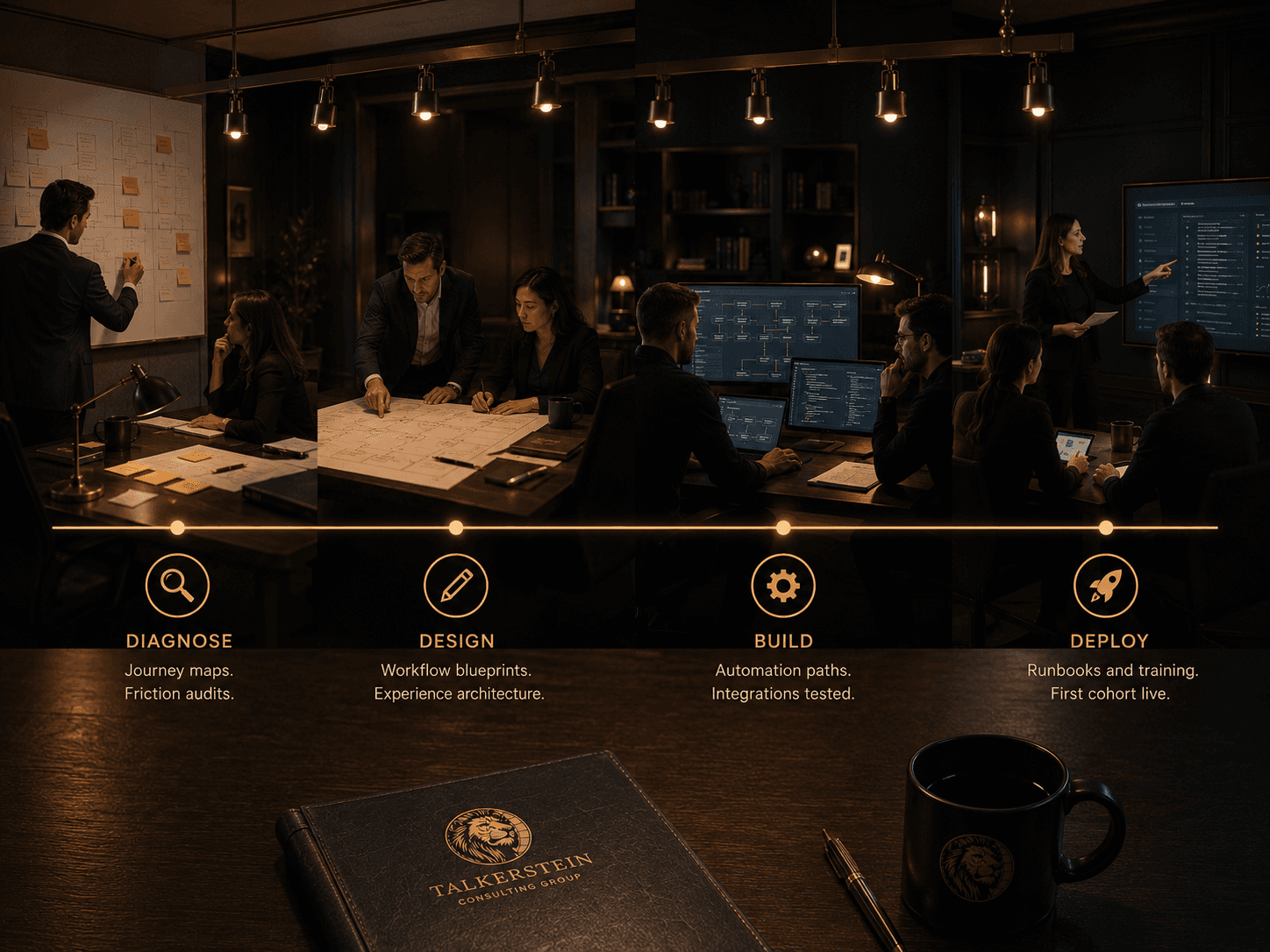
Four phases. Client experience first. Handoff designed, not assumed.
01 Diagnose — We map your current onboarding end to end, interview sales and delivery, and surface the friction points costing you time, reputation, or retention. Output is a documented journey with the top leaks named and ranked.
02 Design — We redesign the workflow. Fewer steps. Clearer requirements. A communication sequence that reassures, not overwhelms. We design the sales-to-delivery handoff explicitly, not as an afterthought.
03 Build — We configure the automation platform, wire integrations, create the sequences and conditional logic, and build the tracking and alerts. We test every path on real client data before anything ships.
04 Deploy — We launch with a first cohort, monitor completion and friction live, and optimise inside thirty days. Your team is trained, documentation is handed over, and we measure the impact against the baseline from phase one.
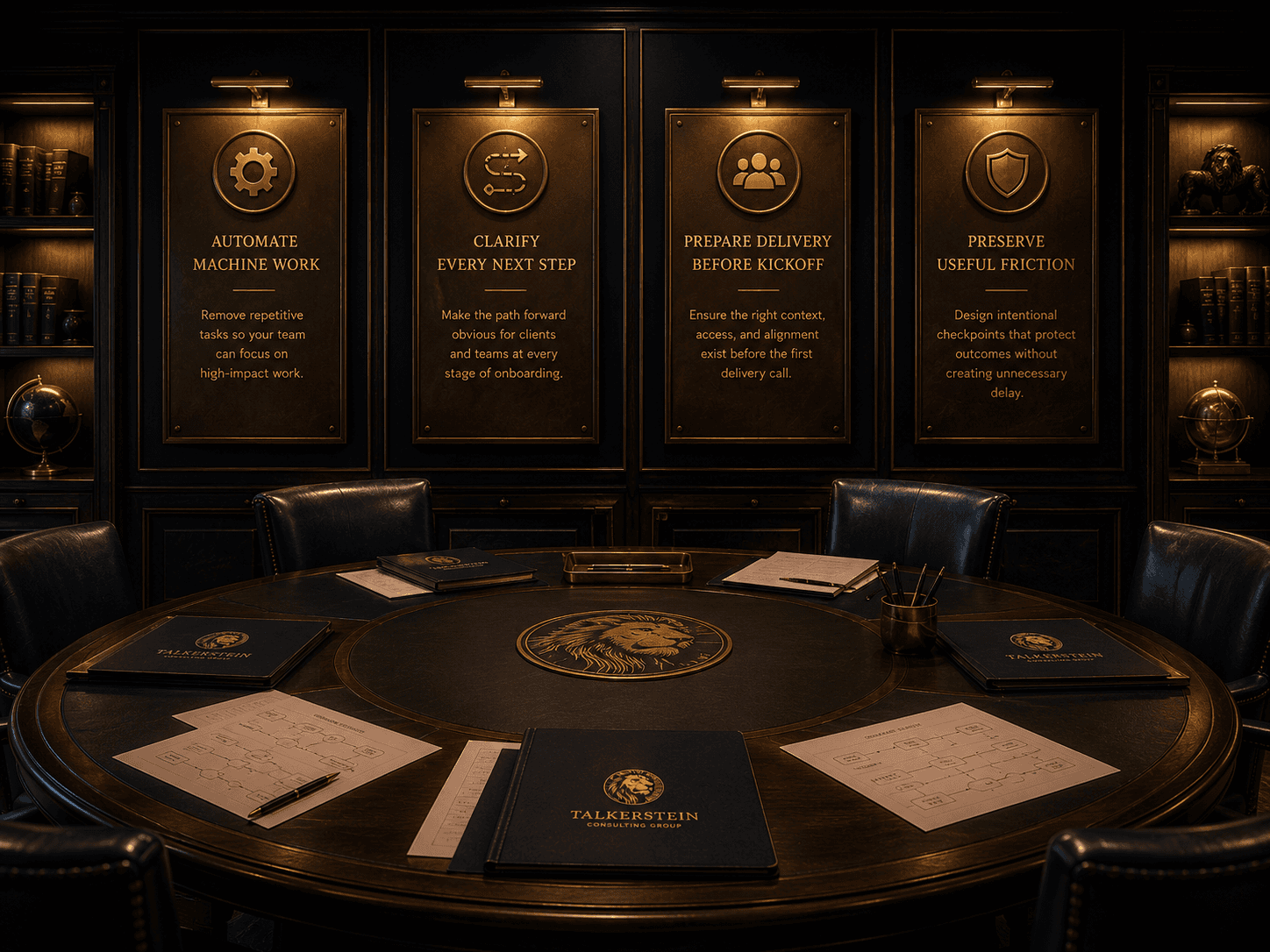
Four rules we will not break.
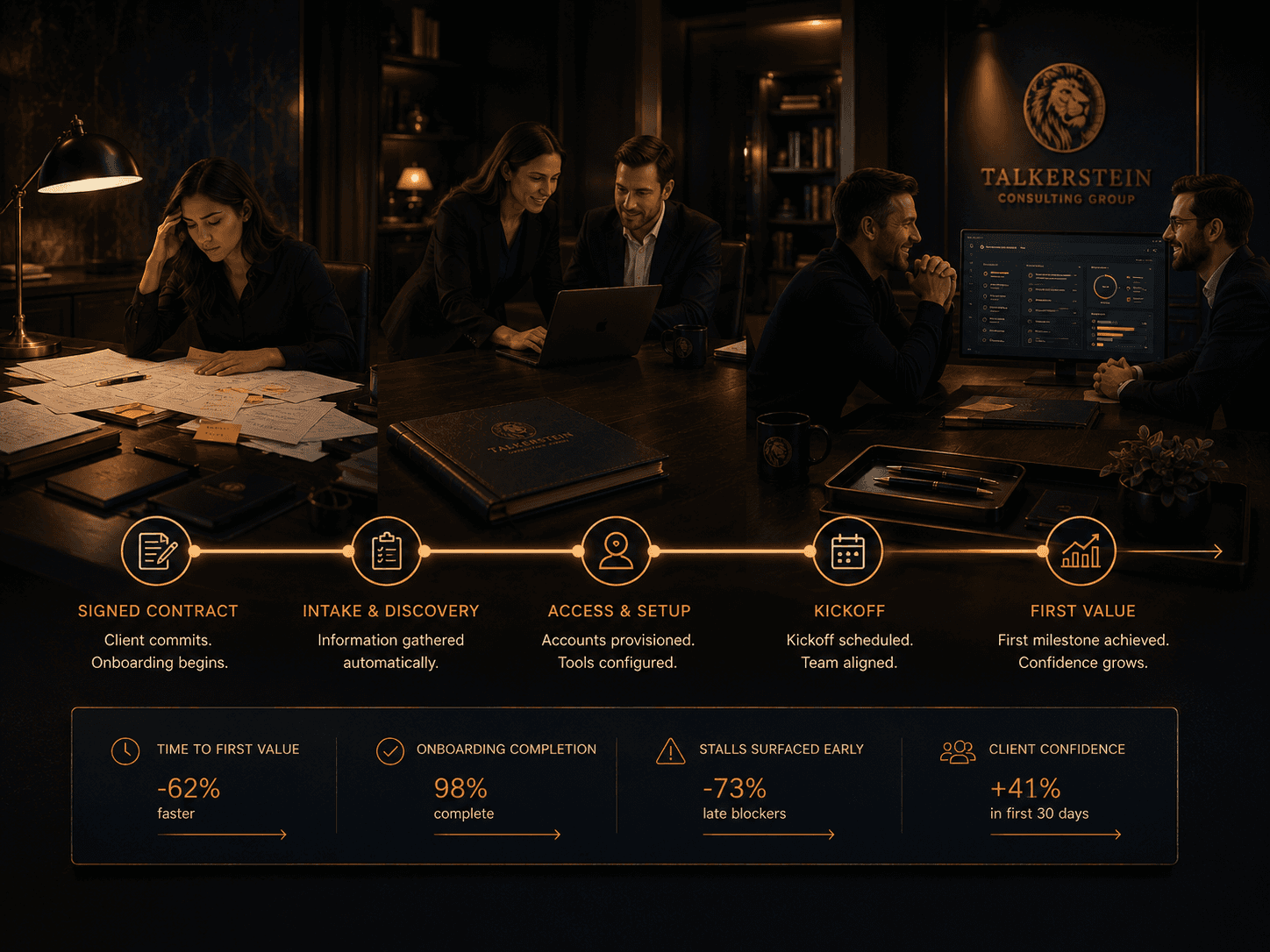
The first month becomes an asset, not a liability.
When onboarding is automated well, the change shows up in three places at once. The client experience feels deliberate and organised from signature forward. Your team gets hours back every week, and the hours they keep are spent on relationship rather than admin. And the quiet leak of clients who never fully onboarded, the ones who silently left at twelve or eighteen months, gets named and closed.

Is this the right step for you?
Work with us if
Your team has outgrown manual, spreadsheet-driven intake but has not replaced it with anything real.
You have noticed clients cancelling or disengaging in months two through six and suspect the first month is part of the cause.
Your sales-to-delivery handoff depends on memory, favour, or a single person who could leave the company next quarter.
You run more than one client type or product and your single onboarding workflow no longer fits either of them.
You want onboarding metrics that are clean enough to show a board or investor.
Do not work with us if
Every client genuinely needs a fully custom, one-off onboarding experience and you are not willing to standardise the parts that are actually repeatable.
Your leadership team does not believe onboarding has any material effect on retention and is not willing to measure it.
You are looking for a generic template dropped into a new tool without involving sales and delivery in the design.
You expect automation to compensate for a broken offer, pricing model, or delivery capability.
Your team is not in a position to absorb even modest process change in the next quarter.
What serious buyers usually ask.
How much faster is automated onboarding, honestly?
Most service businesses see time-from-signature-to-first-value drop from a few weeks to a few days. The exact delta depends on how much of your current onboarding is truly manual versus lightly tooled. We measure the baseline in phase one so the improvement is a real number, not a marketing line.
Can clients still move through onboarding at their own pace?
Yes. The workflow sets expected windows, for example complete by day three, but clients move at their own speed. Automated reminders and alerts keep them on track. Clients who stall become visible to your team before they disengage completely.
What integrations do you need from our side?
At minimum, your CRM. Ideally also your email platform, calendar, payments or billing system, and any tools new clients will be granted access to. If something is missing, we can build the integration inside the engagement. We prefer to consolidate onto tools you already pay for rather than add yet another subscription.
What happens when a client gets stuck?
Alerts route the account to the right internal owner. The workflow does not keep sending cheerful emails at someone who is stuck. A human from your team steps in with context, ideally before the client has to ask. Most of our work in phase one is making those alerts useful, not noisy.
How much can we customise the onboarding experience?
Foundation is a single, clean path for the bulk of your clients. Production supports meaningful branching by client type or product. Custom supports entirely separate onboarding paths per segment, product, or region. We match the tier to the honest shape of your business, not the ambition of the roadmap.
How do you measure whether onboarding is working?
Time to first value, completion rate, drop-off points, self-reported client satisfaction in the first thirty days, and downstream retention at the six and twelve month mark. We compare pre and post automation so the impact is legible, not just asserted.
Can clients sign documents inside the workflow?
Yes. Production and Custom tiers include embedded digital signatures and document collection. No more PDF attachments floating around email, no more chasing countersignatures, no more version confusion.
How involved does our team need to be during the build?
Expect about three to five hours a week from an ops or delivery lead during the build, plus a scoping session with your sales lead and a handoff design session with your delivery lead. Less than that and we risk building an onboarding flow that does not match how you actually onboard.
What realistic budget range should we be thinking about?
Foundation runs lighter. Production, the most common fit, sits in the mid five figures for setup plus a modest monthly optimisation fee if you want us to stay on. Custom is scoped from the business case. We never quote before a scoping call and a review of your current workflow.
What happens if we choose not to continue with you after go-live?
You keep everything. Platform access, documentation, dashboards, and integrations are yours. The onboarding system continues running. We build every engagement so another team, internal or external, could pick it up cleanly. That is the test of whether the build was honest.
Our Services




Automation • Client Onboarding
The first thirty days decide whether the client stays. Most teams leave them to chance.
Onboarding is not a document. It is the period where a new client is quietly deciding whether the thing they just paid for is going to work. They notice every delay. They read every email. They remember the first time your team asks for information you already have. Most service and software businesses treat onboarding as an administrative inconvenience between sales and delivery, held together by whichever team member is least likely to forget. That is how churn starts before the work does. Onboarding automation puts the client on a clear, fast, documented path from signed contract to first value, and it gives your team the time and information to make the human part of the relationship actually feel human.
You are losing clients inside a process you do not measure.
Ask most operators how their onboarding is performing and the answer will be a shrug, a vague number, or a description of the intake form. Ask them what the median time is from contract signature to first value, and most will not know. Ask how many clients actually complete every onboarding step, and it will be a guess. The reason this matters is that unmanaged onboarding does not produce loud failures. It produces quiet ones. Clients who never fully onboard limp through the relationship with half the context, lower satisfaction, and a much shorter lifetime. They do not complain. They cancel at the twelve month mark and blame the product. The real cause was a first month that never quite resolved. Automation is the tool that makes the onboarding process visible, measurable, and improvable, rather than a black box the team is always rebuilding from memory.
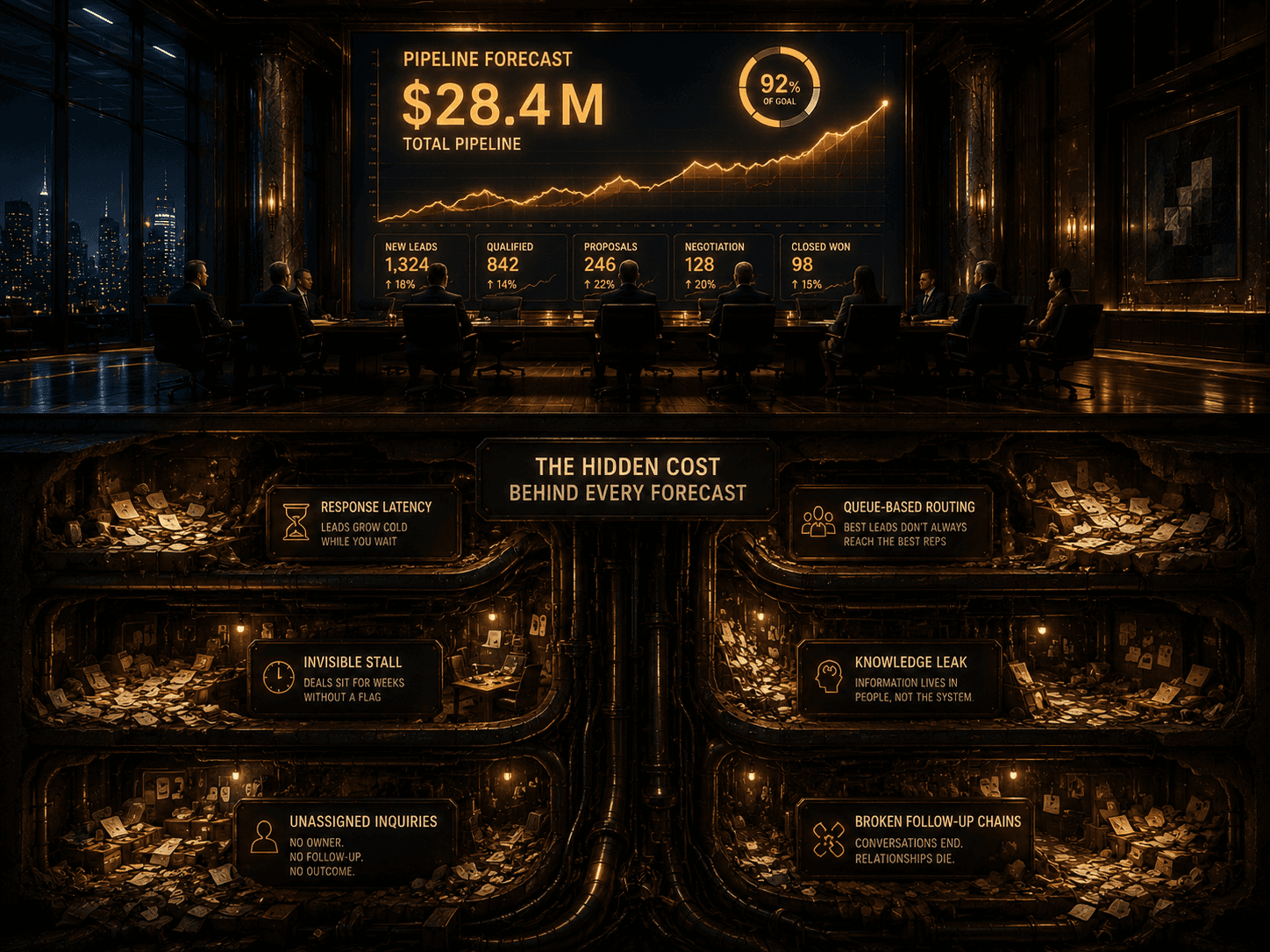
What manual onboarding actually costs
The cost of a broken first month shows up twelve months later.
Silent churn
Clients who never fully onboard cancel months later, and the team blames product when the real cause was a missed first month.
Handoff fog
Sales finishes the deal, delivery inherits a half-filled folder, and the client has to repeat themselves. Every repeat costs credibility.
Inconsistent experience
Two clients who signed the same contract have wildly different first-month experiences, depending on who happened to own their account that week.
Delivery drag
Projects that should start in week one start in week four because information is still being chased. Your best people spend their best hours nagging.
Admin tax on senior people
Hours a week of form-chasing, access provisioning, and reminder sending sit on people whose time is worth more than the workflow they are replacing.
Invisible process
When the workflow lives in one person's head, it cannot be audited, improved, or handed over. One departure and institutional knowledge walks out the door.
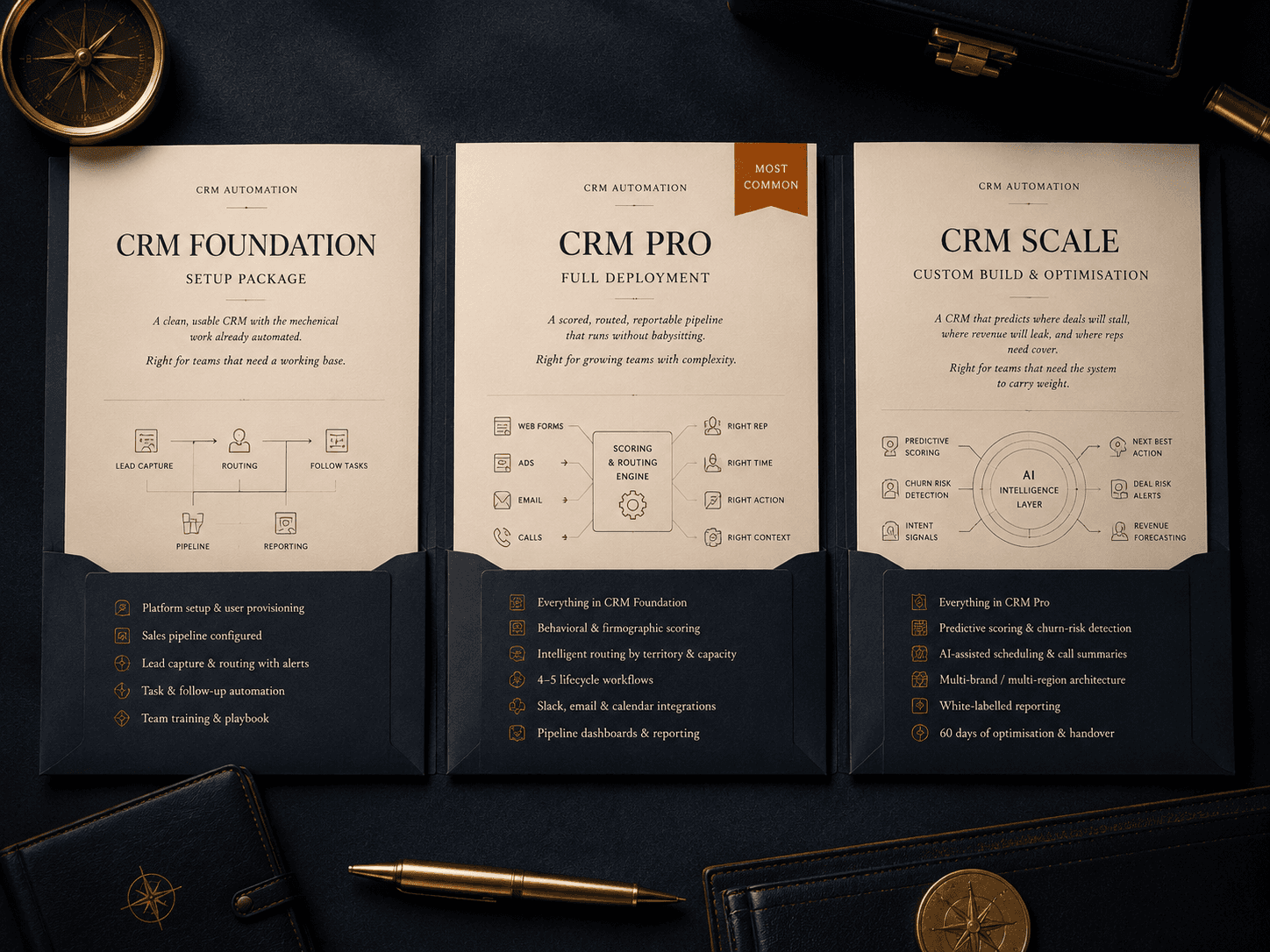
A documented onboarding system, scoped to the shape of your business.
We scope client onboarding automation in three tiers. Most service businesses land in the middle tier because their scale has outgrown their old intake form but their onboarding is still mostly linear. Teams with multiple products, multiple client types, or multiple regions usually need the upper tier from day one. Every tier is built on the tools you already run, not a parallel stack the team has to learn from scratch.
G1
Streamlined Onboarding
A single, clean onboarding path for the bulk of your clients. Right for teams standardising for the first time or moving off email-and-spreadsheet intake: onboarding journey mapped end to end, three to five automated emails and task triggers, digital intake and data collection synced into the CRM, conditional branching for the key variations, handoff document generated for delivery, completion tracking and status view.
I'm Interested
G2
Full Onboarding System
Most Common
A complete, automated onboarding orchestration layer that handles intake, access, kickoff scheduling, and sales-to-delivery handoff. Right for growth-stage service and SaaS teams scaling past the founder-run phase: everything in Foundation, multi-stage sequences, conditional routing by client type, CRM sync, system access provisioning, calendar integration, document collection and digital signatures, delivery team dashboard, and pre-built reporting on time to first value.
I'm Interested
G3
Enterprise Onboarding
Different onboarding paths for different client types, products, or regions, with advanced governance and reporting. Right for teams running multiple brands, regulated industries, or enterprise-level accounts: everything in Production, separate onboarding journeys per product or segment, advanced data validation, billing and entitlement system integration, custom API connections, white-label client portal, advanced permission management, and detailed onboarding analytics with cohort views and churn correlation.
I'm Interested

The automations that carry the most weight in a real onboarding.
No two businesses need exactly the same onboarding flow. That said, the automations below are the ones we keep coming back to across service, SaaS, and hybrid businesses. They are a starting palette. We build the ones that match how you actually onboard and skip the ones that add complexity without return.
Welcome and intake sequence
Automated welcome email with branded tone, intake form collection, and CRM record creation triggered at contract signature. The client has a clear first step before your team has opened their inbox.
System access provisioning
Automated seat creation, tool access, and licence assignment tied to completion of intake steps. No more access being granted days late by someone who forgot.
Sales-to-delivery handoff
Every piece of intake data, sales context, and signed scope handed to the delivery team in a structured brief. They walk into kickoff already informed.
Stalled client alerts
Automated detection when a client has not progressed past a step within the expected window. The right internal owner is alerted before the client disengages.
Conditional routing by client type
Routing logic that branches by product, tier, or client segment. Different clients follow different paths without your team manually directing each one.
Kickoff scheduling
Calendar invite generation and availability matching sent automatically at the right stage. No email back-and-forth, no missed handoffs.
Document collection and signatures
NDAs, contracts, scope acknowledgements, and onboarding documents collected and countersigned inside the workflow. No more PDF attachments floating in email.
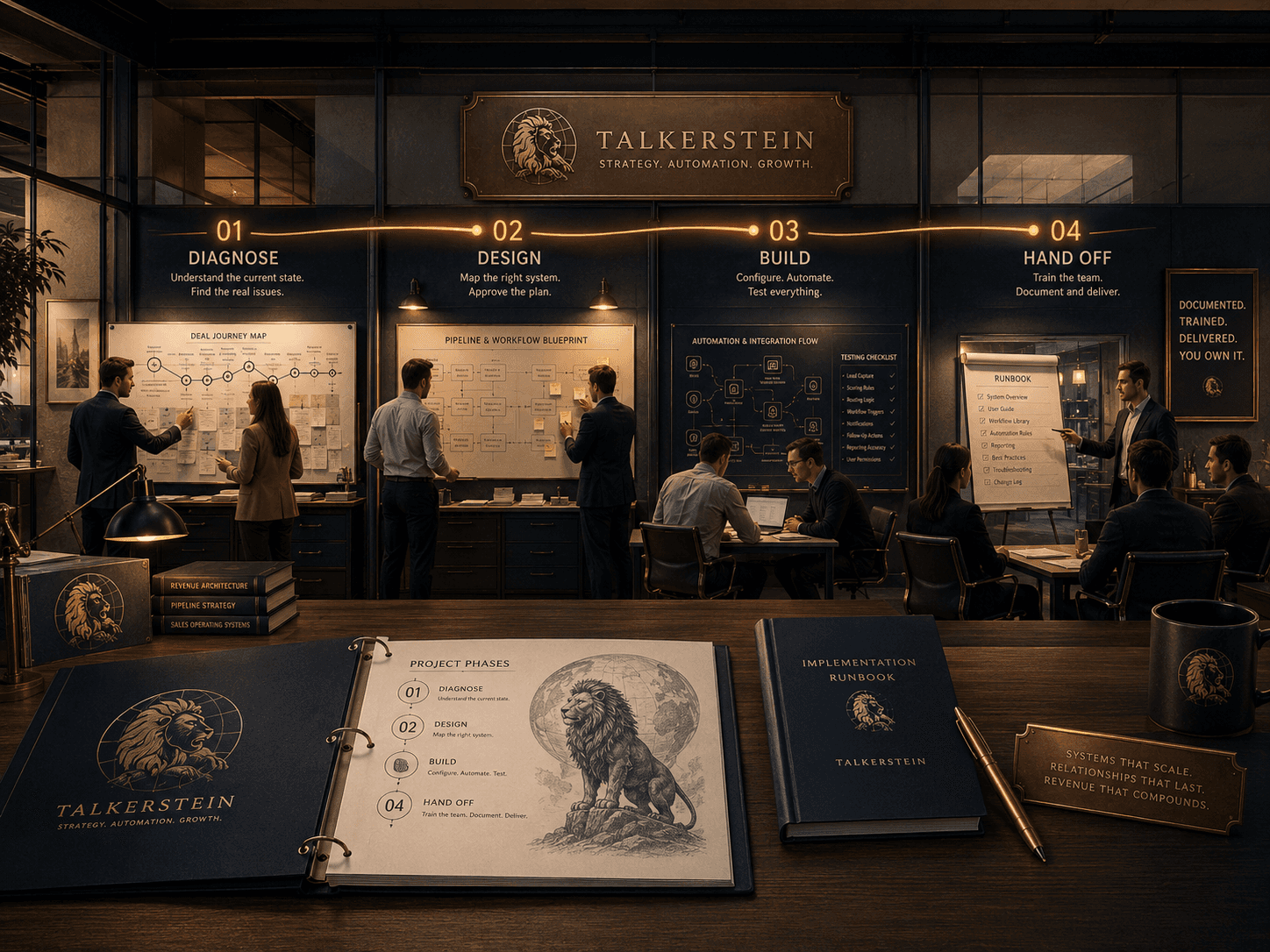
Four phases. Client experience first. Handoff designed, not assumed.
01 Diagnose — We map your current onboarding end to end, interview sales and delivery, and surface the friction points costing you time, reputation, or retention. Output is a documented journey with the top leaks named and ranked. 02 Design — We redesign the workflow. Fewer steps. Clearer requirements. A communication sequence that reassures, not overwhelms. We design the sales-to-delivery handoff explicitly, not as an afterthought. 03 Build — We configure the automation platform, wire integrations, create the sequences and conditional logic, and build the tracking and alerts. We test every path on real client data before anything ships. 04 Deploy — We launch with a first cohort, monitor completion and friction live, and optimise inside thirty days. Your team is trained, documentation is handed over, and we measure the impact against the baseline from phase one.

Four rules we will not break.
Automate the machine work. Keep the human work human.
Forms, access provisioning, reminders, and sequencing get automated. Kickoff calls, strategy moments, and account relationship stay with your best people. Clients should feel the team, not the platform.
The delivery team never inherits a blank page.
By the time delivery meets the client, every piece of information they need is in the CRM, tagged, searchable, and linked to the account. They should walk into kickoff already informed.
Every client always knows the next step.
If a client ever has to ask what happens next, the workflow has failed. Every stage ends with a clear, specific, human-language action for the client and for your team.
Friction is a feature, not a bug, in the right places.
Some friction is necessary. Signatures, confirmations, scope acknowledgements. We design in the friction that protects the relationship and design out the friction that corrodes it.
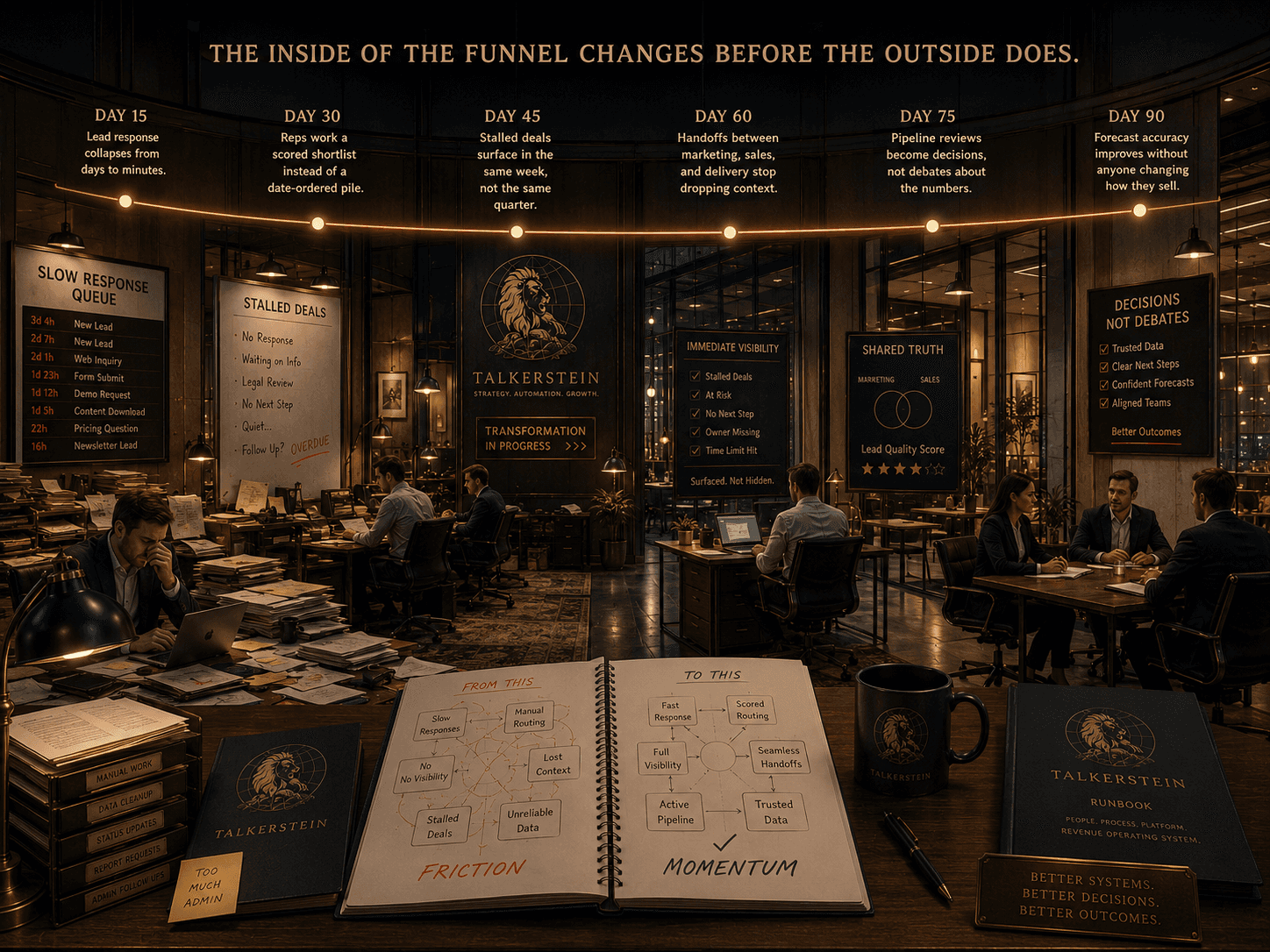
The first month becomes an asset, not a liability.
When onboarding is automated well, the change shows up in three places at once. The client experience feels deliberate and organised from signature forward. Your team gets hours back every week, and the hours they keep are spent on relationship rather than admin. And the quiet leak of clients who never fully onboarded, the ones who silently left at twelve or eighteen months, gets named and closed.
Time from signed contract to first value drops meaningfully.
Senior delivery hours stop being spent on form-chasing.
Stalled or stuck clients become visible and addressable, not invisible.
Sales-to-delivery handoff becomes a documented event, not a hope.
Clients report higher confidence in the first thirty days.
Leadership has onboarding metrics they can actually trust.

Is this the right step for you?
Work with us if
Your team has outgrown manual, spreadsheet-driven intake but has not replaced it with anything real. You have noticed clients cancelling or disengaging in months two through six and suspect the first month is part of the cause. Your sales-to-delivery handoff depends on memory, favour, or a single person who could leave the company next quarter. You run more than one client type or product and your single onboarding workflow no longer fits either of them. You want onboarding metrics that are clean enough to show a board or investor.
Do not work with us if
Every client genuinely needs a fully custom, one-off onboarding experience and you are not willing to standardise the parts that are actually repeatable. Your leadership team does not believe onboarding has any material effect on retention and is not willing to measure it. You are looking for a generic template dropped into a new tool without involving sales and delivery in the design. You expect automation to compensate for a broken offer, pricing model, or delivery capability. Your team is not in a position to absorb even modest process change in the next quarter.
What serious buyers usually ask.
How much faster is automated onboarding, honestly?
Most service businesses see time-from-signature-to-first-value drop from a few weeks to a few days. The exact delta depends on how much of your current onboarding is truly manual versus lightly tooled. We measure the baseline in phase one so the improvement is a real number, not a marketing line.
Can clients still move through onboarding at their own pace?
Yes. The workflow sets expected windows, for example complete by day three, but clients move at their own speed. Automated reminders and alerts keep them on track. Clients who stall become visible to your team before they disengage completely.
What integrations do you need from our side?
At minimum, your CRM. Ideally also your email platform, calendar, payments or billing system, and any tools new clients will be granted access to. If something is missing, we can build the integration inside the engagement. We prefer to consolidate onto tools you already pay for rather than add yet another subscription.
What happens when a client gets stuck?
Alerts route the account to the right internal owner. The workflow does not keep sending cheerful emails at someone who is stuck. A human from your team steps in with context, ideally before the client has to ask. Most of our work in phase one is making those alerts useful, not noisy.
How much can we customise the onboarding experience?
Foundation is a single, clean path for the bulk of your clients. Production supports meaningful branching by client type or product. Custom supports entirely separate onboarding paths per segment, product, or region. We match the tier to the honest shape of your business, not the ambition of the roadmap.
How do you measure whether onboarding is working?
Time to first value, completion rate, drop-off points, self-reported client satisfaction in the first thirty days, and downstream retention at the six and twelve month mark. We compare pre and post automation so the impact is legible, not just asserted.
Can clients sign documents inside the workflow?
Yes. Production and Custom tiers include embedded digital signatures and document collection. No more PDF attachments floating around email, no more chasing countersignatures, no more version confusion.
How involved does our team need to be during the build?
Expect about three to five hours a week from an ops or delivery lead during the build, plus a scoping session with your sales lead and a handoff design session with your delivery lead. Less than that and we risk building an onboarding flow that does not match how you actually onboard.
What realistic budget range should we be thinking about?
Foundation runs lighter. Production, the most common fit, sits in the mid five figures for setup plus a modest monthly optimisation fee if you want us to stay on. Custom is scoped from the business case. We never quote before a scoping call and a review of your current workflow.
What happens if we choose not to continue with you after go-live?
You keep everything. Platform access, documentation, dashboards, and integrations are yours. The onboarding system continues running. We build every engagement so another team, internal or external, could pick it up cleanly. That is the test of whether the build was honest.
Our Services

Quick Links


" height="149.2535067768008px" id="IOCTf08f5" width="1199.9520008715217px"/></svg>)