Branding • Brand Guidelines

Guidelines your team will actually open.

Most guideline documents fail the same way. They are sixty pages of theory, saved on a shared drive nobody opens, and the next freelancer still builds a deck with the wrong colors, the wrong logo lockup, and a font nobody sanctioned. The brand does not drift because people disrespect it. It drifts because the rulebook is not usable in the work.

We write the other kind of guideline. Short enough to read, specific enough to apply, and anchored to the tools your team is already in. The test is not how beautiful the document looks. The test is whether the rulebook is open on someone's second screen while real work ships.
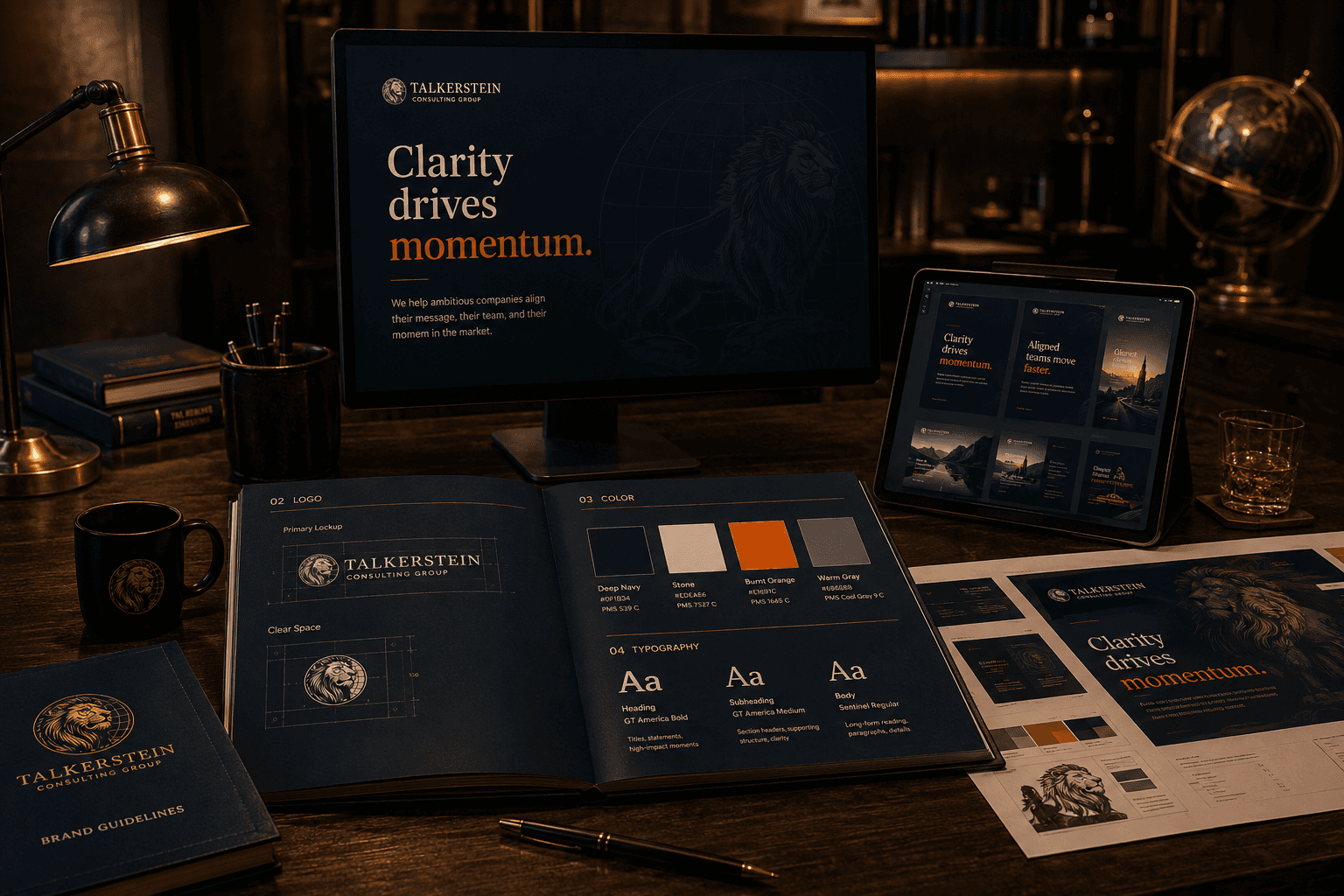
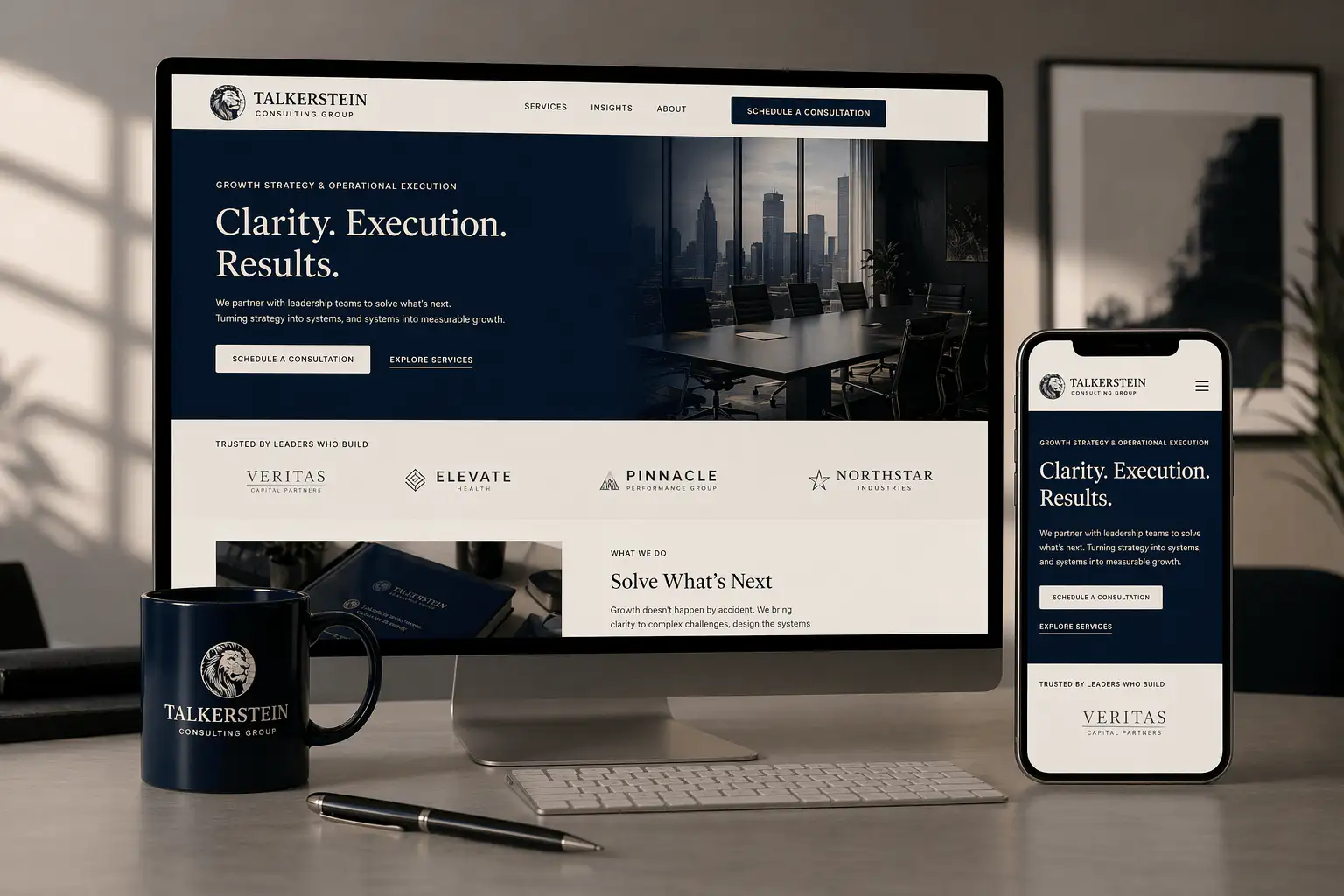
branding guidelines talkerstein consulting group

A brand without a rulebook drifts the moment you stop being the only person touching it.

At three people, every surface runs through the founder. The brand stays consistent because one person is the filter. At fifteen people, that filter is a bottleneck. At fifty, it is a tax. Freelancers pick colors from an old deck. A new hire uses an off-brand font because the right one is not installed. Sales redesigns the proposal template because the old one looked "a bit dated."

Guidelines are how you stop paying that tax. Not as control. As permission. Permission for the next freelancer to produce on-brand work on day one. Permission for the new marketing hire to ship a campaign in week two without a review queue. Permission for the founder to stop adjudicating which blue to use in the invoice header.

talkerstein consulting group image of branding costs

You feel the cost in rework, in perception, and eventually in the pipeline.

Brand drift is quiet. No one email makes the case to the founder that the guidelines matter. Each individual slip looks like nothing. The cumulative cost shows up later as rework hours, onboarding delays, and the slow erosion of how serious your brand feels to buyers comparing three vendors.
Vendor rework.

Every new freelancer or agency reinvents the wheel. They redraw the logo at wrong proportions. They pick a color from an older deck. They choose a font close to but not the actual brand font. Someone on your team catches it at review, the contractor rebuilds, the project ships a week late.

Surface inconsistency.

The website, the deck, the invoices, the support email, and the social grid look like five adjacent companies. A buyer compares you to a competitor with a tighter visual language and feels the gap without being able to name it.

Onboarding drag.

A new marketing hire spends their first fortnight reverse-engineering the brand from old decks instead of reading it. They ship their first piece a month in, it needs correction, and the team rebuilds the rulebook in their head one Slack message at a time.

Perceived softness.

Inconsistency reads as disorganization. Serious buyers feel it before they can name it. A competitor that holds a tighter visual line feels more competent, even when their product is weaker on paper.

Vendor rework.

Every new freelancer or agency reinvents the wheel. They redraw the logo at wrong proportions. They pick a color from an older deck. They choose a font close to but not the actual brand font. Someone on your team catches it at review, the contractor rebuilds, the project ships a week late.

Onboarding drag.

A new marketing hire spends their first fortnight reverse-engineering the brand from old decks instead of reading it. They ship their first piece a month in, it needs correction, and the team rebuilds the rulebook in their head one Slack message at a time.

Surface inconsistency.

The website, the deck, the invoices, the support email, and the social grid look like five adjacent companies. A buyer compares you to a competitor with a tighter visual language and feels the gap without being able to name it.

Perceived softness.

Inconsistency reads as disorganization. Serious buyers feel it before they can name it. A competitor that holds a tighter visual line feels more competent, even when their product is weaker on paper.

Vendor rework.

Every new freelancer or agency reinvents the wheel. They redraw the logo at wrong proportions. They pick a color from an older deck. They choose a font close to but not the actual brand font. Someone on your team catches it at review, the contractor rebuilds, the project ships a week late.

Surface inconsistency.

The website, the deck, the invoices, the support email, and the social grid look like five adjacent companies. A buyer compares you to a competitor with a tighter visual language and feels the gap without being able to name it.

Onboarding drag.

A new marketing hire spends their first fortnight reverse-engineering the brand from old decks instead of reading it. They ship their first piece a month in, it needs correction, and the team rebuilds the rulebook in their head one Slack message at a time.

Perceived softness.

Inconsistency reads as disorganization. Serious buyers feel it before they can name it. A competitor that holds a tighter visual line feels more competent, even when their product is weaker on paper.

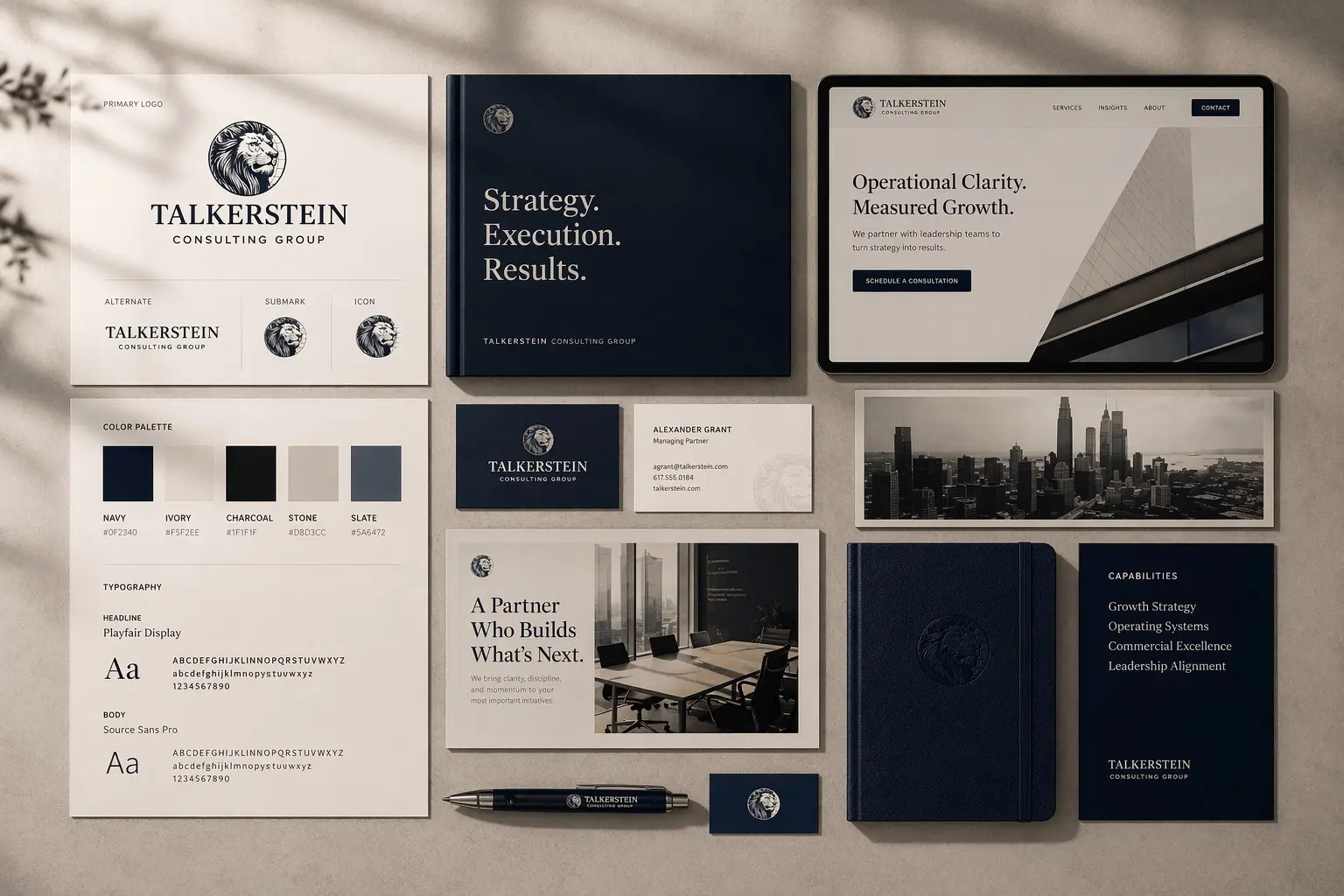
six components of branding by talkerstein consulting

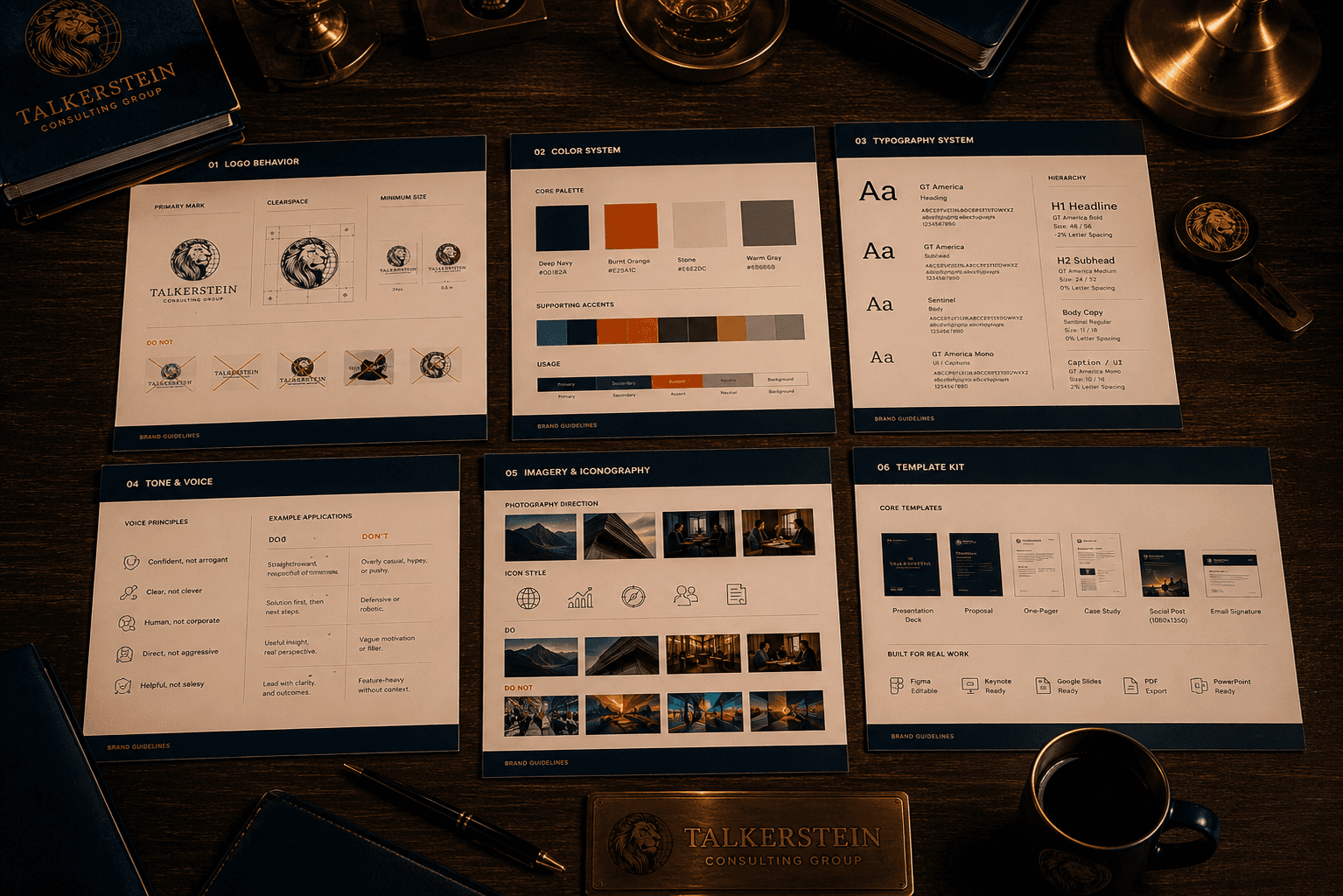
Six components. Written the way your team actually uses them.

We do not write to a page count. We write the decisions your team makes every week. Each component answers a specific operational question, with examples of the right answer and the wrong one.
Logo behavior.

Primary and secondary marks, clearspace rules, minimum sizes across screen and print, stacking and lockup variations, what never touches the logo, how the mark behaves on dark, photographic, and noisy backgrounds.

Typography system.

Type families, weights, sizes, line heights, letter spacing, and the hierarchy rules for headlines, subheads, body, UI, and captions. Licensing and installation notes so the stack works in Google Docs, Figma, Keynote, and production tools.

Imagery and iconography.

Photography direction, illustration or pattern rules, icon style, and the specific aesthetic choices you want protected. Includes the do-not examples that usually matter most for contractors.

Color system.

Core palette, supporting accents, tints and shades, accessibility pairings, print and screen values, and the rule for where each color belongs in the hierarchy so the team is not re-picking colors every brief.

Tone and voice.

Voice principles, audience adjustments, banned words, preferred phrasing, and worked examples across cold email, support reply, social post, and sales deck. Voice lives in the guideline, not in a separate document nobody cross-references.

Template kit.

The three to six templates your team reaches for weekly. Deck, proposal, social, email signature, one-pager, and a case study layout. Editable in Figma and exported to the tools your team actually ships from.

Logo behavior.

Primary and secondary marks, clearspace rules, minimum sizes across screen and print, stacking and lockup variations, what never touches the logo, how the mark behaves on dark, photographic, and noisy backgrounds.

Color system.

Core palette, supporting accents, tints and shades, accessibility pairings, print and screen values, and the rule for where each color belongs in the hierarchy so the team is not re-picking colors every brief.

Typography system.

Type families, weights, sizes, line heights, letter spacing, and the hierarchy rules for headlines, subheads, body, UI, and captions. Licensing and installation notes so the stack works in Google Docs, Figma, Keynote, and production tools.

Tone and voice.

Voice principles, audience adjustments, banned words, preferred phrasing, and worked examples across cold email, support reply, social post, and sales deck. Voice lives in the guideline, not in a separate document nobody cross-references.

Imagery and iconography.

Photography direction, illustration or pattern rules, icon style, and the specific aesthetic choices you want protected. Includes the do-not examples that usually matter most for contractors.

Template kit.

The three to six templates your team reaches for weekly. Deck, proposal, social, email signature, one-pager, and a case study layout. Editable in Figma and exported to the tools your team actually ships from.

Logo behavior.

Primary and secondary marks, clearspace rules, minimum sizes across screen and print, stacking and lockup variations, what never touches the logo, how the mark behaves on dark, photographic, and noisy backgrounds.

Typography system.

Type families, weights, sizes, line heights, letter spacing, and the hierarchy rules for headlines, subheads, body, UI, and captions. Licensing and installation notes so the stack works in Google Docs, Figma, Keynote, and production tools.

Imagery and iconography.

Photography direction, illustration or pattern rules, icon style, and the specific aesthetic choices you want protected. Includes the do-not examples that usually matter most for contractors.

Color system.

Core palette, supporting accents, tints and shades, accessibility pairings, print and screen values, and the rule for where each color belongs in the hierarchy so the team is not re-picking colors every brief.

Tone and voice.

Voice principles, audience adjustments, banned words, preferred phrasing, and worked examples across cold email, support reply, social post, and sales deck. Voice lives in the guideline, not in a separate document nobody cross-references.

Template kit.

The three to six templates your team reaches for weekly. Deck, proposal, social, email signature, one-pager, and a case study layout. Editable in Figma and exported to the tools your team actually ships from.

four phases mapped out of a branding guideline service by talkerstein consulting

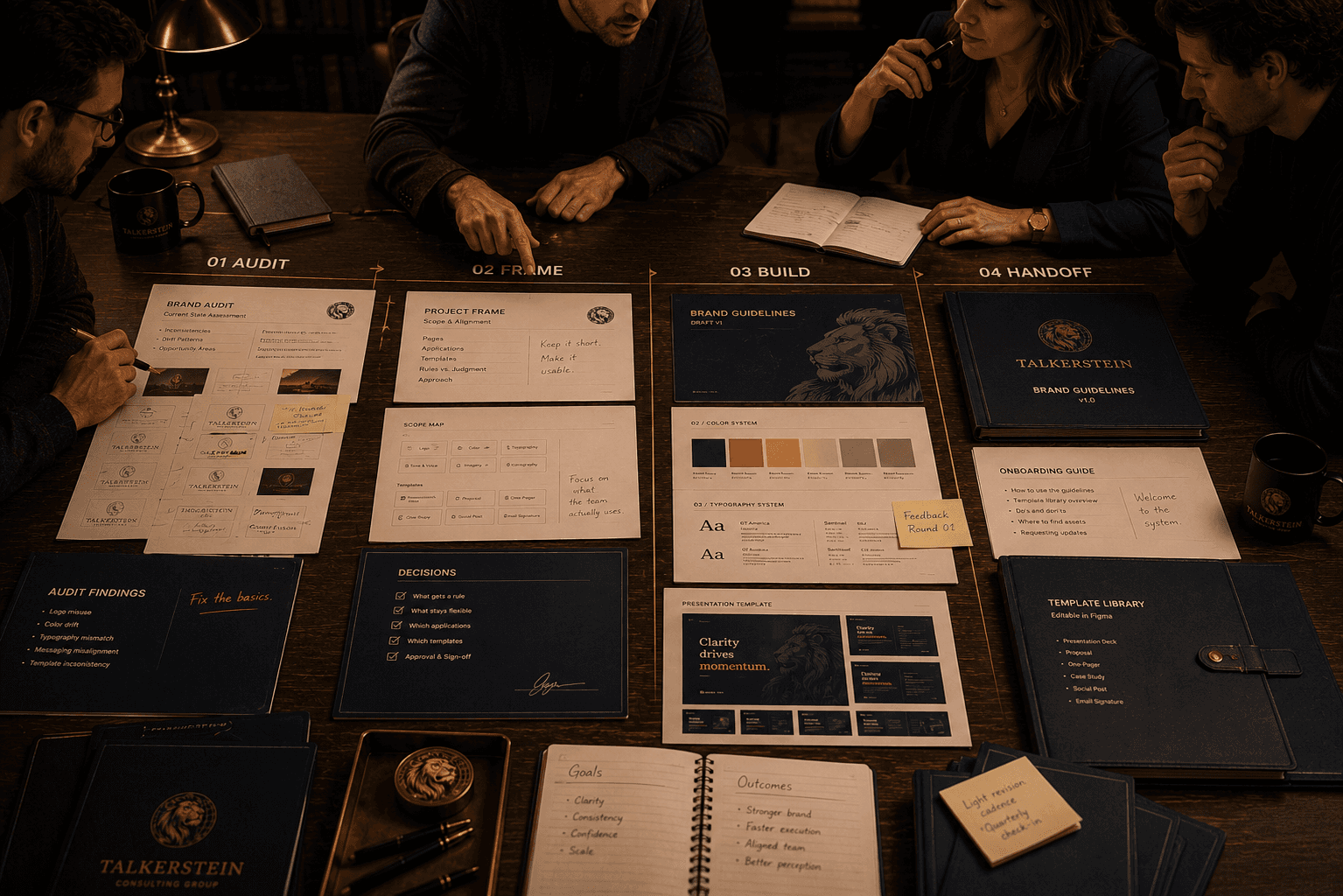
Four phases, roughly three to five weeks.

Phase 1 Audit

We pull every live surface of your brand, everything shipped in the last six months, and whatever exists as a guideline today. We name the drift patterns and the rules that need to exist so the drift stops.

Phase 2 Frame

We agree on the scope of the guideline with leadership. How many pages. Which applications. Which templates. What gets a rule and what stays to team judgment. The scope is signed before we draft a single page, which is how we keep the document short.

Phase 3 Build

We draft the document, build the Figma file with editable components, produce the templates, and ship a review round to your team. One revision round is standard. We write the document with the working designer and the marketing manager in mind, not the brand deck judges.

Phase 4 Hand off

We run a one-hour team session so everyone sees the document in use, not just as a PDF. We set up the editable Figma file and template library inside your workspace, agree to a light revision cadence, and exit.
a descriptive image of do's and don't that talkerstein consulting follows for brand guidelines

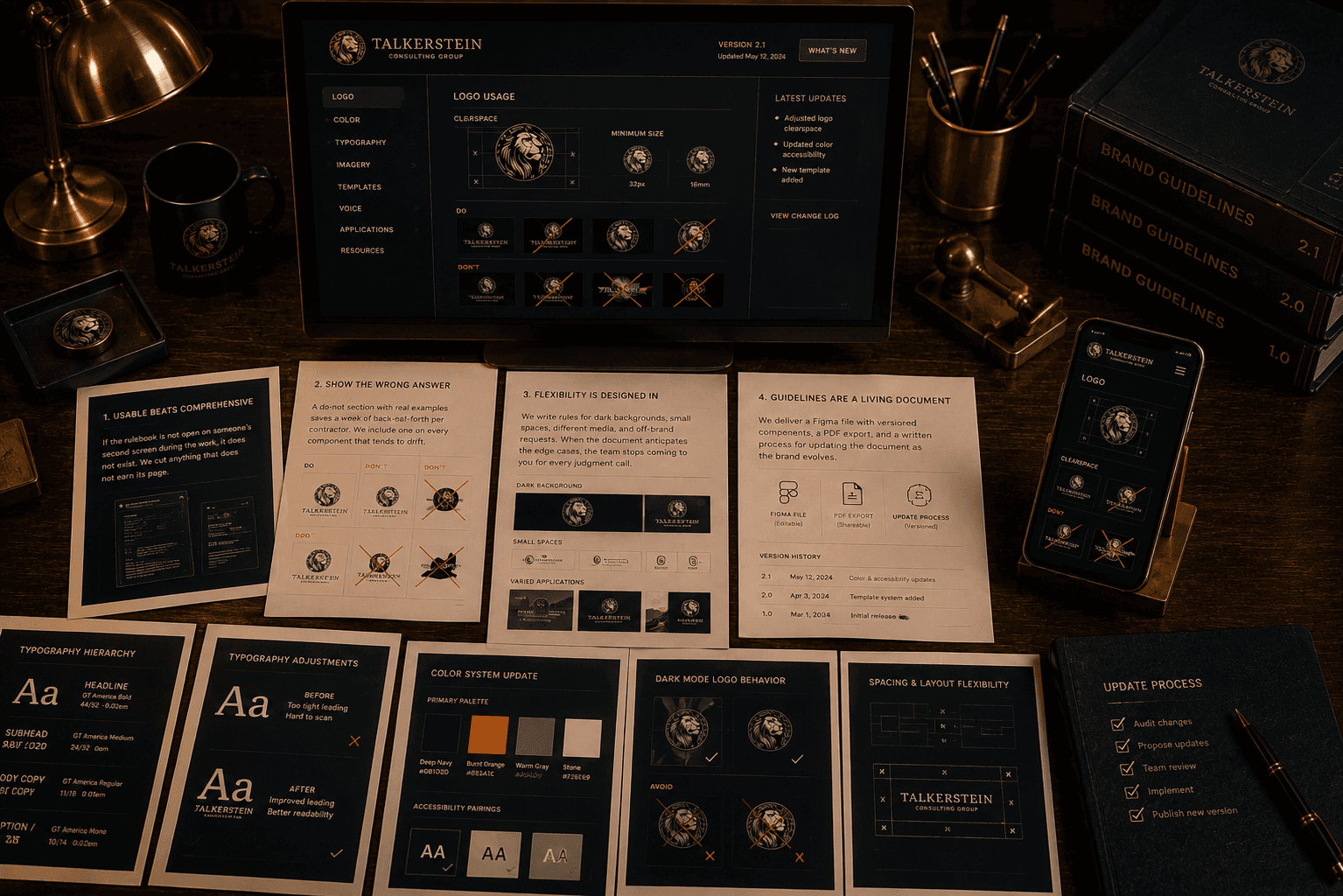
Four rules we hold the document to.

Usable beats comprehensive.

If the rulebook is not open on someone's second screen during the work, it does not exist. We cut anything that does not earn its page.

Flexibility is designed in.

We write rules for dark backgrounds, small spaces, different media, and off-brand requests. When the document anticipates the edge cases, the team stops coming to you for every judgment call.

Show the wrong answer.

A do-not section with real examples saves a week of back-and-forth per contractor. We include one on every component that tends to drift.

Guidelines are a living document.

We deliver a Figma file with versioned components, a PDF export, and a written process for updating the document as the brand evolves.

Usable beats comprehensive.

If the rulebook is not open on someone's second screen during the work, it does not exist. We cut anything that does not earn its page.

Show the wrong answer.

A do-not section with real examples saves a week of back-and-forth per contractor. We include one on every component that tends to drift.

Flexibility is designed in.

We write rules for dark backgrounds, small spaces, different media, and off-brand requests. When the document anticipates the edge cases, the team stops coming to you for every judgment call.

Guidelines are a living document.

We deliver a Figma file with versioned components, a PDF export, and a written process for updating the document as the brand evolves.

Usable beats comprehensive.

If the rulebook is not open on someone's second screen during the work, it does not exist. We cut anything that does not earn its page.

Flexibility is designed in.

We write rules for dark backgrounds, small spaces, different media, and off-brand requests. When the document anticipates the edge cases, the team stops coming to you for every judgment call.

Show the wrong answer.

A do-not section with real examples saves a week of back-and-forth per contractor. We include one on every component that tends to drift.

Guidelines are a living document.

We deliver a Figma file with versioned components, a PDF export, and a written process for updating the document as the brand evolves.

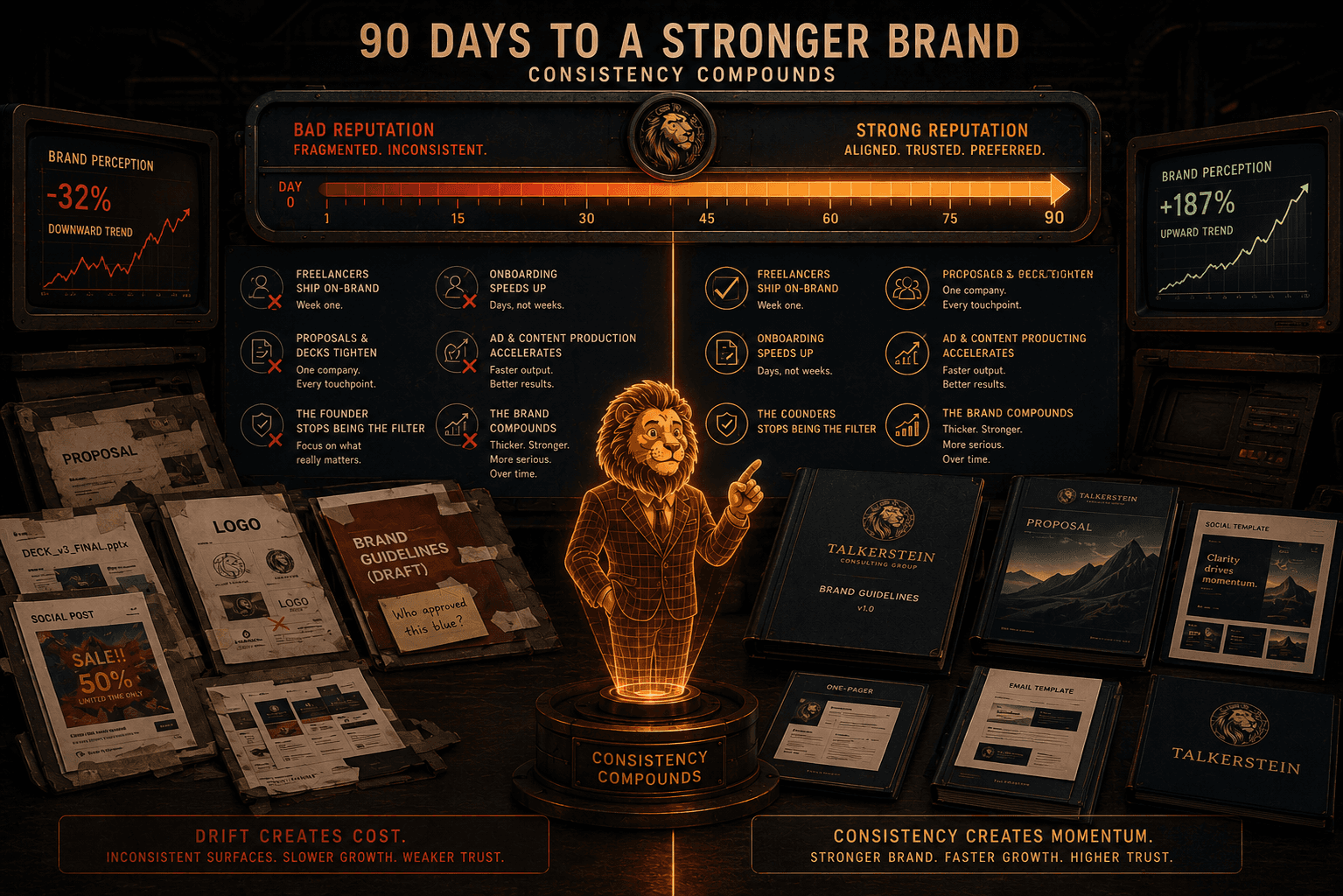
a split comparison image showing the changes after talkerstein consulting's brand guidelines' service

Six shifts you will notice in the first ninety days.

Companies that adopt the system inside a real rollout window tend to see the same pattern inside ninety days. The sales team starts pitching the same company. Marketing stops rewriting foundations on every campaign. Content tightens. New hires ramp faster.

Freelancers ship on-brand in week one. New contractors read the document, produce work that matches, and stop pinging the founder every afternoon.
Proposals and decks tighten. The templates inside the guideline get adopted. The surfaces buyers see look like one company across every touchpoint.
The founder stops being the filter. Leadership stops reviewing brand trivia. Escalations become real ones, not which blue to use.
Onboarding speeds up. New marketing, design, and sales hires pick up the brand in days. Their first pieces are on-brand by default.
Ad and content production accelerates. Social, email, and paid content teams stop reinventing treatment choices on every campaign.
The brand compounds instead of drifting. Every new surface reinforces the last one. The brand starts to feel thicker and more serious over time, not thinner.
Freelancers ship on-brand in week one. New contractors read the document, produce work that matches, and stop pinging the founder every afternoon.
Onboarding speeds up. New marketing, design, and sales hires pick up the brand in days. Their first pieces are on-brand by default.
Proposals and decks tighten. The templates inside the guideline get adopted. The surfaces buyers see look like one company across every touchpoint.
Ad and content production accelerates. Social, email, and paid content teams stop reinventing treatment choices on every campaign.
The founder stops being the filter. Leadership stops reviewing brand trivia. Escalations become real ones, not which blue to use.
The brand compounds instead of drifting. Every new surface reinforces the last one. The brand starts to feel thicker and more serious over time, not thinner.
Freelancers ship on-brand in week one. New contractors read the document, produce work that matches, and stop pinging the founder every afternoon.
Proposals and decks tighten. The templates inside the guideline get adopted. The surfaces buyers see look like one company across every touchpoint.
The founder stops being the filter. Leadership stops reviewing brand trivia. Escalations become real ones, not which blue to use.
Onboarding speeds up. New marketing, design, and sales hires pick up the brand in days. Their first pieces are on-brand by default.
Ad and content production accelerates. Social, email, and paid content teams stop reinventing treatment choices on every campaign.
The brand compounds instead of drifting. Every new surface reinforces the last one. The brand starts to feel thicker and more serious over time, not thinner.
a brand guidelines consulting session in talkerstein's office

Is this the right engagement?

Strong fit if
  • You have a visual identity and a voice, but both exist in people's heads, not on paper

  • Your team is growing past the point where one person can filter every brand decision

  • You have had work done by multiple vendors and no single source of truth exists

  • You are hiring a designer, content lead, or agency and want them on-brand from day one

  • You are shipping enough content that template-level drift is eating production time

Probably not the right fit
  • You do not have a visual identity yet. Build that first, guidelines come after

  • Your team is unwilling to enforce the rules once they exist. A document cannot replace leadership

  • You want unlimited variation written into the document. That is not a guideline, it is a disclaimer

  • You want a sixty-page brand bible that sits unread. We will write a shorter one and you will actually use it

What serious buyers usually ask.

How long does a guidelines project take end to end?

Three to five weeks is typical. One week to audit, one to frame and align with leadership, one to two to draft and revise, and one to hand off. Faster projects skip the template kit. Longer projects usually signal a scope problem we would rather resolve in Phase 2 than paper over in the document.

Do we need a visual identity in place before we commission guidelines?

Ideally yes. Guidelines document a decision you have already made. If your identity is loose, we can do a light identity pass inside the engagement, but that changes the scope and the timeline. The honest version of the project is: identity first, guidelines after.

What does a guidelines project typically cost?

Standalone guideline engagements sit in a scoped range we cover on the discovery call, with the core variables being how many applications you need documented, how many templates go into the kit, and whether Figma component work is in scope.

What formats and files do we own at the end?

A PDF of the document for reading and sharing, a Figma file with editable components, and the template kit in the tools your team actually works in. You own everything.

How long should the guidelines actually be?

Between eight and twenty pages for most companies. Fewer than eight usually means something was cut that should not have been. More than twenty means the document is about to go unread, which defeats the purpose.

How do we get the team to actually use it after launch?

Three things move the needle. A one-hour training session where the document is walked through in use. The Figma file and templates installed in the workspace people already live in. A named internal owner for the rulebook so updates and questions have a home.

What happens when something needs to break the rule?

That is a leadership call, not a guideline failure. The document gives your team permission to execute inside the rules. When a real reason exists to break one, leadership calls it, and the exception gets documented for next time.

Can you include product or UI guidelines in the same document?

We can document the brand side of product and UI: typography, color, voice in product copy, and iconography direction. Full design-system work with components, states, and accessibility tokens is a separate engagement that we scope with your product team.

How do we keep the guidelines current as the brand evolves?

The Figma file is versioned. The PDF is exported on demand. Most teams run a light revision every twelve to eighteen months. We offer a retainer for that cadence for companies that want the update managed externally.

What usually turns into the next step after guidelines land?

The most common next step is a brand rollout engagement, which is how the new rules actually reach the team, the market, and your channels. The second most common is a website rebuild or a sales enablement refresh that uses the new templates.

What does a strong messaging engagement usually turn into next?

A website messaging rebuild, a sales enablement sprint, a campaign concept build, or a full visual identity refresh informed by the new narrative. Messaging is upstream of most of the marketing work that actually moves revenue.

Our Services
What Our Partners Think

They are highly supportive! I feel completely supported in every part of my marketing. They are a wonderful team of people each bring in their own talents and strengths. They are responsive and eager to please and it's been a pleasure working with them.

Tova, Toronto

Co-owner of FRINGE boutique

What Our Partners Think

They are highly supportive! I feel completely supported in every part of my marketing. They are a wonderful team of people each bring in their own talents and strengths. They are responsive and eager to please and it's been a pleasure working with them.

Tova, Toronto

Co-owner of FRINGE boutique

Let's Work Together

What Our Partners Think

They are highly supportive! I feel completely supported in every part of my marketing. They are a wonderful team of people each bring in their own talents and strengths. They are responsive and eager to please and it's been a pleasure working with them.

Tova, Toronto

Co-owner of FRINGE boutique

What Our Partners Think

They are highly supportive! I feel completely supported in every part of my marketing. They are a wonderful team of people each bring in their own talents and strengths. They are responsive and eager to please and it's been a pleasure working with them.

Tova, Toronto

Co-owner of FRINGE boutique

Let's Work Together