Creative & Branding • aI product photography

Production-ready product imagery. Without the production-sized bill.

Most e-commerce operators run the same math every quarter. New SKUs are ready to launch but the imagery is not. Color and lifestyle variants are thin. The studio quote comes back with a five-figure number and an eight-week window. The decision becomes skip the shoot, delay the launch, or pay the tax. AI product photography closes that gap without cutting the quality corner. You send us a clean base image and a brief. We return a production-ready set covering angles, colors, lifestyle settings, and format cuts you can push straight to your store, your ad accounts, and your marketplace listings. Turnaround runs in days instead of months. The work is editorial-quality, brand-aligned, and scoped to move with your catalog cadence instead of strangling it.


Premium fashion content production studio featuring a beige jacket displayed on a tailoring mannequin, surrounded by editorial campaign photography, e-commerce product images, fabric detail shots, color variants, social media assets, and digital storefront previews arranged as a complete fashion marketing system.

You do not have a photography problem. You have a catalog throughput problem.

The honest diagnosis most operators avoid: a traditional studio model is not slow because photographers are slow. It is slow because the model was designed for seasonal shoots, annual campaigns, and lookbooks. Modern e-commerce runs on a different clock. You launch variants monthly. You test new angles weekly. You adapt creative per campaign. You fill marketplace coverage continuously. Every one of those motions hits the same bottleneck: booking a studio, shipping product, reshooting when a variant lands, and waiting on editing cycles that cannot parallelise the way software can.

AI product photography was built for the operator who needs the catalog to stay current, the ad engine to keep eating fresh creative, and the marketplace listings to read as complete. It does not replace the hero shoot for your flagship launch or the human-model lifestyle campaign for your next brand moment. It replaces the ninety percent of catalog work where the production bill exists mostly because the workflow never modernised. That is the line we draw, and we draw it honestly, because that is the line our buyers care about.
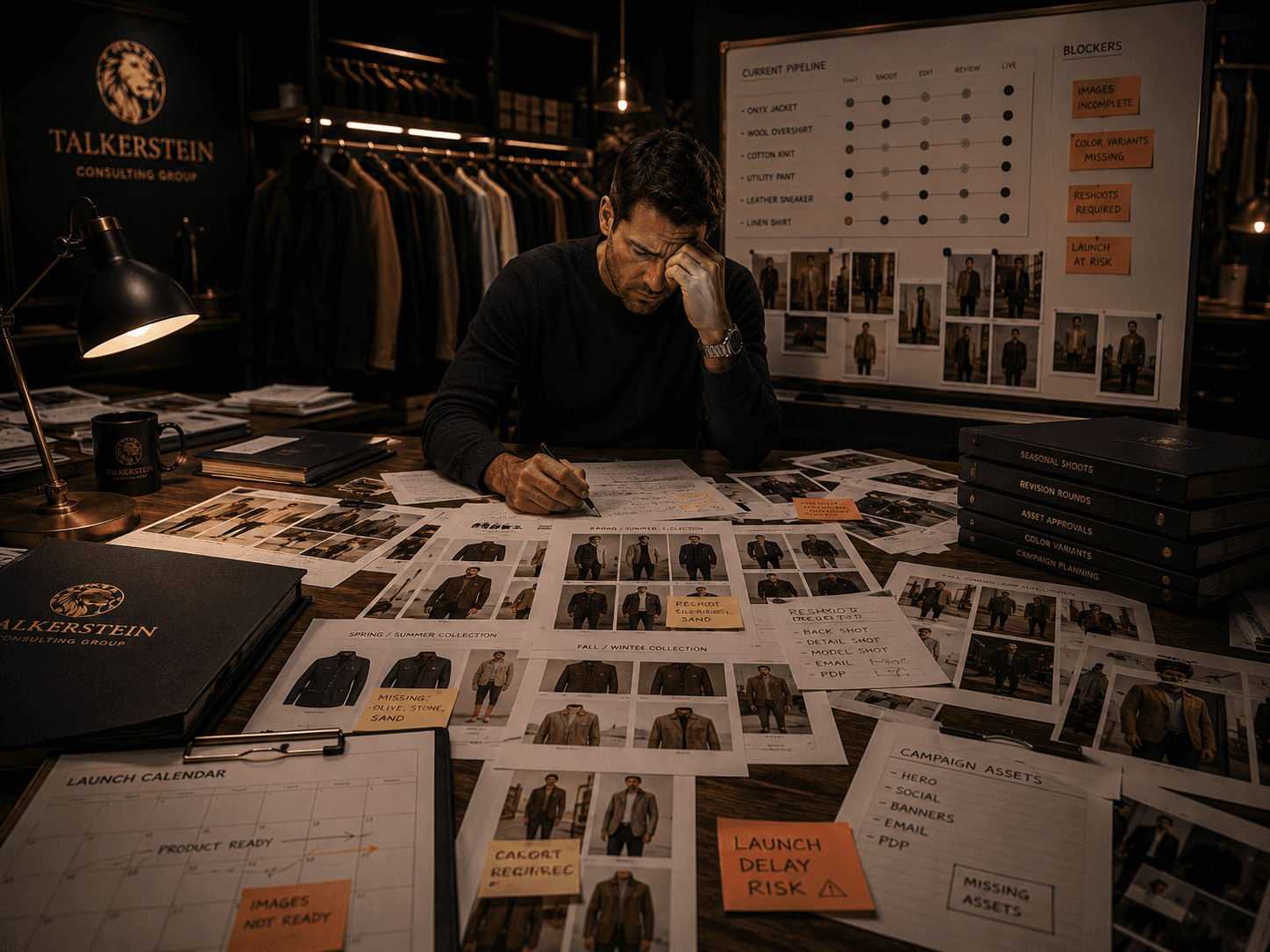
Fashion marketing manager reviewing stacks of product photography proofs, revision requests, and launch materials at a dark walnut desk, while apparel collections hang ready in the background and incomplete image assets delay a planned product launch.

Every missing variant is revenue sitting on a shelf you cannot ship from.

Most e-commerce P&Ls carry the cost of slow catalog production as a diffuse line. It shows up as delayed launches, stale ad creative, gap-filled listings, and senior-team hours burned coordinating shoots. None of those are flagged as a photography problem on a finance review, but every one of them traces back to a production model that cannot keep up with the catalog. The cost is not the invoice from the studio. The cost is everything that stops moving while you wait for the studio.
Missing variants killing conversion

Shoppers expect to see the product in the color they want. Listings that show three out of eight colors convert at a measurable discount, and paid traffic pushed to those listings underperforms until coverage catches up.

Ad creative drought on the paid team

Performance marketing eats creative at a rate most operators underestimate. Without a steady supply of fresh product imagery, ad accounts recycle the same three assets, frequency climbs, and CAC follows. The media team ends up running old inventory.

Reshoot tax on every brand refresh

Traditional studio work is built for a moment, not a system. A style refresh, a seasonal palette shift, or a repositioning all trigger a full reshoot because the assets are not regenerable. The bill arrives every time the brand evolves.

Launch slippage, not launch delay

The SKU is manufactured, warehoused, and ready. The imagery is the blocker. Every week of slippage is a week of marketing air cover that could have been pulled forward, and a week of competitor advantage you gave away for free.

Marketplace listing penalties

Amazon, Shopify storefronts, and major marketplaces all down-rank listings with thin imagery. The penalty is invisible in your own analytics but obvious in your search position. Complete coverage is table stakes, and incomplete coverage has a compounding cost.

Senior-team hours burned on coordination

The owner, the marketing lead, or the head of e-commerce ends up inside the shoot process because no one else has the context. Those are the most expensive hours in the company, and they are the ones most consistently spent on scheduling, logistics, and revision cycles.

Missing variants killing conversion

Shoppers expect to see the product in the color they want. Listings that show three out of eight colors convert at a measurable discount, and paid traffic pushed to those listings underperforms until coverage catches up.

Launch slippage, not launch delay

The SKU is manufactured, warehoused, and ready. The imagery is the blocker. Every week of slippage is a week of marketing air cover that could have been pulled forward, and a week of competitor advantage you gave away for free.

Ad creative drought on the paid team

Performance marketing eats creative at a rate most operators underestimate. Without a steady supply of fresh product imagery, ad accounts recycle the same three assets, frequency climbs, and CAC follows. The media team ends up running old inventory.

Marketplace listing penalties

Amazon, Shopify storefronts, and major marketplaces all down-rank listings with thin imagery. The penalty is invisible in your own analytics but obvious in your search position. Complete coverage is table stakes, and incomplete coverage has a compounding cost.

Reshoot tax on every brand refresh

Traditional studio work is built for a moment, not a system. A style refresh, a seasonal palette shift, or a repositioning all trigger a full reshoot because the assets are not regenerable. The bill arrives every time the brand evolves.

Senior-team hours burned on coordination

The owner, the marketing lead, or the head of e-commerce ends up inside the shoot process because no one else has the context. Those are the most expensive hours in the company, and they are the ones most consistently spent on scheduling, logistics, and revision cycles.

Missing variants killing conversion

Shoppers expect to see the product in the color they want. Listings that show three out of eight colors convert at a measurable discount, and paid traffic pushed to those listings underperforms until coverage catches up.

Ad creative drought on the paid team

Performance marketing eats creative at a rate most operators underestimate. Without a steady supply of fresh product imagery, ad accounts recycle the same three assets, frequency climbs, and CAC follows. The media team ends up running old inventory.

Reshoot tax on every brand refresh

Traditional studio work is built for a moment, not a system. A style refresh, a seasonal palette shift, or a repositioning all trigger a full reshoot because the assets are not regenerable. The bill arrives every time the brand evolves.

Launch slippage, not launch delay

The SKU is manufactured, warehoused, and ready. The imagery is the blocker. Every week of slippage is a week of marketing air cover that could have been pulled forward, and a week of competitor advantage you gave away for free.

Marketplace listing penalties

Amazon, Shopify storefronts, and major marketplaces all down-rank listings with thin imagery. The penalty is invisible in your own analytics but obvious in your search position. Complete coverage is table stakes, and incomplete coverage has a compounding cost.

Senior-team hours burned on coordination

The owner, the marketing lead, or the head of e-commerce ends up inside the shoot process because no one else has the context. Those are the most expensive hours in the company, and they are the ones most consistently spent on scheduling, logistics, and revision cycles.

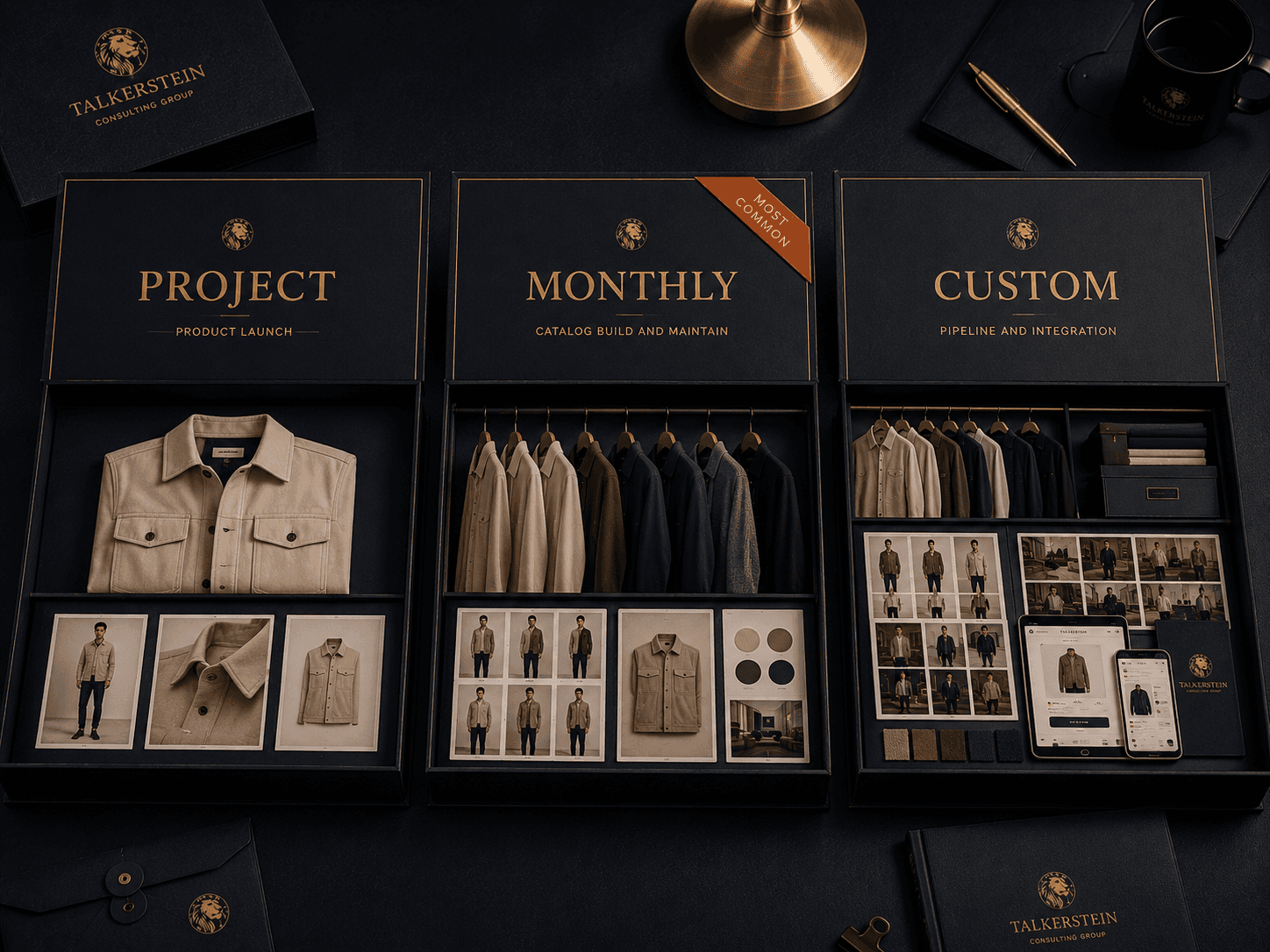
Three fashion content production packages presented in premium navy presentation cases labeled Project, Monthly, and Custom, showcasing increasing levels of apparel photography assets, product variants, campaign imagery, and catalog management resources arranged on a dark leather surface.

Three engagements. Production quality. Brand-consistent across every image.

Work is structured into three engagement shapes so the scope matches the reality of your catalog. The project is for a focused launch: a hero SKU, a featured collection, or a product that needs full angle and variant coverage before it goes live. Monthly is the featured tier because it matches the cadence most scaling e-commerce brands actually run on, where new SKUs, seasonal refreshes, and creative needs come in continuously. Custom is for operators running large catalogs, multiple properties, or ongoing production pipelines that need to plug into the rest of the e-commerce stack. Every engagement ships with brand-consistent output, professional editing as part of the work, and clear commercial rights over the final assets.
Project

Product Launch

Single focused launch. A single product or small capsule taken through full catalog, lifestyle, and ad coverage. The right shape when you are launching a flagship SKU, a featured collection, or need to close a specific imagery gap before a campaign goes live.

What's Included?

Monthly

Catalog Build and Maintain

Most Common

Ongoing catalog cadence. A production pipeline that moves with your catalog. New SKUs, variants, seasonal refreshes, and creative needs handled on a predictable monthly cadence so imagery stops being the blocker on every launch.


What's Included?

Custom

Pipeline and Integration

Multi-property and large-catalog scale. An embedded production pipeline for brands running large catalogs, multiple properties, or ongoing launch velocity that needs to plug directly into the e-commerce stack. Built to operate as an extension of your team.

What's Included?

Project

Product Launch

Single focused launch. A single product or small capsule taken through full catalog, lifestyle, and ad coverage. The right shape when you are launching a flagship SKU, a featured collection, or need to close a specific imagery gap before a campaign goes live.

What's Included?

Monthly

Catalog Build and Maintain

Most Common

Ongoing catalog cadence. A production pipeline that moves with your catalog. New SKUs, variants, seasonal refreshes, and creative needs handled on a predictable monthly cadence so imagery stops being the blocker on every launch.


What's Included?

Custom

Pipeline and Integration

Multi-property and large-catalog scale. An embedded production pipeline for brands running large catalogs, multiple properties, or ongoing launch velocity that needs to plug directly into the e-commerce stack. Built to operate as an extension of your team.

What's Included?

Project

Product Launch

Single focused launch. A single product or small capsule taken through full catalog, lifestyle, and ad coverage. The right shape when you are launching a flagship SKU, a featured collection, or need to close a specific imagery gap before a campaign goes live.

What's Included?

Monthly

Catalog Build and Maintain

Most Common

Ongoing catalog cadence. A production pipeline that moves with your catalog. New SKUs, variants, seasonal refreshes, and creative needs handled on a predictable monthly cadence so imagery stops being the blocker on every launch.


What's Included?

Custom

Pipeline and Integration

Multi-property and large-catalog scale. An embedded production pipeline for brands running large catalogs, multiple properties, or ongoing launch velocity that needs to plug directly into the e-commerce stack. Built to operate as an extension of your team.

What's Included?

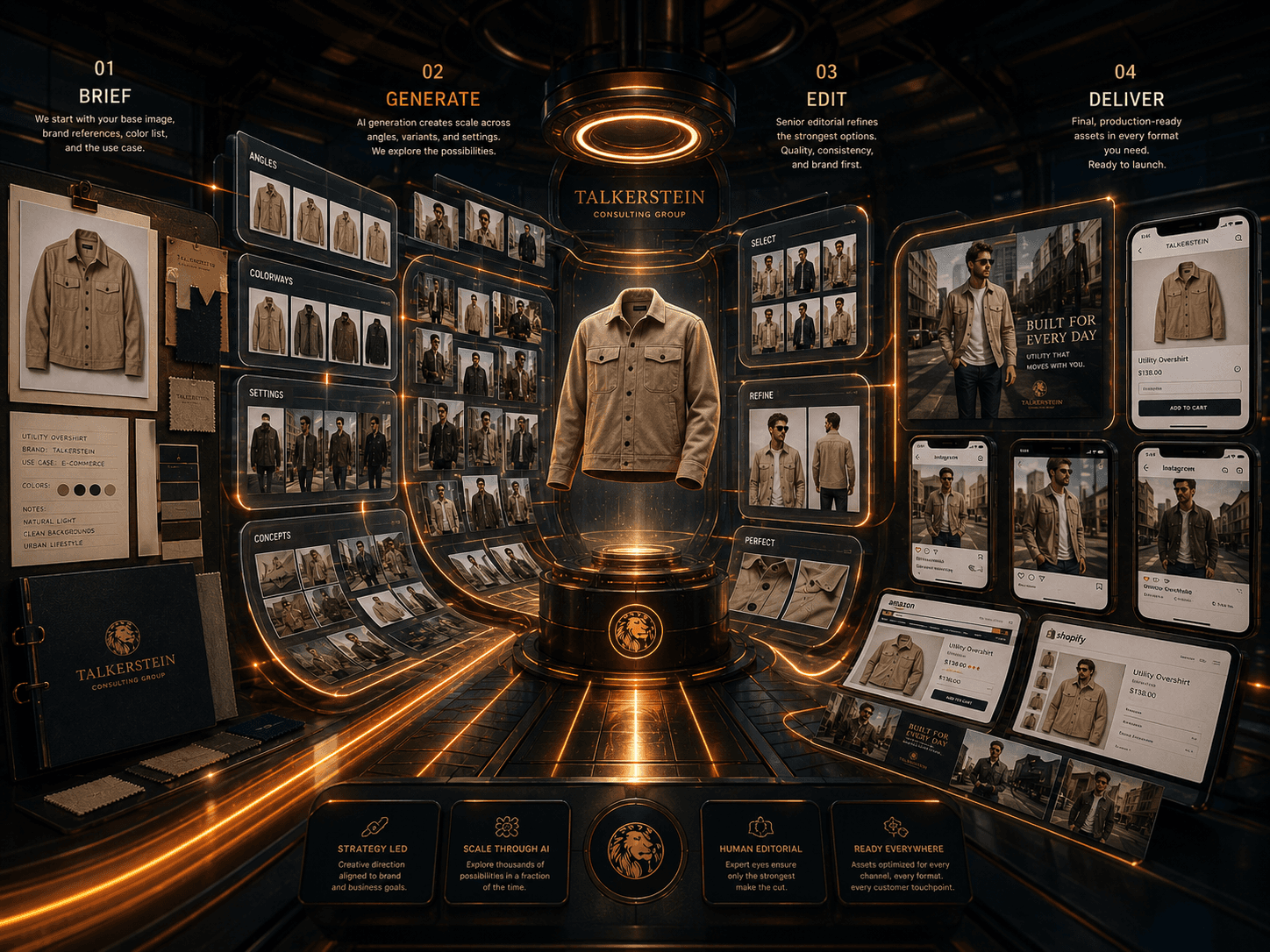
Retro-futuristic fashion production studio featuring a garment suspended at the center of a digital content pipeline, surrounded by fashion variations, editorial imagery, color options, and marketplace assets that evolve from creative brief to finished e-commerce deliverables.

Four phases. Tight brief. Fast iteration. Clean handoff.

01 Brief

Send the base image, the color or variant list, the brand reference, and the use case. We run a short calibration pass to confirm style, lighting direction, and background palette before any render begins. Most briefs settle inside a single working session.

02 Generate

Production runs across angles, settings, variants, and context scenes. The AI generation layer handles scale. Senior editorial handles selection, direction, and the commercial lens on what actually belongs in the final set. You do not see raw, unreviewed output.

03 Edit

Professional retouching, color correction, background consistency checks, and composition adjustments sit inside the scope. Editing is not a separate line item and it is not optional. No render leaves without the editorial pass complete.

04 Deliver

Final assets arrive in the formats you need. Web-optimised for product pages. Square and vertical cuts for paid and social. Marketplace-compliant sizing for Amazon and Shopify. Source files available on request for Custom-tier engagements.
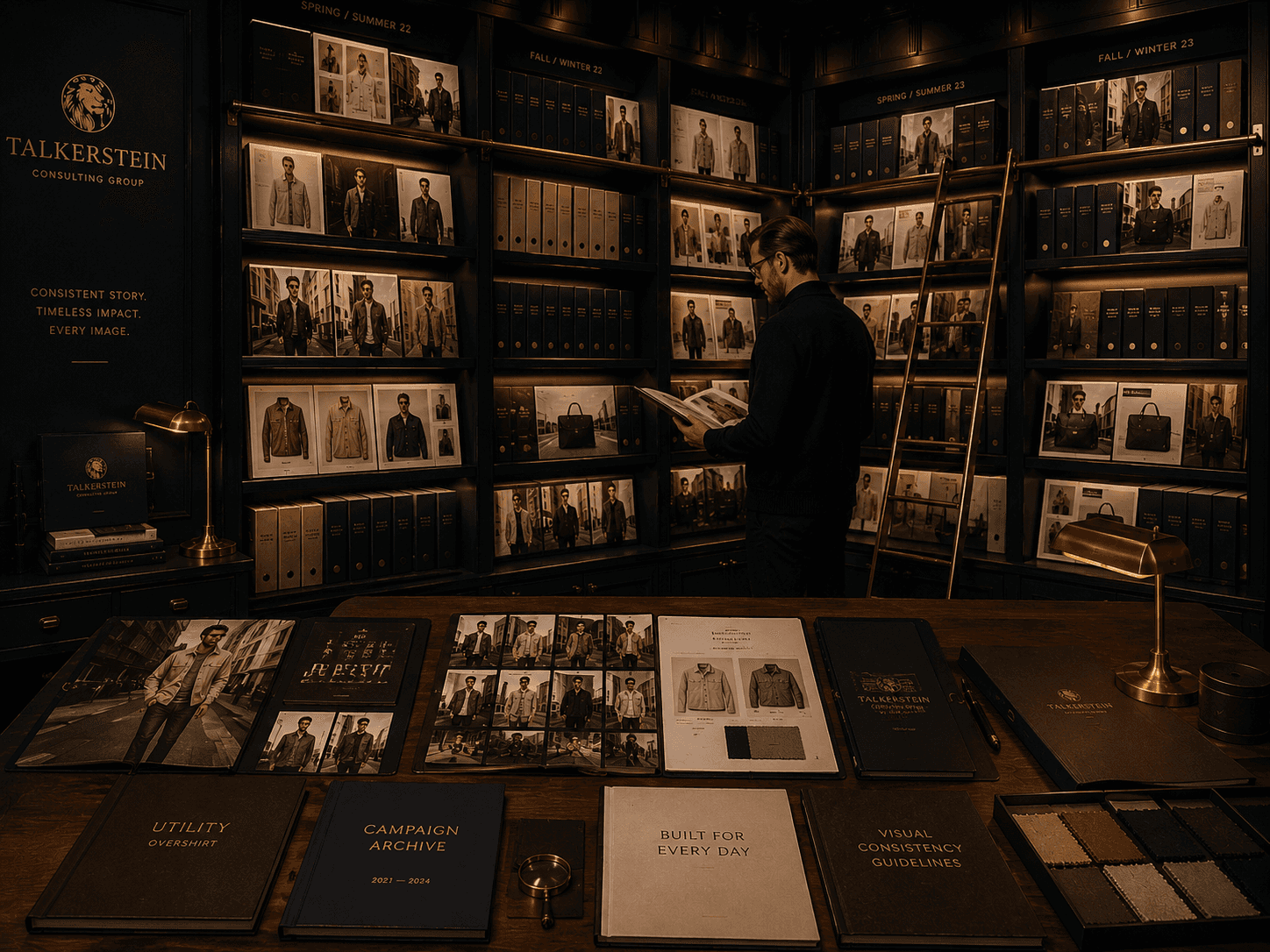
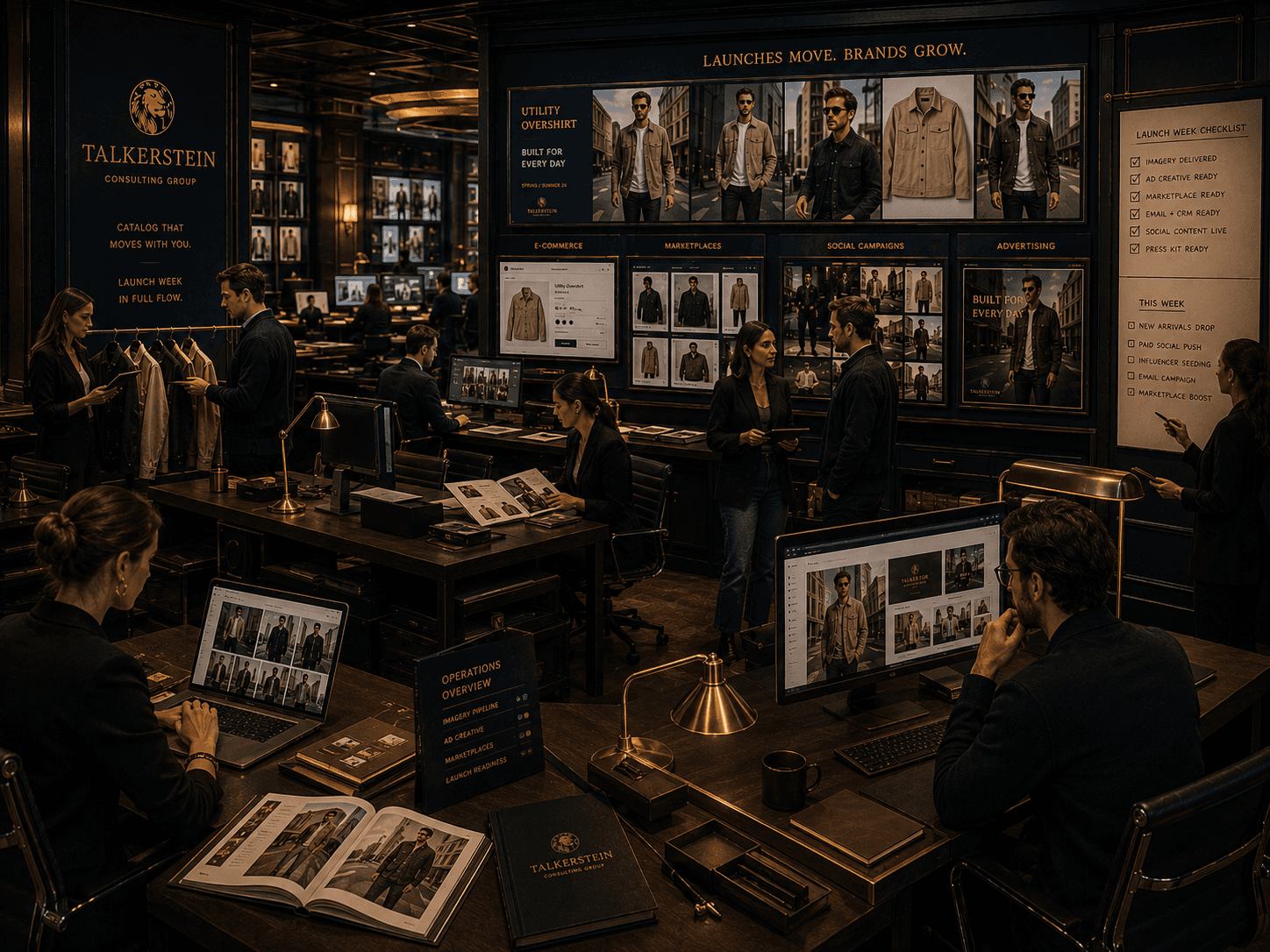
Fashion archive room lined with campaign photography, lookbooks, product imagery, and brand binders spanning multiple seasons, while a curator reviews materials at a dark walnut table under warm brass lighting, showcasing a consistent visual identity across the entire collection.

Four commitments that decide what ships and what does not.
Production quality, or it does not ship.

Editorial review sits between generation and delivery. No watermarks. No AI artefacts. No pose or lighting errors that would not pass on a traditional studio proof. If the render is not ready, we regenerate. The operator never sees a rough draft unless one is requested.

Honest about what AI cannot do yet.

Some categories are not a fit. Reflective jewelry at the premium tier. Specific fabric weaves. Liquid dynamics at scale. We say so at scoping, not halfway through delivery. The model keeps improving. The line moves. We will always tell you where the line currently is.

Brand consistency across the entire set.

Colors match. Lighting tone matches. Composition logic matches. A catalog built across multiple production cycles still reads as one coherent visual system when customers scroll through it. This is editorial work, not a render queue.

Commercial rights are yours by default.

You own the final assets. Use them on your site, in paid ads, on marketplaces, in print, and in future campaigns without rechecking a licence. Source files and commercial-rights documentation travel with the delivery on Monthly and Custom engagements.

Production quality, or it does not ship.

Editorial review sits between generation and delivery. No watermarks. No AI artefacts. No pose or lighting errors that would not pass on a traditional studio proof. If the render is not ready, we regenerate. The operator never sees a rough draft unless one is requested.

Brand consistency across the entire set.

Colors match. Lighting tone matches. Composition logic matches. A catalog built across multiple production cycles still reads as one coherent visual system when customers scroll through it. This is editorial work, not a render queue.

Honest about what AI cannot do yet.

Some categories are not a fit. Reflective jewelry at the premium tier. Specific fabric weaves. Liquid dynamics at scale. We say so at scoping, not halfway through delivery. The model keeps improving. The line moves. We will always tell you where the line currently is.

Commercial rights are yours by default.

You own the final assets. Use them on your site, in paid ads, on marketplaces, in print, and in future campaigns without rechecking a licence. Source files and commercial-rights documentation travel with the delivery on Monthly and Custom engagements.

Production quality, or it does not ship.

Editorial review sits between generation and delivery. No watermarks. No AI artefacts. No pose or lighting errors that would not pass on a traditional studio proof. If the render is not ready, we regenerate. The operator never sees a rough draft unless one is requested.

Honest about what AI cannot do yet.

Some categories are not a fit. Reflective jewelry at the premium tier. Specific fabric weaves. Liquid dynamics at scale. We say so at scoping, not halfway through delivery. The model keeps improving. The line moves. We will always tell you where the line currently is.

Brand consistency across the entire set.

Colors match. Lighting tone matches. Composition logic matches. A catalog built across multiple production cycles still reads as one coherent visual system when customers scroll through it. This is editorial work, not a render queue.

Commercial rights are yours by default.

You own the final assets. Use them on your site, in paid ads, on marketplaces, in print, and in future campaigns without rechecking a licence. Source files and commercial-rights documentation travel with the delivery on Monthly and Custom engagements.

a split comparison image showing the changes after talkerstein consulting's messaging and voice improvements

The practical shift when catalog throughput stops being the blocker.

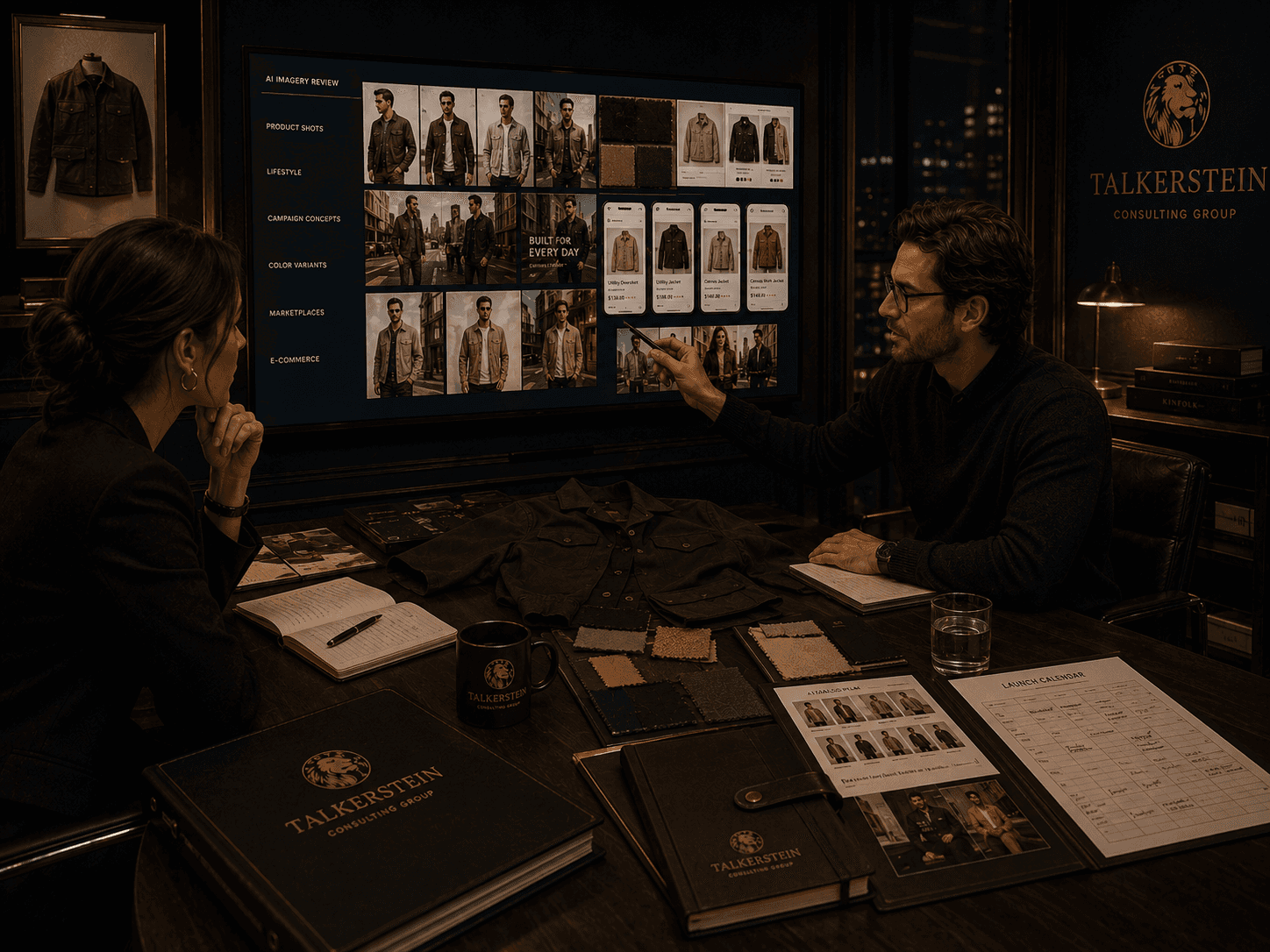
Teams that move to an AI-first catalog photography model tend to see the same pattern. Launches stop slipping on imagery. The ad creative library gets thicker without the media team filing tickets. Marketplace listings close their coverage gaps. Senior hours that used to be spent inside shoots come back. The brand still reads as premium because the editorial layer is doing the work a creative director would do in any serious production, just at a cadence and cost the business can sustain. The operator-level shift is that catalog photography becomes a predictable line item on a monthly cadence instead of a recurring crisis on a quarterly one.
Launch dates were held because imagery ships with the SKU, not three weeks behind it.
Marketplace listings with full angle, variant, and lifestyle coverage by default.
Senior and marketing-leader hours freed from shoot coordination and reshoot triage.
Ad creatives supply that keeps pace with what the paid team actually needs.
Catalog-wide visual consistency maintained across dozens of production cycles.
Seasonal refreshes are handled in days, so the brand can evolve without a full studio reset.
Launch dates were held because imagery ships with the SKU, not three weeks behind it.
Ad creatives supply that keeps pace with what the paid team actually needs.
Marketplace listings with full angle, variant, and lifestyle coverage by default.
Catalog-wide visual consistency maintained across dozens of production cycles.
Senior and marketing-leader hours freed from shoot coordination and reshoot triage.
Seasonal refreshes are handled in days, so the brand can evolve without a full studio reset.
Launch dates were held because imagery ships with the SKU, not three weeks behind it.
Marketplace listings with full angle, variant, and lifestyle coverage by default.
Senior and marketing-leader hours freed from shoot coordination and reshoot triage.
Ad creatives supply that keeps pace with what the paid team actually needs.
Catalog-wide visual consistency maintained across dozens of production cycles.
Seasonal refreshes are handled in days, so the brand can evolve without a full studio reset.
Fashion brand owner and AI product photography strategist reviewing AI-generated apparel imagery, product variants, lifestyle concepts, and e-commerce listings on a large display while evaluating fabric samples, launch plans, and catalog assets during a strategy consultation.

Is this the right engagement?

This engagement fits when
  • You run an active e-commerce or DTC catalog of at least ten SKUs with ongoing launches.

  • Your products come in multiple colors, sizes, or variants that need individual imagery coverage.

  • Your paid-media engine is burning through creative faster than traditional shoots can supply.

  • You sell on marketplaces where listing quality directly affects search position and conversion.

  • You are willing to invest in an editorial layer on top of AI output rather than buying raw renders.

Skip this engagement when
  • Photography itself is the brand story, where the named photographer is the point of purchase.

  • Your category depends on authenticity markers that AI cannot simulate: handmade textures, named models, specific locations, or documentary-style imagery.

  • Your products are jewelry, watches, or high-gloss luxury goods where material rendering is still beyond reliable AI tolerance.

  • You need a one-off cheap shoot and are not ready to invest in a proper editorial and rights structure.

  • You expect raw AI output without a human editorial pass. That is not the service we run.

What serious buyers usually ask.

How good is AI product photography really, and what is the honest ceiling right now?

Quality on fit categories is indistinguishable from traditional studio output to the customer. The ceiling is in categories with complex material behavior: high-gloss jewelry, specific fabric weaves, reflective metal at close range, and liquid dynamics at scale. We map those limits at scoping so there is no surprise mid-project. For the ninety percent of e-commerce catalogs that live outside those edges, the work ships at or above the quality bar most brands are already paying studio rates for.

Which product categories work best, and which ones should we keep in a traditional studio?

Apparel, softgoods, home, electronics, beauty with matte packaging, food and beverage, footwear, accessories, and most categories with stable surface behavior are strong fits. Fine jewelry, mirror-finish watches, precision cut crystal, and categories where a close-up of material authenticity is the primary purchase trigger are better left in a traditional or hybrid setup. We will often recommend a hybrid model for brands straddling those lines, where hero assets run through studio and catalog depth runs through us.

What is the realistic turnaround for a full catalog of ten to twenty SKUs?

A focused catalog build in that range generally lands in two to three weeks end to end, including brief calibration, production, editorial review, and delivery. That includes variants, lifestyle coverage, and ad-ready cuts. Traditional studio work on the same scope runs eight to twelve weeks minimum, often longer, and does not typically include ad cuts in the base price. Timeline is the most consistent measurable gain operators see in the first engagement.

Can you generate lifestyle and context shots, or only clean product-on-white?

Both. Lifestyle and context scenes are part of most tiers, not a separate line item. Product on a desk, in use, in-situ in a real-feeling environment, seasonal context, and brand-world settings are all in scope. What we do not do, and will not pretend to do, is put AI-generated human models into lifestyle shots for brands where authentic human presence is part of the buying story. That is a line we hold.

How accurate is color, especially for brand-critical hues and Pantone matches?

Color accuracy lands in the eighty-five to ninety-five percent range out of the render, and the editorial pass closes that gap to a level that reads as consistent across the catalog. For brand-critical or Pantone-specific work, we run a calibration pass up front using physical reference, digital swatches, or existing assets, and lock the color targets into the production pipeline. Fully color-critical work at the Pantone-print-production level is still a case for a traditional workflow, and we will say so when it applies.

Do we own the images outright, and can we use them on every channel without licence checks?

Yes. Final assets are yours under a full commercial-rights model. Use them on your store, in paid media, on marketplaces, in print, in wholesale decks, and in future campaigns without returning to us for permission. Source files are available on Monthly and Custom engagements by default and on Project engagements by request. Commercial-rights documentation is delivered with every engagement so legal and ops teams have what they need on file.

How are revisions handled when something in the set does not quite land?

Revisions are part of the scope, not an add-on. Project engagements include one scoped revision round. Monthly engagements include unlimited in-cycle revisions within the production window. The editorial lead flags anything that does not meet the bar before delivery, so most revision rounds are small calibration adjustments rather than rescues. Out-of-scope redirections are handled as a scope amendment with clear numbers, not a silent creep.

How do you make sure the imagery stays visually consistent across many production cycles?

Brand-style guardrails are set at the first engagement and written down. Color palette, lighting direction, composition logic, background language, and variant treatment are documented in a style file that the editorial lead works against every cycle. On Custom engagements, category-specific model calibration adds another layer of consistency for brands that need tighter control across multi-property catalogs. The short version: consistency is a system, not a hope.

What happens when AI genuinely cannot handle a specific product in our catalog?

We tell you during scoping, and we tell you again if it surfaces mid-production on a new SKU. The options are usually one of three: we hybrid the work and route the affected SKU to a traditional shoot partner we coordinate with, we defer the SKU to a future cycle if category capability is improving quickly, or we deliver a close-enough render with explicit notes so your team can decide whether to use it or not. What we do not do is quietly ship a weak render and hope nobody notices.

What does the first engagement usually look like, and how do we get started?

The first conversation is a scoping call, typically thirty to forty-five minutes, where we walk through your active catalog, the current imagery coverage gap, your ad and marketplace commitments, and the shape of the launch calendar. You leave that call with a recommended engagement shape, a realistic turnaround window, and a scoping document. Most brands start with a Project engagement on a focused launch to calibrate on quality and fit, then move into a Monthly cadence once the workflow proves out.

How does this compare to hiring a freelance product photographer on retainer?

A good freelancer on retainer solves a specific category of the problem: reliable access to production and a relationship that stays warm. What a freelancer cannot do, regardless of talent, is bend the fundamental economics. A single photographer cannot produce two hundred catalog images a week at studio quality, cover variants at launch speed, and keep lifestyle coverage current. The comparison is not better or worse, it is different. Many brands end up with both: a named photographer for hero campaigns and our pipeline for catalog depth.

Our Services
What Our Partners Think

Rishon and his team built us a beautiful website, brand design and food truck. The team went above and beyond building for us everything from nothing. I truly recommend them for everything from branding to implementing POS systems!

Joseph, Toronto

Owner of Uzbek Delight

What Our Partners Think

Rishon and his team built us a beautiful website, brand design and food truck. The team went above and beyond building for us everything from nothing. I truly recommend them for everything from branding to implementing POS systems!

Joseph, Toronto

Owner of Uzbek Delight

Let's Work Together

What Our Partners Think

Rishon and his team built us a beautiful website, brand design and food truck. The team went above and beyond building for us everything from nothing. I truly recommend them for everything from branding to implementing POS systems!

Joseph, Toronto

Owner of Uzbek Delight

What Our Partners Think

Rishon and his team built us a beautiful website, brand design and food truck. The team went above and beyond building for us everything from nothing. I truly recommend them for everything from branding to implementing POS systems!

Joseph, Toronto

Owner of Uzbek Delight

Let's Work Together