Automation • CRM Automation
A CRM without automation is a filing cabinet your best sales reps waste their day inside.
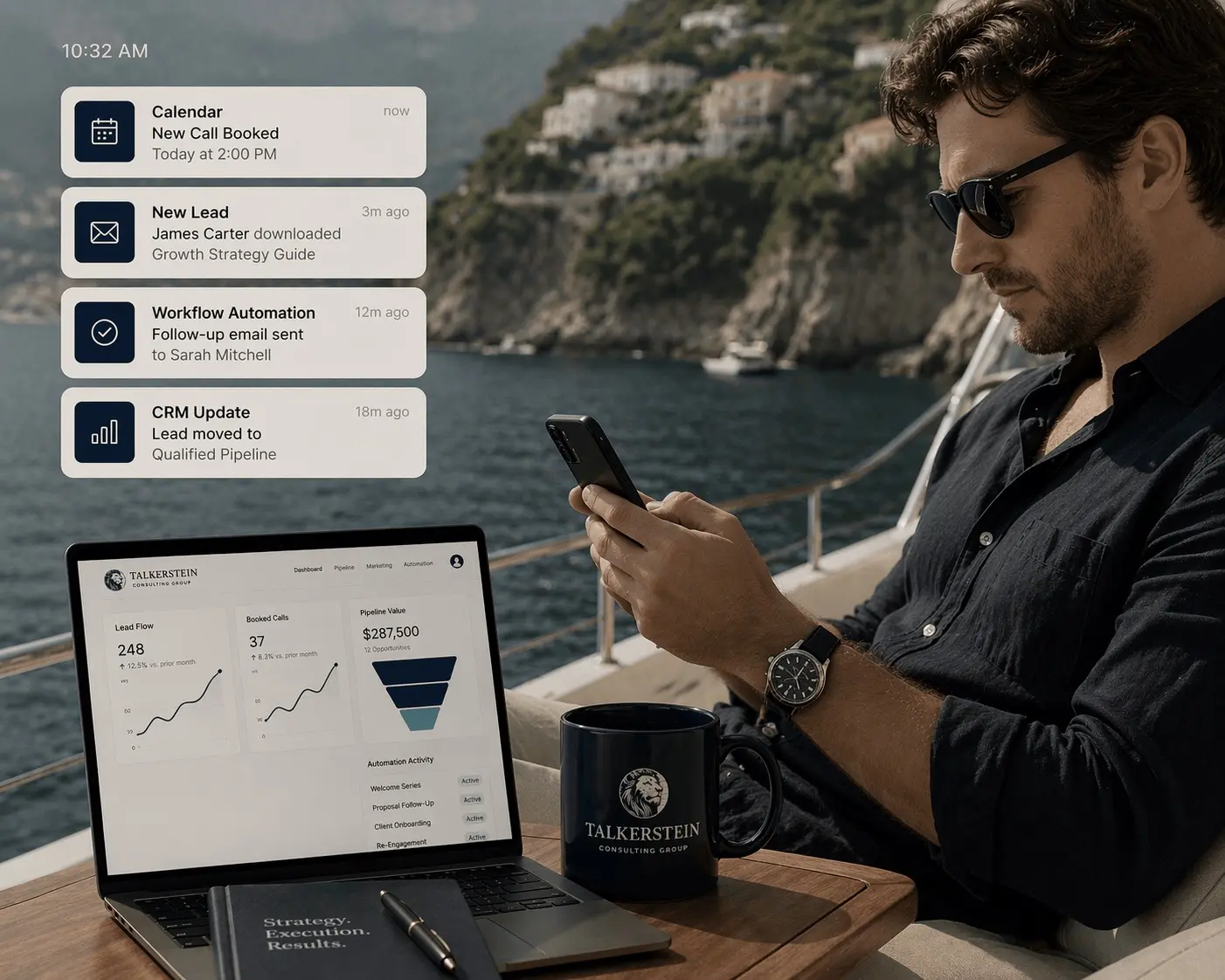
Most teams do not have a CRM problem. They have a process problem wearing a CRM-shaped costume. Leads land in the same bucket and wait their turn. Reps update stages when they remember. The best prospects cool off while the junior rep works the list in the order it came in. Meanwhile, the dashboard looks busy, your pipeline number looks real, and nobody can tell you with a straight face which deals are actually going to close this quarter. CRM automation is the layer that puts an end to that. We take the system you already pay for, usually Go High Level for service and B2B businesses, and turn it into something that routes every lead to the right rep within minutes, scores every deal by real intent, drags stalled opportunities into the light, and makes the pipeline number in your Monday meeting mean what your sales leader thinks it means.
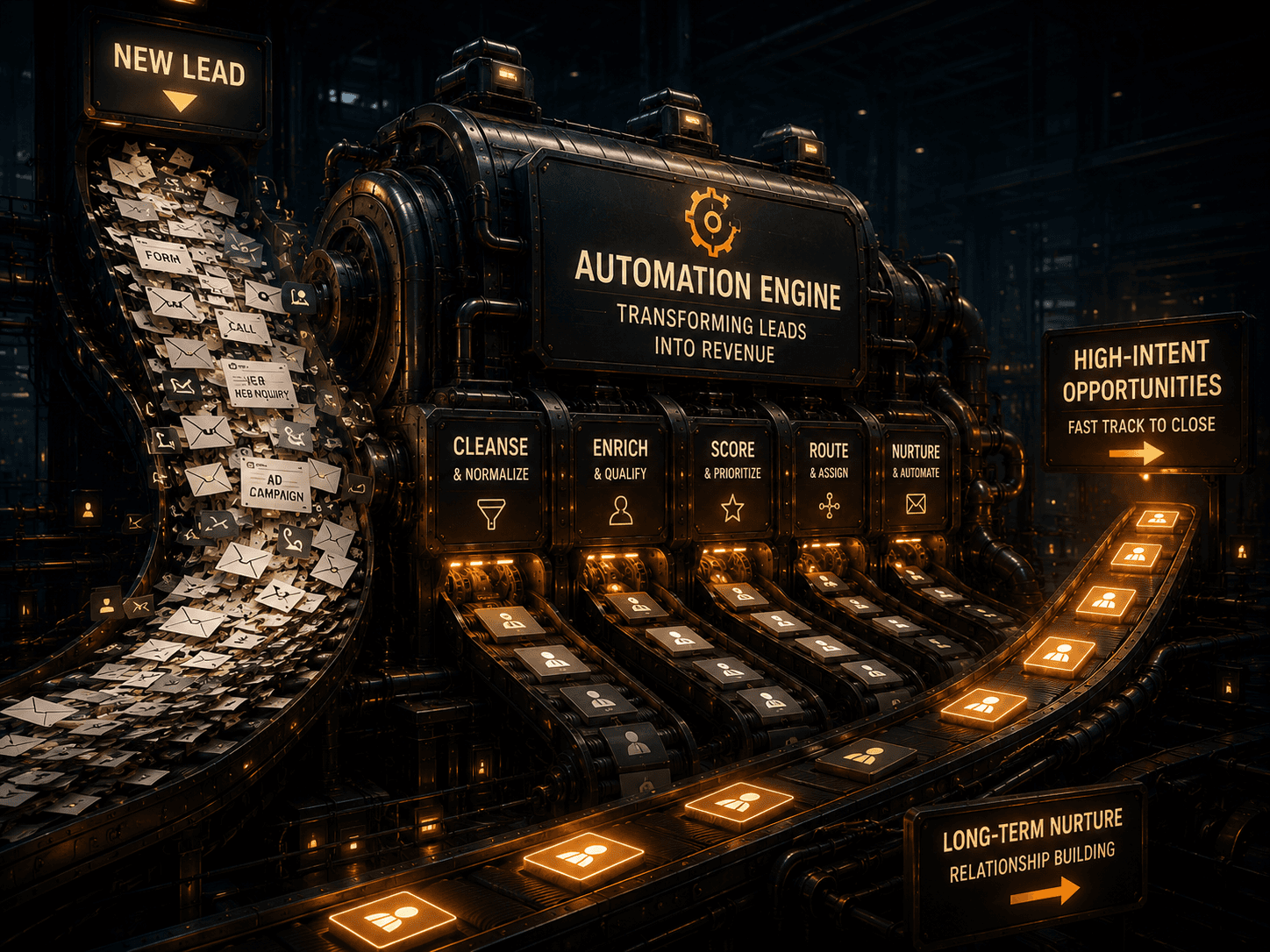
Your sales team is not slow. Your CRM is making them slow.
Pick a rep on your team and watch what they actually do for an hour. Most of it is not selling. It is copy-pasting notes, searching for a contact record, moving a deal card across a board, chasing down the owner of a stuck opportunity, or scrolling back through an email thread to remember what was promised. None of that is sales. All of it is the tax your team pays because the CRM is not doing the mechanical work the CRM is supposed to do. When we automate the middle of the funnel properly, the work does not disappear. It moves. The system handles routing, logging, reminders, status changes, handoffs, and follow-ups. Your team handles conversations. Conversion rates do not improve because the reps tried harder. They improve because the reps finally had the time to show up well.

What a weak CRM process quietly costs
Every manual step is a leak. Stack the leaks and your forecast becomes fiction.
What you actually get
A live sales operating system, not a cleaner database. We start with how your team actually sells, what a qualified lead looks like in your numbers, and where in the pipeline deals reliably go to die. From there we configure the CRM, wire the automations, and document every workflow so your team can run it without calling us every time a change is needed.

The automations that carry the most weight in a real pipeline.
There is no universal stack of workflows. The right mix depends on your sales cycle length, your price point, and how many human touches your close actually takes. That said, the automations below are the ones we keep coming back to across service, B2B, and high-ticket consumer businesses. They are a starting palette, not a template.

Four phases. Documented at every step.
01 Diagnose
We sit with your sales leader and a senior rep, walk through a recent won deal and a recent lost one, and map every manual step between lead and close. The output is a pipeline diagnostic and a prioritised fix list, not a slide deck.
02 Design
We redraw the pipeline stages around how you actually sell, design the scoring model in the room with your sales lead, and draft every workflow logic in plain English. You approve the logic before we touch the platform.
03 Build
We configure the CRM, wire the automations, migrate the data you want to keep, and test every routing path end to end. Nothing ships without being triggered under real conditions.
04 Hand off
We train your team, hand over a written runbook, and stay close for thirty to sixty days while the system calibrates. After that you own it. We can continue under a Care Plan or we step away. Both are valid endings.

Four rules we will not break.
What changes
Revenue is the lagging indicator. Before the revenue line moves, other things shift. Reps spend more of their day on live conversations. Sales leaders stop hearing about stalled deals at the end of the quarter and start hearing about them the same week they stall. Pipeline reviews get shorter because the data is trustworthy. Marketing and sales stop fighting about lead quality because the scoring is transparent and joint. These are the first visible effects of a CRM that has been properly automated.

Is this the right next step for you?
Work with us if
You have a sales team of two or more and a CRM already in place, even if half of it is unused.
Leads are visibly cooling off before sales gets to them, or routing feels arbitrary.
Your reps spend more time on admin than on live conversations.
You need the weighted pipeline number to match reality within a reasonable tolerance.
You are planning to scale headcount and need the system to scale with you rather than break under the new weight.
Do not work with us if
You have no inbound flow yet. Automation amplifies what exists. If nothing is coming in, we are not the right first step.
You close most deals on the first call with no consideration cycle. A heavy CRM build would cost more than it saves.
You are looking for a tool recommendation rather than an operational partner.
You are not willing to commit to one CRM and have your team use it consistently. No automation survives half-adoption.
What serious buyers usually ask.
Why Go High Level instead of HubSpot or Salesforce?
For most service, B2B, and multi-location businesses under a few hundred employees, GHL is the right commercial fit. It bundles website, email, SMS, calendar, payments, and pipeline in a single platform at a fraction of the enterprise-grade stack. HubSpot and Salesforce make sense when compliance, RevOps headcount, or enterprise sales motions justify them. When they do, we configure inside those.
We already have a CRM. Do we have to move?
Usually no. If your current platform is functional and the problem is process, we configure and automate inside it. Migration is only recommended when the platform itself is the bottleneck, and we tell you that directly in the diagnostic. We do not charge for migrations you do not need.
How do we decide routing rules?
In a working session with your sales leader. We run the rules against your last ninety days of closed deals and adjust until the routing behaves the way you would have routed if you had unlimited time. The rules are yours. We help you build them and calibrate them.
What does our team need to do during the build?
Expect about four to six hours a week from a sales leader or senior ops person during the build, plus a one-hour scoring session with your sales team. Less than that and we risk building a system that does not match how you actually sell.
Will this replace our sales ops or RevOps person?
No. The best outcomes happen when the build runs alongside an internal ops owner. We build the system and the documentation. Your ops person runs and evolves it. If you do not have one yet, we train one during handover.
How long before the team trusts the new system?
Most teams cross the trust line at around three to four weeks after go-live. That is when the new workflows have run enough cycles for reps to see that the routing was fair, the reminders were accurate, and the stalled-deal flags caught the right things. Trust is earned by repetition, not by training decks.
What if we change our sales process later?
Expected. Sales processes should evolve. The system is built to be edited without a consultant in the room. Stages, scoring rules, and routing logic can all be adjusted inside the platform. The runbook explains how. Larger structural changes are where a Care Plan helps.
How do you protect us from a bad data migration?
We migrate in stages with a parallel period where both systems run. Data is validated on a sample before the full import. No lead record is overwritten until it has been matched, cleaned, and reviewed. The old data stays archived until you sign off on the new one.
What budget range usually makes sense here?
G1 Foundation sits at the lower end of the range for teams that want a clean working base. G2 Pro is the most common fit and lives in the mid five figures for the build, plus an optional Care Plan if you want us to keep tuning it. G3 Scale is bespoke and always scoped after a diagnostic.
What does a strong engagement usually turn into next?
Two common next steps. One, we add a Marketing Automation layer upstream so the lead quality feeding the CRM matches what the scoring model expects. Two, we layer a Reporting Dashboard on top so the same numbers run your weekly sales meeting, monthly leadership review, and quarterly forecast.
Our Services

Automation • CRM Automation
A CRM without automation is a filing cabinet your best sales reps waste their day inside.
Most teams do not have a CRM problem. They have a process problem wearing a CRM-shaped costume. Leads land in the same bucket and wait their turn. Reps update stages when they remember. The best prospects cool off while the junior rep works the list in the order it came in. Meanwhile, the dashboard looks busy, your pipeline number looks real, and nobody can tell you with a straight face which deals are actually going to close this quarter. CRM automation is the layer that puts an end to that. We take the system you already pay for, usually Go High Level for service and B2B businesses, and turn it into something that routes every lead to the right rep within minutes, scores every deal by real intent, drags stalled opportunities into the light, and makes the pipeline number in your Monday meeting mean what your sales leader thinks it means.

Your sales team is not slow. Your CRM is making them slow.
Pick a rep on your team and watch what they actually do for an hour. Most of it is not selling. It is copy-pasting notes, searching for a contact record, moving a deal card across a board, chasing down the owner of a stuck opportunity, or scrolling back through an email thread to remember what was promised. None of that is sales. All of it is the tax your team pays because the CRM is not doing the mechanical work the CRM is supposed to do. When we automate the middle of the funnel properly, the work does not disappear. It moves. The system handles routing, logging, reminders, status changes, handoffs, and follow-ups. Your team handles conversations. Conversion rates do not improve because the reps tried harder. They improve because the reps finally had the time to show up well.

What a weak CRM process quietly costs
Every manual step is a leak. Stack the leaks and your forecast becomes fiction.
Response latency
Lead response over 48 hours sharply reduces the odds of a booked meeting. Without auto-routing and real-time alerts, most teams are measuring days where they should be measuring minutes.
Invisible stall
Deals quietly park in a stage for weeks without a flag. By the time a manager notices, the prospect has already chosen someone else and just has not told you yet.
Admin tax
Reps spend hours copy-pasting notes, moving cards, chasing owners, and rebuilding context instead of selling. The CRM becomes the work instead of removing the work.
Queue-based routing
Assigning leads in round-robin or first-in-first-out order ignores territory, product fit, rep win-rate, and current load. Your best leads land with the least relevant rep as often as not.
Knowledge leak
Calls and commitments live in the rep's head, not the record. When a rep leaves or goes on leave, the accounts they owned effectively reset. You rebuild the relationship from scratch.
Forecast fiction
The dashboard looks busy and the pipeline number looks real, but stages do not reflect close probability. Leadership debates the number instead of making decisions.

What you actually get
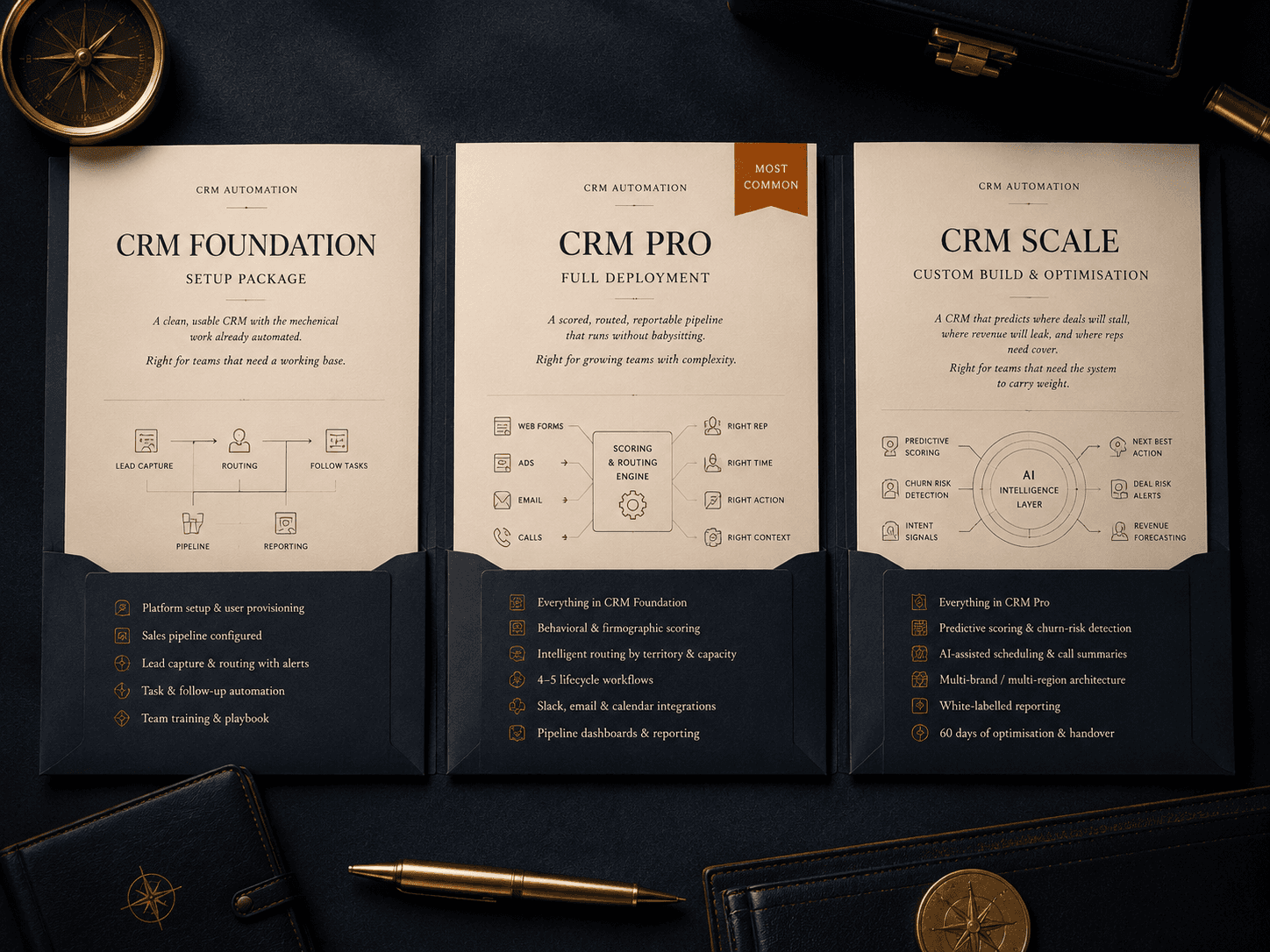
A live sales operating system, not a cleaner database. We start with how your team actually sells, what a qualified lead looks like in your numbers, and where in the pipeline deals reliably go to die. From there we configure the CRM, wire the automations, and document every workflow so your team can run it without calling us every time a change is needed.
G1
CRM Foundation
A clean, usable CRM with the mechanical work already automated. Right for teams running a spreadsheet or abandoned CRM and needing a working base: platform setup, permissions, sales pipeline stages, lead capture, routing, alerts, follow-up automation, training, and a lightweight internal playbook.
I'm Interested
G2
CRM Pro
Most Common
A scored, routed, reportable pipeline that runs without babysitting. Right for teams closing across multiple touchpoints, reps, and regions: everything in G1, behavioural and firmographic scoring, intelligent routing, lifecycle workflows, Slack, email, calendar integrations, and a pipeline dashboard.
I'm Interested
G3
CRM Scale
A CRM that predicts where deals stall, where revenue leaks, and where reps need cover. Right for larger teams, multi-brand portfolios, or sales ops with real budget: everything in G2, predictive scoring, churn-risk detection, AI-assisted scheduling and summaries, segmentation architecture, reporting, and sixty days of optimisation.
I'm Interested

The automations that carry the most weight in a real pipeline.
There is no universal stack of workflows. The right mix depends on your sales cycle length, your price point, and how many human touches your close actually takes. That said, the automations below are the ones we keep coming back to across service, B2B, and high-ticket consumer businesses. They are a starting palette, not a template.
Lead capture and auto-qualify
New leads from a form, ad, or email are instantly scored against your ICP rules. Hot leads trigger a same-hour rep alert. Disqualified leads are tagged for nurture or suppression, not silently deleted.
Handoff with context
When a lead is passed from marketing to sales, the rep does not open a blank profile. They get the lead source, the sequence history, the pages viewed, and the suggested opening line.
Stall detection
Any deal that sits in a stage beyond its typical velocity is flagged to the rep and the manager. No more deals that only reappear in the forecast as bad news.
Renewal and expansion
Accounts approaching renewal or crossing an expansion trigger enter a dedicated workflow. The CS or sales lead is alerted ahead of the window, not after it closes.
Intelligent lead routing
Routing looks at territory, product fit, rep win-rate, current queue size, and time zone, then assigns the lead to the rep most likely to close it. Not the rep who happens to be next.
Proposal follow-through
A proposal sent without a follow-through sequence is a proposal you have already lost. We automate the review window, the soft nudges, the decision call, and the decision deadline.
Customer handoff
A closed deal triggers the delivery kickoff, the contract signature sequence, the payment reminder, and the internal ops record without the rep having to remember any of it.
List hygiene
Unsubscribes, bounces, do-not-contact requests, and cold-lead suppression run quietly in the background. Your deliverability stays clean because the CRM respects the list.

Four phases. Documented at every step.
01 Diagnose
We sit with your sales leader and a senior rep, walk through a recent won deal and a recent lost one, and map every manual step between lead and close. The output is a pipeline diagnostic and a prioritised fix list, not a slide deck.
02 Design
We redraw the pipeline stages around how you actually sell, design the scoring model in the room with your sales lead, and draft every workflow logic in plain English. You approve the logic before we touch the platform.
03 Build
We configure the CRM, wire the automations, migrate the data you want to keep, and test every routing path end to end. Nothing ships without being triggered under real conditions.
04 Hand off
We train your team, hand over a written runbook, and stay close for thirty to sixty days while the system calibrates. After that you own it. We can continue under a Care Plan or we step away. Both are valid endings.

Four rules we will not break.
Automate the mechanical. Protect the conversation.
Routing, scoring, reminders, and logging belong to the system. The sales conversation belongs to the human. We never automate the part of the job that is supposed to feel personal.
Every stage has an exit rule.
No deal sits in a stage without a defined next step, an owner, and a time limit. When those rules trigger, the system surfaces it. Silence is not a valid pipeline state.
Score against closed deals, not opinions.
A scoring model built from how leadership imagines the ICP is a fiction. We build scoring from your actual won and lost data and calibrate it every quarter.
The pipeline number must mean something.
If your weighted pipeline does not match what actually closes within reasonable variance, the problem is not sales. The problem is how the CRM is defining stages. We fix that first.

What changes
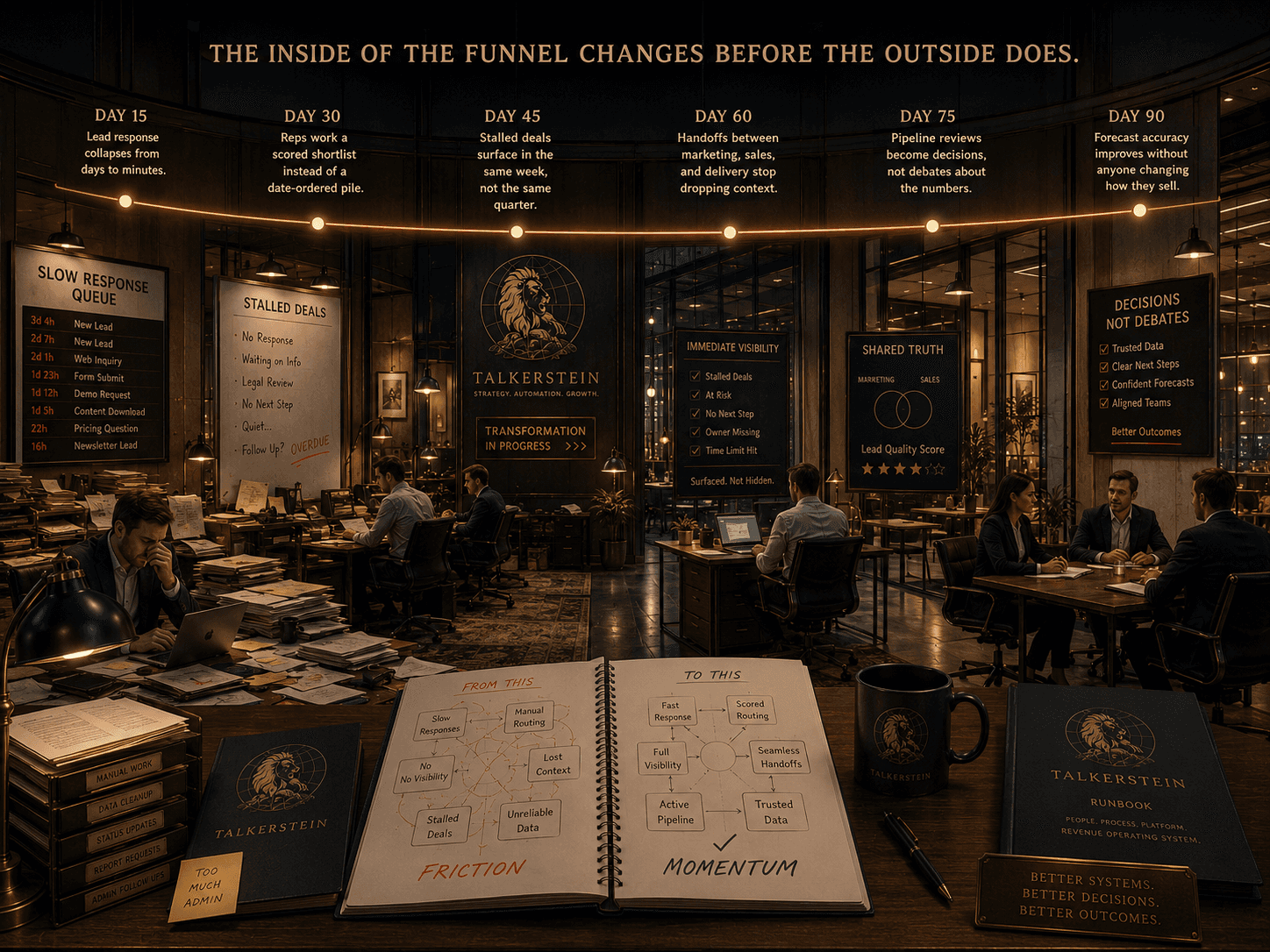
Revenue is the lagging indicator. Before the revenue line moves, other things shift. Reps spend more of their day on live conversations. Sales leaders stop hearing about stalled deals at the end of the quarter and start hearing about them the same week they stall. Pipeline reviews get shorter because the data is trustworthy. Marketing and sales stop fighting about lead quality because the scoring is transparent and joint. These are the first visible effects of a CRM that has been properly automated.
Lead response collapses from days to minutes.
Stalled deals surface in the same week, not the same quarter.
Pipeline reviews become decisions, not debates about the numbers.
Reps work a scored shortlist instead of a date-ordered pile.
Handoffs between marketing, sales, and delivery stop dropping context.
Forecast accuracy improves without anyone changing how they sell.

Is this the right next step for you?
Work with us if
You have a sales team of two or more and a CRM already in place, even if half of it is unused.
Leads are visibly cooling off before sales gets to them, or routing feels arbitrary.
Your reps spend more time on admin than on live conversations.
You need the weighted pipeline number to match reality within a reasonable tolerance.
You are planning to scale headcount and need the system to scale with you rather than break under the new weight.
Do not work with us if
You have no inbound flow yet. Automation amplifies what exists. If nothing is coming in, we are not the right first step.
You close most deals on the first call with no consideration cycle. A heavy CRM build would cost more than it saves.
You are looking for a tool recommendation rather than an operational partner.
You are not willing to commit to one CRM and have your team use it consistently. No automation survives half-adoption.
What serious buyers usually ask.
Why Go High Level instead of HubSpot or Salesforce?
For most service, B2B, and multi-location businesses under a few hundred employees, GHL is the right commercial fit. It bundles website, email, SMS, calendar, payments, and pipeline in a single platform at a fraction of the enterprise-grade stack. HubSpot and Salesforce make sense when compliance, RevOps headcount, or enterprise sales motions justify them. When they do, we configure inside those.
We already have a CRM. Do we have to move?
Usually no. If your current platform is functional and the problem is process, we configure and automate inside it. Migration is only recommended when the platform itself is the bottleneck, and we tell you that directly in the diagnostic. We do not charge for migrations you do not need.
How do we decide routing rules?
In a working session with your sales leader. We run the rules against your last ninety days of closed deals and adjust until the routing behaves the way you would have routed if you had unlimited time. The rules are yours. We help you build them and calibrate them.
What does our team need to do during the build?
Expect about four to six hours a week from a sales leader or senior ops person during the build, plus a one-hour scoring session with your sales team. Less than that and we risk building a system that does not match how you actually sell.
Will this replace our sales ops or RevOps person?
No. The best outcomes happen when the build runs alongside an internal ops owner. We build the system and the documentation. Your ops person runs and evolves it. If you do not have one yet, we train one during handover.
How long before the team trusts the new system?
Most teams cross the trust line at around three to four weeks after go-live. That is when the new workflows have run enough cycles for reps to see that the routing was fair, the reminders were accurate, and the stalled-deal flags caught the right things. Trust is earned by repetition, not by training decks.
What if we change our sales process later?
Expected. Sales processes should evolve. The system is built to be edited without a consultant in the room. Stages, scoring rules, and routing logic can all be adjusted inside the platform. The runbook explains how. Larger structural changes are where a Care Plan helps.
How do you protect us from a bad data migration?
We migrate in stages with a parallel period where both systems run. Data is validated on a sample before the full import. No lead record is overwritten until it has been matched, cleaned, and reviewed. The old data stays archived until you sign off on the new one.
What budget range usually makes sense here?
G1 Foundation sits at the lower end of the range for teams that want a clean working base. G2 Pro is the most common fit and lives in the mid five figures for the build, plus an optional Care Plan if you want us to keep tuning it. G3 Scale is bespoke and always scoped after a diagnostic.
What does a strong engagement usually turn into next?
Two common next steps. One, we add a Marketing Automation layer upstream so the lead quality feeding the CRM matches what the scoring model expects. Two, we layer a Reporting Dashboard on top so the same numbers run your weekly sales meeting, monthly leadership review, and quarterly forecast.