
The Hidden Costs of Cheap Websites (And Why They’re Killing Your Sales)
The hidden costs of cheap websites are brutal: slow loads, broken mobile, no SEO, no analytics. Here’s what the $500 site actually costs you over 12 months.
A guy called me last month. Specialty food business in the GTA, 38K Instagram followers, real product, real demand. He’d hired someone off a marketplace to build his site for $600 flat. A year later he was doing three orders a week online despite pushing tens of thousands of people to the site through paid ads and organic social.
We audited the site in twenty minutes. It took 11 seconds to load on mobile. The checkout broke on Safari. The product images were 4 MB each. There was no analytics installed, so he had no idea where his traffic was going or why it was leaving. His Google ranking for his own brand name was on page two. He didn’t save $2,000 by going cheap. He lost roughly $80,000 in revenue in his first year alone. That’s what the hidden costs of cheap websites actually add up to — and if you’re comparing quotes right now wondering why one person wants $8,000 and another wants $500, this post is the math you need.
The Math Nobody Does When Comparing Quotes
When owners evaluate website quotes, they compare prices. $500 vs $5,000 vs $15,000. Line the numbers up, pick the cheapest you can tolerate, move on.
That’s the wrong math.
The right math is cost of ownership over three years against revenue generated by the site. A $500 site that generates $5,000 in revenue is a disaster. A $15,000 site that generates $400,000 in revenue is the best money you ever spent. The upfront cost is almost irrelevant. The only question that matters is what the site does for your business once it’s live.
The problem is that when you’re evaluating quotes before launch, you can’t see the revenue side yet. You only see the price tag. So the rational-feeling move is to pay less. And that’s how owners end up with cheap sites that quietly bleed them out for years without anyone being able to point at the line item where the money is leaving.
Here’s where the bleeding actually happens.
Bleed Point 1: Speed (The Line Google Has Been Drawing for a Decade)
Google has been saying this for ten years and most owners still don’t internalize it. Every additional second your site takes to load cuts conversion rate by 5–20 percent. A site that loads in 4 seconds instead of 2 isn’t twice as slow — it’s converting at maybe 60 percent of the fast site’s rate.
Cheap sites are almost always slow. Not because the developer is lazy, but because speed requires work that cheap quotes don’t cover. Image optimization. Code minification. Smart caching. CDN configuration. Lazy loading. Theme selection based on performance instead of looks. Removing 12 unused plugins. Every one of those is an hour of real work. Twelve hours at a proper hourly rate is $1,500. Guess what gets cut when the whole quote is $600.
Shopify is the anti-cheap-site in this specific way. It ships with a global CDN, automatic image optimization, server-side rendering, and modern themes built with performance as a requirement. You still have to not do dumb things — don’t install 40 apps, don’t upload 10 MB hero images — but the baseline is fast. On a cheap WordPress build the baseline is slow, and fixing it later costs more than building it right the first time.
Bleed Point 2: Mobile Is 70 Percent of Your Traffic
Over 70 percent of ecommerce traffic in 2026 is on mobile. That’s not a stat, that’s the reality for almost every business I work with. If your site is broken on mobile, you don’t have a website. You have a desktop brochure that a third of your customers tolerate.
Cheap builds almost always have mobile problems. Buttons that don’t fit the thumb zone. Text that doesn’t resize. Forms that break. Checkouts that require pinching and zooming. Images that push content off the edge. The cheap developer built it on their desktop, checked it on their own phone once, shipped it. They didn’t test on three different devices, two browsers, and three screen sizes. They didn’t test the checkout flow with a fat-thumbed person in a bouncing car because who has time for that at $600.
Your customers don’t care why your site doesn’t work on their phone. They leave. You never even know they were there.
A quick test: pull up your own site on your phone, right now. Time it. Try to check out. Try to reset your password. Try to find your return policy. If any of those friction points make you wince, your customers are wincing too — and they’re leaving.
Bleed Point 3: SEO Structure (The Plumbing You Can’t See)
A cheap site is almost never built with SEO structure. I don’t mean keyword stuffing or blog posts. I mean the foundation — clean URL hierarchy, proper heading order, image alt text, schema markup, meta descriptions, sitemap submission, robots.txt, canonical tags, fast indexing, internal linking. The boring plumbing that determines whether Google can understand and rank your site at all.
This stuff doesn’t make the site look different. You can’t see it. Which is exactly why it’s the first thing a cheap build skips. Six months later, when you’re wondering why you can’t rank for your own product names, the answer is that your site never told Google what it was in the first place.
Rebuilding a site with SEO structure after the fact is roughly 3x more expensive than doing it right the first time because everything has to be unwound and redone. And you lose whatever organic traffic you would have earned in the meantime, which compounds year over year.
Bleed Point 4: Zero Analytics (Flying Blind With Ad Spend)
This one still stuns me. I audit cheap sites all the time where there is no Google Analytics, no Meta Pixel, no Shopify analytics configured, no event tracking, no conversion tracking. The owner is running ads, driving traffic, and flying completely blind.
If you don’t know which pages people leave, which products they look at, which channels send converting traffic, or where your funnel breaks — you can’t fix anything. You’re guessing. And guessing with marketing spend is the most expensive thing you can do as a business. Every dollar you spend on ads without conversion tracking is a dollar you can’t optimize, can’t attribute, and probably wasted.
Proper analytics setup on a Shopify store takes a couple of hours. It’s always worth it. Cheap builds skip it because the scope didn’t include it and the developer didn’t know or didn’t care enough to include it.
Bleed Point 5: Security, PCI, and the 2am Phone Call
Cheap sites usually live on cheap hosting, run outdated platform versions, and have no maintenance plan. Then they get hacked, break during an update nobody applied, or develop a vulnerability from a stale plugin. I’ve seen small business WordPress sites get taken over by spam injectors, redirect attacks, and crypto miners. I’ve seen entire product catalogs wiped out because nobody configured backups.
Shopify handles this structurally. Security patches, PCI compliance, uptime, SSL, backups — Shopify’s job, not yours. You will genuinely never wake up to a hacked Shopify store in a way you absolutely will with a cheap WordPress build. That peace of mind is a real line item in your cost of ownership, even if it never shows up on the invoice.
The Actual Cost of a $600 Site
Let’s do the math on a real scenario.
You pay $600 for a site. It takes 8 seconds to load. Mobile checkout is janky. You have no analytics. You have no SEO structure. You have no security maintenance.
Over 12 months, if your marketing works at all, you’re probably driving 20,000 sessions to that site. Conservative. A properly built Shopify store in your category might convert at 2.5 percent. Your cheap site — between the speed problems, the mobile jank, and the trust signals a broken design sends — is probably converting at 0.6 percent.
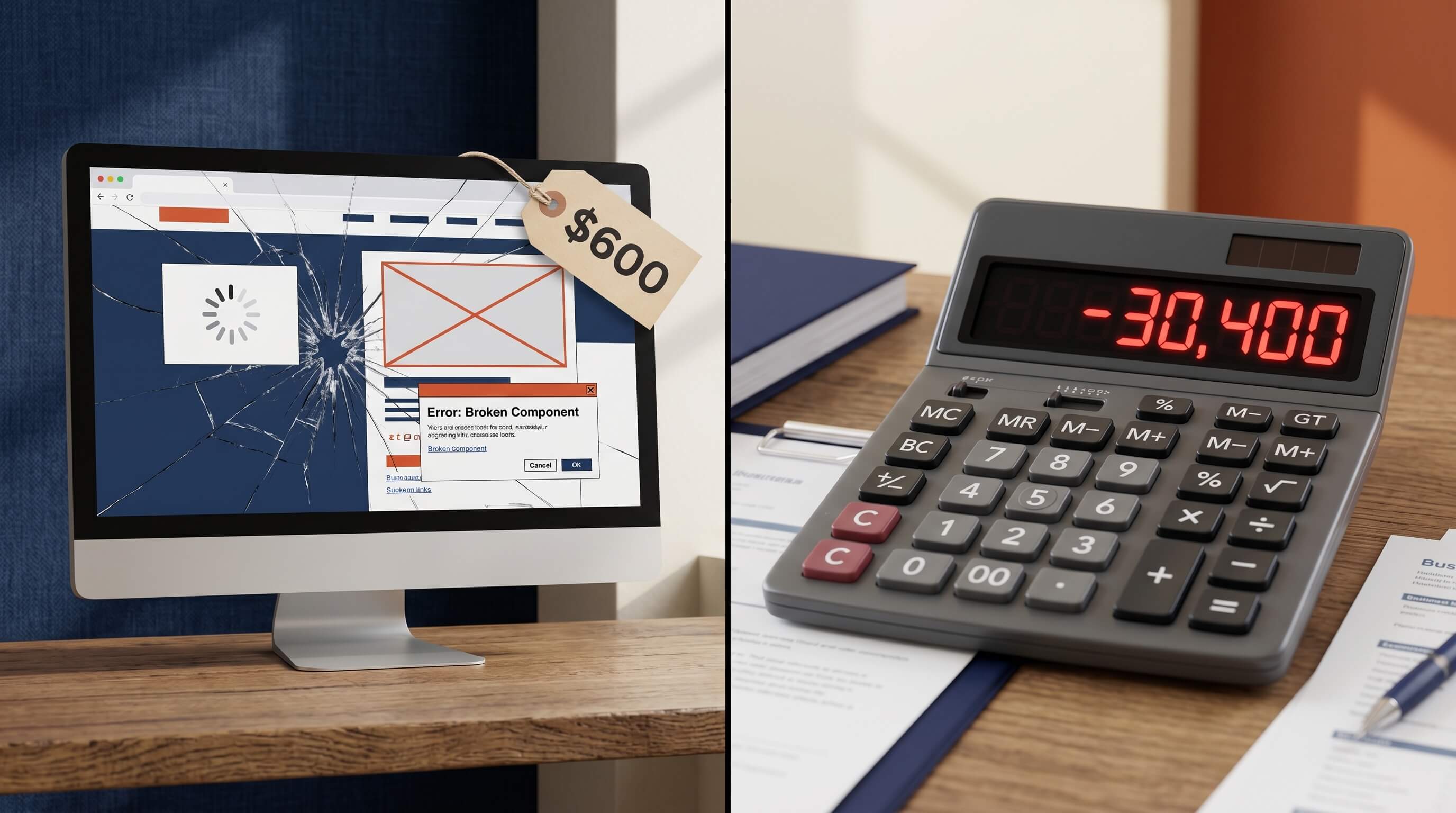
That gap, 2.5 percent vs 0.6 percent on 20,000 sessions with an $80 average order value, is the difference between $40,000 and $9,600 in revenue. You saved $4,400 on the build and lost $30,000 in the first year alone. And it compounds, because the traffic you don’t convert this year isn’t coming back next year, and the SEO equity you didn’t build this year isn’t earning for you next year.
That’s the hidden cost of a cheap website. Not hidden because it’s mysterious. Hidden because it happens quietly, in customers who leave before you know they were there.
What “Doing It Right” Actually Looks Like
A real website investment for a small-to-mid business in 2026 looks like this. Platform picked based on your actual needs — Shopify for most, something else for specific cases (see Shopify vs. WooCommerce for where the lines are). Theme or custom build scoped to performance, mobile, and conversion. Information architecture built around how your customers actually shop, not how you think about the business internally. SEO structure from day one. Analytics and conversion tracking installed and tested before launch. A content structure that supports ranking. Security, backups, maintenance handled. And a support model for after launch, because no site is ever really “done.”
That’s not a $600 job. It’s also not a $50,000 job unless you’re doing something genuinely complex. For most small-to-mid businesses, it’s $8,000–$25,000 plus ongoing support. That investment, on a site that actually works, typically pays for itself inside 6–12 months if the business has real demand behind it.
If it doesn’t have demand behind it, no website is going to save you. That’s a different problem.
The Monday Morning Move
Here’s the one thing to do this week. Open your own site on your phone right now. Time the load. Attempt a checkout. Check whether Google Analytics or a pixel is firing (you can inspect the page source if you’re not sure). If any of those tests fail, you already know what you’re living with — and you know the cost isn’t zero.
When someone asks Talkerstein for a quote, we start with the business, not the website. Who are your customers, what do they buy, where do they come from, what’s working now, what’s broken, what’s the honest revenue opportunity. Then we build around the answers. We don’t do $600 websites and we don’t pretend we can. What we do is build sites that earn back their cost inside the first year for businesses with real demand, and we tell people honestly when they’re not ready for what we do.
If you’re running a cheap site right now and you suspect it’s costing you more than it saved, book a free 30-minute website audit. I’ll look at your current site, tell you exactly where it’s bleeding, and give you a straight answer on whether a rebuild makes sense. The only question is how long it takes you to find out. Cheap is expensive.
One firm. Every system. Properly handled.
How much should a real small business website cost in 2026?
For a small-to-mid business with real ecommerce ambitions, $8,000–$25,000 for the build, plus ongoing support at $500–2,500/month depending on scope. Anything dramatically below that range is cutting corners somewhere — most often on speed, SEO structure, analytics, or security.
Can a cheap website really lose me that much revenue?
Yes. On 20,000 annual sessions at $80 AOV, the difference between a 0.6 percent conversion rate and a 2.5 percent rate is $30,400 in year one. That’s the typical gap between a broken cheap build and a properly built Shopify store, and it compounds year over year as SEO equity and repeat customers stack.
Is Shopify more expensive than a cheap custom build?
Upfront, Shopify plus a well-scoped build costs more than a $600 freelance site. Over three years, once you factor in revenue generated, Shopify is almost always cheaper per dollar of outcome. The upfront price is a distraction. The revenue gap is the number that matters.
What are the warning signs my current site is hurting my business?
Slow load times (over 3 seconds on mobile), high bounce rate, low mobile conversion, no ranking for your brand name, checkout issues on common browsers, and missing analytics. If two or more apply, your site is costing you money right now.
Can I fix a cheap website instead of rebuilding?
Sometimes. If the platform choice was fine and the issues are cosmetic, yes. If the site was built without SEO structure, proper analytics, or on an unmaintained WordPress stack, rebuilding is usually cheaper than unwinding the original work.






Quick Links


" height="149.2535067768008px" id="IOCTf08f5" width="1199.9520008715217px"/></svg>)