
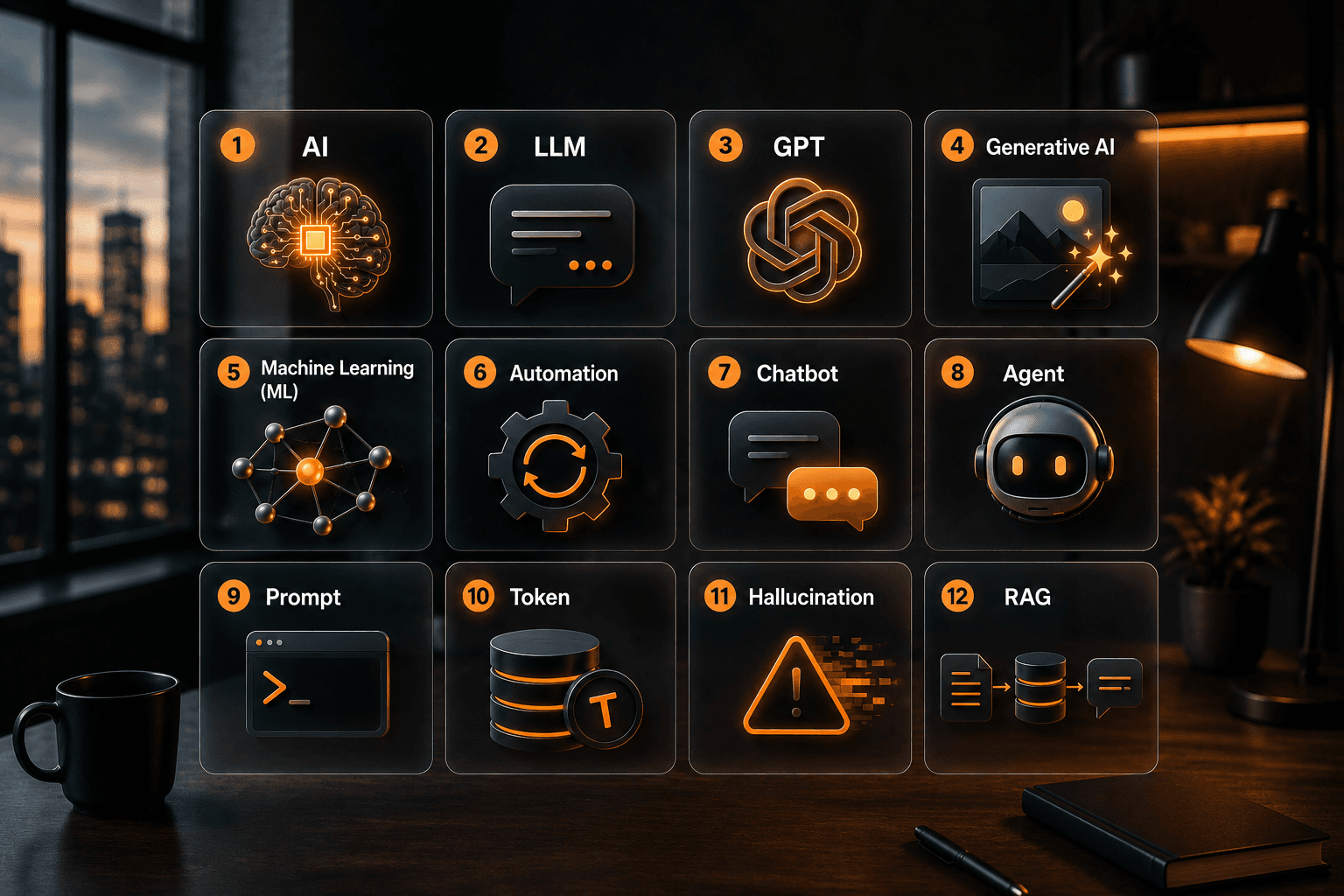
AI Jargon Decoded: LLMs, Machine Learning, Automation, and Chatbots in Plain English
The 12 AI terms a small business owner actually needs to understand. What they mean, why they matter, and the difference between the ones people confuse.
We sat down with the owner of an insurance and risk consulting firm last year to talk about how AI could help his B2B sales process. About 10 minutes in, it became clear that he thought the entire AI industry was ChatGPT. He had been pitched four "AI-powered" platforms by four different vendors and could not tell the difference between any of them. Two of the vendors knew this and were charging him for what was essentially a glorified email template.
He is not stupid. He runs a serious business. The vendors had wrapped basic technology in technical-sounding jargon and counted on him not knowing the difference. This article is the dictionary that protects you from that.
Why the Jargon Matters
Every AI vendor has a financial incentive to make what they sell sound more advanced than it is. "We use machine learning" sounds impressive even when it means "we have an if-then rule." "AI-powered" gets put on landing pages whether the underlying tech is GPT-4 or a 1995-era spreadsheet macro. The jargon is the moat.
You do not need a computer science degree to spot the difference. You need 12 words and one quiet hour. After that, you can sit in any vendor pitch and know within five minutes whether they actually have AI or whether they are selling you a price tag.
The 12 Terms That Cover 95% of Conversations
1. AI (Artificial Intelligence)
The umbrella term. Software that does tasks that used to require a human brain. Pattern recognition, language, vision, decision-making. Everything below this list is a sub-category of AI.
2. LLM (Large Language Model)
The technology behind ChatGPT, Claude, and Gemini. An LLM is a model trained on huge amounts of text that learns to predict which words come next. When you type a question, it generates a response by predicting the most likely sequence of words. That is the entire trick. Everything else is engineering on top.
3. GPT (Generative Pre-trained Transformer)
A specific family of LLMs made by OpenAI. ChatGPT is the consumer product. GPT-4o is the model under the hood. People say "GPT" and "ChatGPT" interchangeably even though one is the model and one is the product.
4. Generative AI
Any AI that creates new content (text, images, audio, video) rather than just analyzing existing content. ChatGPT is generative AI. A spam filter is not.
5. Machine Learning (ML)
The broader category that LLMs sit inside. Software that learns from data instead of being programmed with explicit rules. Recommendation engines, fraud detection, your email spam filter, and ChatGPT are all machine learning.
6. Automation
Not the same as AI. Automation is software that performs a task in a fixed sequence. "When a new lead comes in, send this email" is automation. It can be triggered by AI, run alongside AI, or work without any AI at all. Most "AI workflows" are 80% automation and 20% AI.
7. Chatbot
Software that holds a conversation with a user. Old chatbots were rule-based ("if user types X, respond with Y"). Modern chatbots use LLMs to generate responses dynamically. Both still get called chatbots. Ask the vendor which kind they are selling.
8. Agent
A newer term that means an AI system that can take actions on its own, not just generate text. An agent can browse a website, fill out a form, send an email, and update a spreadsheet without you clicking each step. Most "AI agents" being sold in 2026 are early-stage and require human checkpoints to work reliably.
9. Prompt
The instructions you give an AI tool. Covered in detail in our Prompts Guide, but the short version: prompts are the user input that tells the LLM what to do.
10. Token
A unit of text the LLM processes. Roughly a word, sometimes a part of a word. Pricing on most AI APIs is per token. You will see this when you look under the hood of a paid AI tool. Practical implication: very long inputs cost more.
11. Hallucination
When an AI confidently generates information that is wrong. The biggest risk in using AI for any factual work. LLMs do not "know" anything. They predict plausible-sounding text. Plausible is not the same as true. Always verify facts, names, statistics, and quotes.
12. RAG (Retrieval Augmented Generation)
An architecture that connects an LLM to your specific data (a knowledge base, your past emails, your company docs) so it can give answers grounded in your reality instead of its training data. RAG is what makes a "custom AI for your business" actually work. Without RAG, the AI is just guessing from general knowledge.
The Three Distinctions That Confuse Everyone
Three pairs of terms cause 90% of the confusion in vendor conversations. Memorize these.
AI vs Automation. Automation is "if X, do Y." AI is "given this fuzzy input, generate something new." Most workflow tools (Zapier, Make) are automation. The AI part comes when you plug a chat tool into the workflow.
Chatbot vs Agent. A chatbot answers messages. An agent takes actions across systems. A chatbot can tell you what your meeting tomorrow is about. An agent can reschedule it for you. Most "AI chatbots" being sold are not agents. Most "AI agents" being sold are not yet reliable.
LLM vs AI. LLMs are one type of AI. AI also includes vision models, audio models, recommendation engines, and a dozen other things. When a vendor says "we use AI," ask "specifically which model?" If they cannot answer, they are reselling someone else's tool with markup.
A Real Vendor Conversation, Decoded
The insurance client we mentioned at the top got pitched a "fully AI-powered lead engagement platform" for $1,200 per month. We sat in on the demo. Here is what the platform actually was, in plain language: a Zapier-style automation tool with a ChatGPT API plug-in that cost the vendor $40 per month to operate. It was 3% AI and 97% workflow logic. The "machine learning" they kept mentioning was an if-then rule that picked which email template to send based on the lead's job title.
We told him to walk away. We built the same flow for him in two hours using free tools and a $20 ChatGPT subscription. Total monthly cost, $20. Total monthly value, identical.
That conversation is repeating itself in small businesses across North America right now. The jargon is the price tag. Once you know the words, the price tag falls off.
How to Use This Glossary in Vendor Pitches
Three questions to ask any vendor selling "AI" to your business:
First, ask which underlying model they use (GPT-4, Claude, Gemini, custom). If they cannot name a specific model, they probably do not have one.
Second, ask whether the system uses RAG to ground answers in your data. If the answer is "no, it just uses ChatGPT's general knowledge," you are paying for a wrapper.
Third, ask what would happen if their service went down. If everything stops working, the value is in the integration. If you could rebuild 80% of it with $20 in tools and a weekend, you are paying for convenience, not technology. Sometimes that is fine. Sometimes it is not.
Got a vendor pitch you want a second opinion on?
Forward it to us. We will tell you what is real, what is wrapper, and what to negotiate. Book a free 20-minute call.
What does LLM stand for?
Large Language Model. It is the technology behind ChatGPT, Claude, and Gemini. An LLM learns patterns from huge amounts of text and uses those patterns to generate new text on demand.
What is the difference between AI and automation?
Automation runs fixed steps in order ("when X happens, do Y"). AI generates new content or makes judgment calls based on input. Most modern workflows combine both: automation handles the steps, AI handles the parts that need to be written or decided.
Is a chatbot the same as AI?
A modern chatbot uses AI (specifically an LLM) to generate responses. An older rule-based chatbot does not. The word "chatbot" covers both, which is why you should ask the vendor which kind they are selling.
What is machine learning in simple terms?
Software that learns patterns from data instead of being told exactly what to do. Your email spam filter, Netflix recommendations, and ChatGPT are all machine learning. The shared trait is that nobody hand-wrote rules for every case. The system learned the rules from examples.
How do I know if a vendor is selling real AI?
Ask three questions: which underlying model do they use, do they use RAG to ground answers in your data, and what could you rebuild with free tools in a weekend. The answers will tell you whether you are paying for technology or for a wrapper.






Quick Links


" height="149.2535067768008px" id="IOCTf08f5" width="1199.9520008715217px"/></svg>)