
Shopify POS in 2026: Why Your Retail Store Needs a Unified System
Shopify POS in 2026 kills the disconnect between your store and your website. Unified inventory, POS Hub hardware, Tap to Pay, same-day delivery — here’s what it changes.
A customer walks into a boutique on Queen Street on a Saturday afternoon with a jacket she bought online three weeks ago. She wants to return it and exchange it for a different size. The staff behind the counter smiles, takes the jacket, and then starts clicking. Thirty seconds pass. A minute. She opens a browser tab. She logs into a dashboard. She can’t find the order. The customer is standing there watching the hunt unfold. The store is losing the sale, losing the exchange, and losing a repeat customer all at once — and nobody at the counter can tell her why.
That moment happens a thousand times a day in Canadian retail. Most owners assume it’s a staff problem. It’s not. It’s a system problem. The website and the in-store register were built by two different vendors, connected with two different plugins, synced on different schedules, and the customer standing at the counter is the collateral damage. Shopify POS in 2026 is the version of retail where that stops being the norm — and if you run a physical store, this is the post I want you to read before you renew your current POS contract.
The Real Cost of Multi-System Retail
The pitch for split systems used to be simple. Your ecommerce is a website. Your retail is a register. They’re different animals. Use the best tool for each. That logic worked when online and offline were separate businesses. It stopped working about five years ago. Most retailers haven’t caught up because the cost is invisible — no single line item, just compound drag from a dozen small friction points.
Here’s what actually breaks on split systems. Inventory drifts because the sync between POS and website runs on a delay, so you oversell stock that’s already gone. Customer profiles split in two because the in-store system doesn’t know the same person bought online last week. Loyalty points earned on the website don’t redeem at the counter. Returns become a customer service escalation because counter staff can’t see online orders without opening a separate dashboard. Reporting becomes a guessing game because no two systems agree on the numbers and your accountant has to reconcile them twice a month.
The cost isn’t one thing you can point to. It’s the compound friction. Most owners can’t see it because they’ve never run the other way.
What “Unified” Actually Means
Running retail on Shopify means one system. One product catalog. One inventory count. One customer profile. One set of reports. The product on your shelf is the same product on the website. When one sells, the other updates in real time. The customer walking into the store is recognized by the same email address she used to sign up online. The gift card bought on the site works at the register. The return she wants to process at the counter pulls up her online order without anyone logging into a separate tool.
That’s not a feature. It’s a structural shift. And it’s why Shopify’s retail business is quietly eating the category — offline revenue grew 27 percent year-over-year in 2025. That’s not a rounding error. That’s retailers switching platforms and telling their friends.
The Winter 2026 POS Upgrades That Actually Move Revenue
Shopify’s Winter 2026 Editions dropped about 150 updates, and a real chunk went into the retail stack. Most don’t matter for a small-to-mid retailer. Four do.
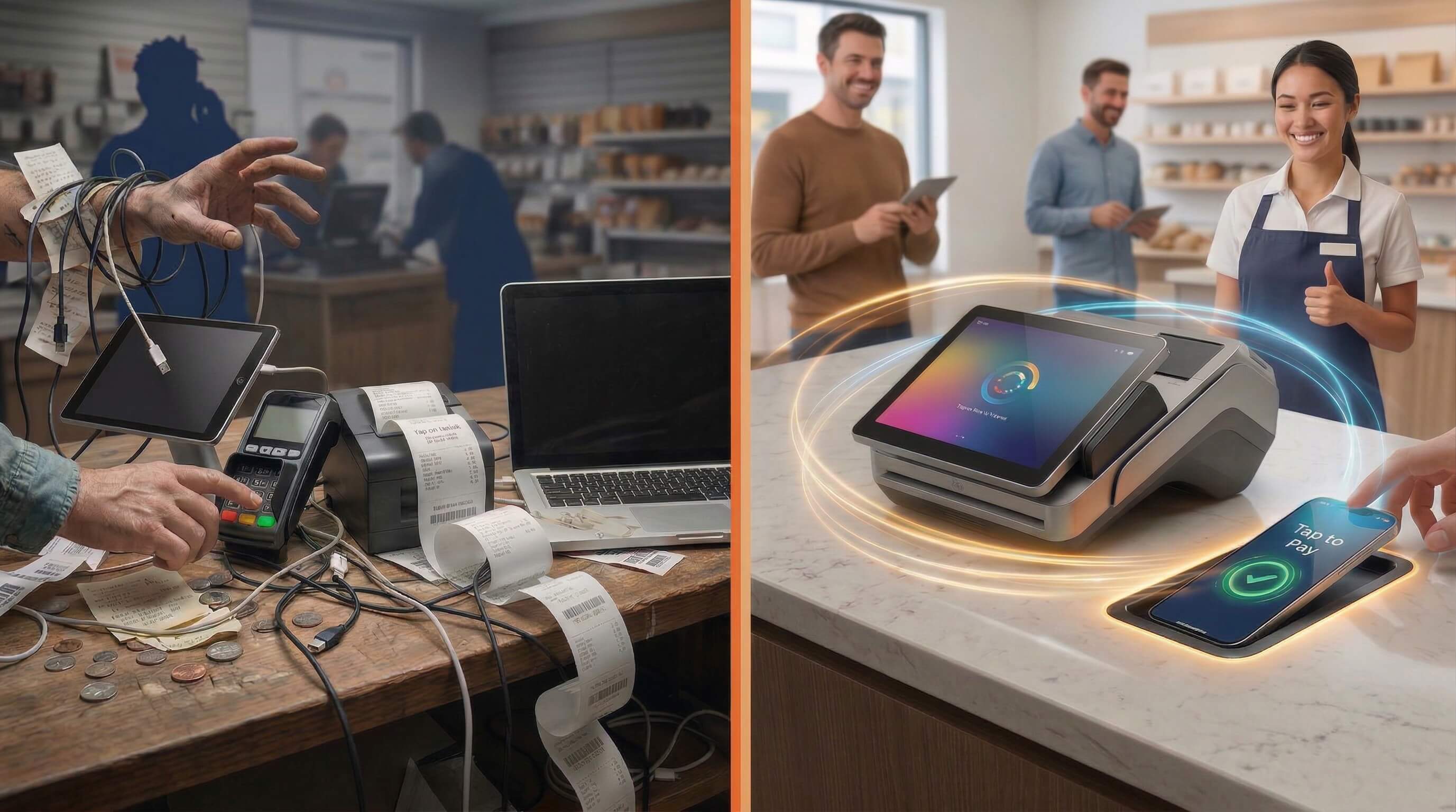
POS Hub hardware. The terminal everyone’s going to talk about. One clean unit combining payments, a customer-facing display, and a staff-facing screen. If you’re still running a tablet with a card reader clipped to the side and a cash drawer on a shelf underneath, the Hub is the upgrade. Faster at checkout, cleaner on your counter, and it consolidates three pieces of hardware into one. Your staff stops fighting the setup. Your store stops looking like it was built in 2014.
Tap to Pay expansion. The quieter upgrade that matters more. You can now take card payments directly on an iPhone or supported Android device without a separate card reader. For pop-ups, markets, trunk shows, on-the-floor checkout during busy hours, or a sales rep running an event — this is the feature. No extra hardware, no dongles, no Bluetooth pairing hell. Tap, take the payment, done. The first time your staff uses it in a busy Saturday rush, they understand immediately why this matters.
Same-day delivery through Uber Direct. This solves a retail problem I hear about constantly. A customer buys online, lives ten minutes away, doesn’t want to wait two days for shipping. With Uber Direct integrated natively into Shopify, you offer same-day delivery from store inventory without building your own driver network. Suburban retail killer feature. Most retailers don’t even know it exists yet — which is exactly why the stores that turn it on this quarter are going to pull ahead.
QR code payments and cleaner mobile checkout. Small features, real impact on a busy Saturday when the line at the counter is five people deep and your staff is trying to ring up the person closest to the door.
The Inventory Story Nobody Tells You
The reason unified retail works isn’t the hardware, it’s the inventory logic underneath it. Shopify handles multi-location inventory natively — warehouse, flagship, second store, pop-up — as distinct stock pools rolling up into one catalog. When a customer online buys the last unit of something, the POS at the store sees it gone the same second. When a staff member sells something at the counter, the website updates in real time.
That unlocks features split systems can’t touch. Buy online, pick up in store becomes trivial because the inventory already knows where the product lives. Ship from store becomes a switch you flip, letting retail locations fulfill online orders when the warehouse runs out. Local delivery becomes possible because the system knows the product, the customer, and the distance.
These aren’t novelties. These are how modern retailers actually compete in a market where Amazon has trained shoppers to expect same-day or next-day on everything.
The Staff Side of the Equation
The thing that gets underrated in POS conversations: unified systems are dramatically easier to staff. A new hire on a split system learns the POS, the ecommerce admin, the inventory tool, and the reporting dashboard as four different products, each with its own login, its own logic, its own quirks. A new hire on Shopify POS learns one interface — and the same interface works at the counter, on a phone, on a tablet, and in the back office.
Training time collapses. Mistakes drop. And crucially, the staff actually likes it. I’ve watched retail clients lose good employees because the technology was so frustrating they’d rather work at the shop across the street with fewer hassles. Your POS is an employee experience decision as much as a customer experience decision. Owners who ignore that end up paying for it in turnover.
Where This Fits for a Small-to-Mid Retailer
If you run one location and a simple website, you might look at all of this and think it’s overkill. It isn’t. Shopify’s retail stack scales down cleanly. Start with one register, one website, one catalog, and the system grows with you. Add a second location — the inventory logic is already there. Add a warehouse, same thing. Launch a pop-up at a trade show and your salesperson takes a phone to run it off the same catalog, same pricing, same customer database.
The businesses getting the most out of it are the ones with two to five locations, a real website, and a frustrated ops person trying to keep it all aligned with duct tape. If that’s you, the move isn’t another duct tape fix. It’s consolidating on one platform and letting the platform do the work your team has been doing manually.
This is one of the features the Winter 2026 Edition brought into the “standard-plan, not enterprise-only” category, and it’s one of the biggest underappreciated shifts of the release.
The Monday Morning Move
If you run retail and you’re on a split system, here’s the week one audit. Count the number of tools your closing manager has to log into every night to reconcile the day. Measure the gap between a product selling in store and that change hitting your website. Ask your longest-tenured employee which part of the tech stack they’d set on fire if they could. Those three answers will tell you, fast, whether you’re paying the invisible tax of multi-system retail — and how much.
Retail migrations are different from pure ecommerce migrations, and they’re where the agencies that only do websites fall down. The hardware matters. The physical layout of the store matters. Staff training matters. Integration with accounting matters. And the day of the cutover, someone has to be on site with the team while they ring up real customers on a system they’ve never used before.
We’ve done enough retail launches at Talkerstein to know where the friction lives. We scope hardware, map inventory, rebuild the catalog, set up receipt templates, train staff, and sit in the store on day one so nothing catches fire during the lunch rush. That’s the piece most agencies skip — and it’s the piece that decides whether your launch is a win or a mess.
If you’re running a retail store in 2026 and still stitching together multiple systems, book a free retail consultation. Tell us what you’re running, where the friction is, and what you want next year to look like. We’ll walk you through what unified Shopify would mean for your specific store and the realistic path to get there without disrupting the business.
One firm. Every system. Properly handled.
Is Shopify POS good for small retailers with one location?
Yes. The system scales down to a single register on a single location without losing any features. Most of the POS capabilities — including unified inventory, customer profiles, and Tap to Pay — are available on standard Shopify plans, not gated to Plus or enterprise.
What’s the difference between Shopify POS Lite and POS Pro?
POS Lite is included free with every Shopify plan and covers basic retail needs. POS Pro ($89/location/month) adds features like staff permissions, smart inventory management, detailed retail analytics, and advanced staff roles. Most multi-employee retail operations want Pro.
Can Shopify POS handle my physical store and online store as one business?
Yes. That’s the entire point. One catalog, one inventory count, one customer database, one set of reports. A sale in-store updates online stock in real time, and vice versa.
Do I need new hardware to run Shopify POS?
Not necessarily. Tap to Pay works on recent iPhones and supported Android devices with no extra hardware. If you want a dedicated setup, the new POS Hub terminal is the cleanest option, but you can also run POS on existing iPads with compatible card readers.
How does Uber Direct same-day delivery actually work?
You enable it in your shipping settings, set a delivery radius, and Uber Direct becomes a shipping option at checkout for customers in range. When an order comes in, an Uber driver is dispatched to your store, picks up the order, and delivers it — usually within a few hours.






Quick Links


" height="149.2535067768008px" id="IOCTf08f5" width="1199.9520008715217px"/></svg>)