
Shopify B2B: The Wholesale Feature Set Most Agencies Won’t Tell You About
Shopify B2B in 2026 handles custom pricing, net terms, ACH, and global supplier-retailer matchmaking natively. Here’s why most businesses don’t need a separate B2B platform.
Shopify B2B GMV grew 96 percent year-over-year in 2025. That number is the single most buried stat in ecommerce right now, and it’s the one that kills the pitch you’ve probably been sold. If you sell to other businesses and an agency has told you that you need a “real” B2B platform quoted somewhere between $40K and $250K, that stat is the reason to get a second opinion before you sign anything. The feature set the enterprise vendors charge six figures to build has been living inside Shopify for two years, and in 2026 it’s actually competitive with the platforms they were trying to sell you.
This is the post most agencies won’t write because it kills an easy upsell. If you’re running wholesale operations on spreadsheets and email — or you’ve been quoted a custom B2B build that feels too big for the problem — read this before you commit.
Why Nobody Talks About Shopify B2B
Shopify B2B has a marketing problem. It lives inside Shopify Plus, it doesn’t get a splashy launch event, and most agencies quoting big B2B builds make their margin on legacy platforms that charge per-seat licenses and implementation fees. Neither the legacy vendors nor the agencies attached to them have an incentive to point you toward a platform that quietly does 80 percent of the job for a fraction of the cost.
The result is that a feature set quietly built into a platform tens of thousands of businesses already use gets treated like a hidden menu at a restaurant. That 96 percent year-over-year B2B growth number didn’t come from nowhere. It came from businesses figuring out — usually by accident, usually after getting quoted a six-figure build — that the wholesale tools they needed were already inside the platform their consumer brand was running on.
What Shopify B2B Actually Does in 2026
Let me run through the feature set in plain English so you can stop wondering what’s real and what’s marketing fluff.
Custom pricing per customer or per company. Different prices for different wholesale accounts, different volume tiers, different product groups. The same store can serve a retailer buying at 40 percent off and a distributor buying at 55 percent off without either seeing the other’s pricing.
Company accounts with multiple buyers. A customer in Shopify B2B isn’t one person — it’s a company. Inside that company you have multiple buyers, each with their own login, their own permissions, their own order history. The front desk places orders. The owner approves them. The accountant sees invoices.
Net payment terms. Net 15, net 30, net 60, custom terms per company. Orders go through without requiring upfront payment, invoices generate automatically, customers pay on terms. This was the single biggest gap in Shopify B2B for years. It’s now native.
ACH payments (new in Winter 2026). Wholesale customers can pay invoices via ACH directly inside the storefront. This kills the credit card processing fees that used to make wholesale on Shopify mathematically painful. For a business doing serious B2B volume, this one feature changes the unit economics of the entire operation.
Quantity rules and order minimums. Set minimums per product, per company, per order. Sell case packs only. Force a 100-unit minimum on specific SKUs. The store enforces it automatically — you stop fielding emails about why someone can’t add three units to the cart.
Draft orders and quote workflows. Sales reps build draft orders on behalf of customers, send them for approval, and convert them into live orders once accepted. This replaces the spreadsheet-and-email quote dance that most wholesale operations still run on, and it shaves days off every deal.
Store credit for B2B (new in Winter 2026). Issue store credit to wholesale accounts the same way you’d issue it to retail customers. Useful for refunds, promotions, dispute resolution, and loyalty programs.
Buy online, pick up at warehouse. Wholesale customers place an order online and pick it up at your warehouse or showroom. Sounds basic. Most legacy B2B platforms can’t do it without a custom integration.
Separate B2B catalog from your DTC catalog. Run a wholesale storefront and a consumer storefront from the same backend, with different products, different pricing, and different access rules. Or blend them. Your call.
Shopify Collective Goes Global
This deserves its own section because it’s the feature most businesses don’t know exists, and it might be the most strategically interesting thing in the Winter 2026 release.
Shopify Collective is a supplier-retailer matchmaking layer built into the platform. If you make products, you can list them in the Collective and let other Shopify merchants pull them into their stores to resell. If you sell products, you can browse the Collective, find suppliers, and start carrying their inventory without cutting a wholesale agreement on paper. The supplier handles fulfillment. The retailer handles the customer. Money flows through Shopify.
In Winter 2026, Shopify announced Collective is going global. A Toronto retailer can pull product from a US supplier. A Canadian brand can list to be resold by stores in the UK. The entire supplier-retailer relationship gets handled inside the platform without anyone onboarding to a new system.
For a Canadian business owner thinking about wholesale expansion, this is the single biggest change in the release. The traditional path — hire a sales rep, attend trade shows, cold email retailers, manage it in a CRM you barely use — is still there. The Collective path is: list your products, get discovered, get pulled into stores, get paid. It won’t replace direct sales for your biggest accounts, but for filling the long tail of smaller resellers without hiring, it’s a category shift.
When You Actually Do Need More Than Shopify B2B
I’m going to be honest because that’s the only way this post earns its keep. Shopify B2B isn’t right for every business. Here’s where it falls short.
If you run highly complex contract manufacturing with bills of materials, custom production runs, and tight ERP integration, you probably need an actual ERP and a purpose-built B2B platform for that workflow. Shopify B2B is built for catalog-driven wholesale, not made-to-order industrial production.
If you have hundreds of negotiated price lists with thousands of unique SKUs per customer, the management overhead inside Shopify gets clunky. It’s doable. It wasn’t designed for that level of complexity.
If your buyers expect EDI integration with their procurement systems, you’ll need to layer in an EDI bridge. Shopify can do it through apps, but it’s not native.
For roughly 80 percent of B2B businesses, none of those edge cases apply. You sell a catalog to other businesses. You want net terms, custom pricing, a clean ordering experience, and a reliable way for buyers to reorder without calling your sales rep. That’s exactly what Shopify B2B is built for — and that’s the reason the 96 percent growth number exists.
The Real Math: $40K Quote vs. Shopify B2B
Let’s price out a realistic scenario. A distribution business with 150 wholesale accounts, custom pricing per customer, net 30 terms, three sales reps running quote workflows, and about 1,200 SKUs.
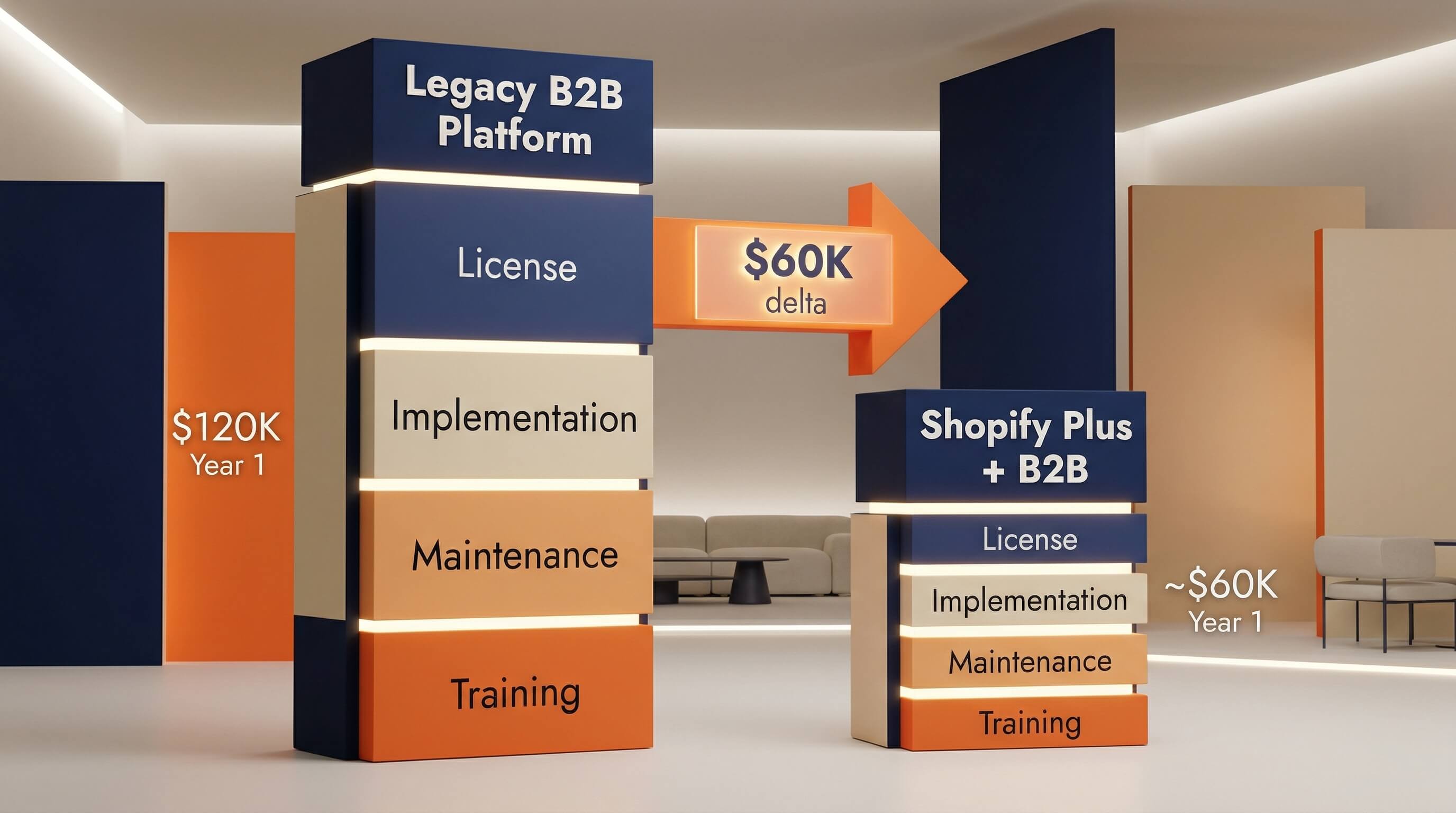
The traditional B2B build: $60K–$150K implementation, $2K–$5K/month platform fee, 4–6 month timeline, a dedicated PM on the vendor side, and a two-year contract that’s painful to exit. Let’s call it $120K year one.
The Shopify Plus + B2B configuration: Shopify Plus plan, configuration and setup, data migration, staff training, launch support. $15K–$35K implementation, $2,300+/month platform, 4–8 weeks to launch. Let’s call it $60K year one.
That’s a $60K delta in year one. It’s also a four-month head start on revenue, and a platform your team actually adopts because it doesn’t look like 2011 enterprise software. The vendor pitch ignores this math. Your operations team won’t.
The Monday Morning Move
If you sell B2B and you’re evaluating wholesale platforms — or worse, you’ve already signed a big contract and you’re starting to have doubts — here’s the week one audit. Write down the 10 things you actually need your B2B system to do. Not the list the vendor handed you. The list your sales team, your ops person, and your best wholesale customer would write on a napkin. Nine times out of ten, that list is fully covered by Shopify B2B. The tenth case is real, and when it shows up we’ll tell you honestly.
At Talkerstein we build wholesale operations on Shopify because the math works, the platform is reliable, and the feature set is finally good enough to recommend without caveats. We’ve shipped industrial distributors, apparel wholesalers, and specialty food brands with multi-buyer company accounts, net terms, ACH, and custom pricing — live in weeks, not months, at a fraction of the cost of the alternative. The ongoing maintenance cost is lower too, because the platform isn’t fighting you every time Shopify ships an update. Context on why that matters across the board is in the Shopify vs. WooCommerce breakdown.
If you’re evaluating B2B platforms right now, or you’ve been quoted a build that feels too big for the problem, book a free B2B consultation. I’ll tell you honestly whether Shopify B2B fits your workflow, and if it doesn’t, I’ll tell you what does. Either way, you walk away knowing what you actually need instead of what someone wanted to sell you.
One firm. Every system. Properly handled.
Is Shopify B2B only available on Shopify Plus?
Yes. The full B2B feature set — company accounts, custom pricing, net terms, quote workflows, ACH — requires Shopify Plus. Starting at $2,300/month, which is still dramatically cheaper than legacy B2B platforms for the same functionality.
Can I run B2B and DTC on the same Shopify store?
Yes. You can serve retail customers and wholesale customers from the same backend, with separate catalogs, separate pricing, and separate access controls. Many businesses run them blended; some keep them completely separate. Both work.
Does Shopify B2B handle EDI integration?
Not natively. You can layer EDI through third-party apps, and for most mid-market wholesale that’s enough. If your buyers require deep EDI integration with their procurement systems, budget for an app or middleware.
How does net terms billing actually work in Shopify B2B?
You set payment terms per company (net 15, 30, 60, or custom). The buyer places an order and gets an invoice instead of being charged at checkout. They pay via ACH, credit card, or whatever method you allow. Aging reports live in the admin.
Can Shopify B2B handle multi-location inventory for wholesale?
Yes. Shopify’s multi-location inventory applies to B2B as well. You can allocate stock across warehouses, fulfill from the closest location, and expose accurate availability to wholesale buyers at checkout.
What does the Winter 2026 ACH payment feature actually change?
It removes the 2.4–2.9% credit card processing fees on wholesale invoices, which is often the difference between profitable and marginal B2B volume. For a business doing $2M/year in wholesale, that’s $48K–$58K in fees saved annually.






Quick Links


" height="149.2535067768008px" id="IOCTf08f5" width="1199.9520008715217px"/></svg>)